Are you willing to die for Jesus?

John 3:16

For the last 10 days, we all have watched with great horror and trepidation the terrifying events in Japan.

A 9.0 earthquake, 100 times worse than the earthquake in Haiti.

A tsunami that breached every wall built to defend against it.

Entire small towns literally erased from the face of the earth.

Up to 17,000 people believed dead, some washed out to sea, never to be found.

Hundreds of thousands of people displaced, without sufficient food, water, medicine, or shelter.

And, of course, the nuclear power plants that are melting down, or in the process of melting down.

Fukushim Daiichi nuclear power plants

The rods that cannot be cooled.

The breaches in the containment walls for spent fuel.

The rising radiation readings.

Not only the Japanese but the entire world lives in fear of the latter. Scientists around the world are warning that the radiation will spread, not just across the Pacific to the United States, but from the United States over the Atlantic to Europe.

And yet … there are stories of redemption and hope coming out of Japan as well. Stories of babies being rescued days after the quake, of families being reunited, of those thought lost at sea forever found. And today comes news of a 16-year-old boy and his 80-year-old grandmother being rescued after being trapped in the ruins for nine days.

But the most powerful story of all is that of the nuclear power plant workers, engineers and others, who have volunteered – volunteered – to go back to work, to step into the infernos of radiation hell, risking their lives so that others might live.

Just last Thursday, Agence France-Presse reported a Twitter message “by a woman who Tweeted with pride – and anguish – that her father, just six months from retirement, had decided to offer his help.”

““I fought back tears when I heard father, who is to retire in a half a year, volunteered to go,” the message read.

““He said, ‘The future of nuclear power generation depends on how we’ll cope with this. I’ll go with a sense of mission’ … I’ve never been more proud of him,” she added.”[1]

Her father, 59 years old, who worked for the nuclear industry for four decades, is willing to go back into the inferno, where the radiations readings are rising and a total meltdown is feared, so that others might live.

Risking your life to give life to others is the focus not only of this morning’s passage from John’s Gospel, it is the focus of our lives.

We hear of the brave nuclear power plant workers and we are in awe – Oh, my, we think. How brave they are. They are sacrificing for us!

But do we think the same when we hear this morning’s Gospel? Are we in awe when we hear of the sacrifice God made for us? The sacrifice where God sent himself as a sacrifice for us?

Go anywhere in the world where the Gospel is known, and this is the passage you will hear preached, over and over again.

For God so loved the world that he gave his only Son, so that everyone who believes in him may not perish but may have eternal life.

It is the best known, most-quoted verse in the entire Bible.

But are we in awe of that verse and what it means to us? Is the news of God’s willingness to sacrifice for us as awe-inspiring as the news of Japanese nuclear power plant workers’ willingness to sacrifice their lives for us? Does it make us fall to our knees in gratitude, or jump with joy for the good news that it bears?

There’s no doubt about it, my friends: We are hearing good news this morning!

And anywhere you go in the world, you will hear people proclaiming it to us.

Because it speaks truth.

Because it gives hope.

Because it has power.

Notice, if you please, that never once does God ask us if we want God to give us this incredible gift.[2]

Just as God never asked Abram if he wanted to go on a journey to a strange place (with no directions, no end point, just “the land that I will show you,” and no, you can’t have a GPS to guide you, because it hasn’t been invented yet!), God never asks whether we wish to be saved, whether we wish to have life eternal.

God simply acts.

God sends his Son, his only-begotten Son, to be born as one of us, to live as one of us with us, to suffer as we suffer, to rejoice as we rejoice, and to die as we die … and not as we die, because Jesus died for us.

It is an incredible sacrifice that God makes …

… because God loves us.

Each of us and all of us.

From before time began to the ages of ages.

God … loves … us.

Now, we could, if you wanted, spend some time discussing Nicodemus, the Pharisee and leader of the Jews who came in fear and trembling to meet with Jesus in the dark of the night, wondering whether this rabbi was the one for whom the Jews waited.

Or we could, if you wanted, spend more time debating how to translate gennethé anáothen, which could mean “born again,” “born anew” or “born from above.” (Trust me, this is a matter of great debate to some Christians. There are thousands of Christians out there who will tell you that if you are not “born again” according to their definition, you are not a Christian, and you are going to hell!)

Or we could, if you wanted, spend even more time talking about Moses lifting up the serpent in the wilderness and how the Son of Man has to be lifted up as well, and debate whether that is allegorical or metaphorical (I am well aware that I am on a university campus, and these kinds of discussions take place all the time).

There is a lot to talk about when it comes to this passage, this story of Nicodemus’ fearful visit to Jesus in the middle of the night.

But those, my friends, are nothing but side paths to take if we wish to avoid the main point of this passage, which is this:

God loves us so much God that God sacrificed his Son –God sacrificed himself! – for … us!

When we focus on this – on God’s willingness to sacrifice for us – when we go down this path – we end up in a very hard place.

Because then we have to ask ourselves several questions, questions that are hard, questions that make us uncomfortable, but ones that we need to address if we indeed want to be true disciples of Jesus.

The first question we have to ask ourselves is this:

Do we believe that God loves us?

Do we?

Really?

If we answer yes to that, we have to ask ourselves a second one:

Do we believe that Jesus died for us?

Do we?

Do we really believe that Jesus died for each of us, personally?

These are important questions, because if we answer “Yes” to those questions, then we have to confront the big question, the question of our lives:

Are we willing to die for Jesus?

Are … we … willing … to … die … for … Jesus?

Because, my friends, that is what it means to be a disciple of Jesus. That is what it means when we say we want to follow Jesus.

God loves us so much that without asking us, without so much as a by-your-leave, God sent his Son, his only Son, to die for us.

And God wants to know:

Are we willing to die for Jesus?

Are we willing to set aside those things that get in our way of loving God with all our heart and soul and strength so that we can really love God?

Are we willing to set aside those things that get in our way of loving our neighbors, not just as ourselves – because trust me, there are days when I do not love myself, and those are the days when it’s easy for me not to love my neighbor either – but as Jesus loves us?

… If we are willing to do those things – to set aside our pride, our envy, our anger, our greed, our need to be right all the time, our feelings of superiority …

… If we are willing to put those down and walk in love as Christ loved us, to respect the dignity of every human being, to love our enemies, to care for the weak, cure the sick, give sight to the blind, hearing to the deaf and voice to the mute, to make the lame leap for joy, to set the prisoners free, to proclaim the year of the Lord not every 50 years but every year …

… If we are willing to do all those things, to, in essence die to our old ways, die to the ways of a society that does not care about the weak, that offers them up as sacrifices so that it can have more, more, more!

… If we are willing to do all this and more, all for the love of God, then … then! … we can answer: Yes.

Yes, I am willing to die for Jesus.

Because Jesus died for me.

Make no mistake.

God is not asking us whether we want to be loved.

God is not asking us whether we deserve to be loved.

God simply … wildly … radically … inexplicably … inexhaustibly … love us.
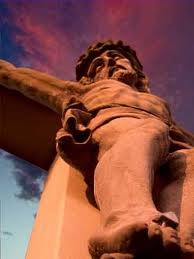
So much that God sacrificed his beloved son for us.

Are we willing to do the same?

Are we willing to sacrifice ourselves – for each other and for God?

Those nuclear power plant workers who are walking into the hell of failing nuclear reactors right now? They are doing this, they are sacrificing themselves, so that we might live.

Would we be willing to do the same, to sacrifice ourselves for others?

God sacrificed God’s self for us so that we might have life eternal.

Are we willing to sacrifice … for God?

Amen.

A sermon preached on the Second Sunday in Lent, 20 March 2011 Year A, at R.E. Lee Memorial Parish, Lexington, Va.


[1] Entire story found at http://news.yahoo.com/s/afp/japanquakenuclearvolunteers by Agence France-Presse, 17 March 2011.


[2] From Like It or Not!, Professor David Lose, Marbury E. Anderson Biblical Preaching Chair, Luther Seminary, St. Paul, MN, on WorkingPreacher.org,

http://www.workingpreacher.org/dear_wp.aspx?article_id=463, posted 13 March 2011.


Share this:
Share this page via Email Share this page via Stumble Upon Share this page via Digg this Share this page via Facebook Share this page via Twitter

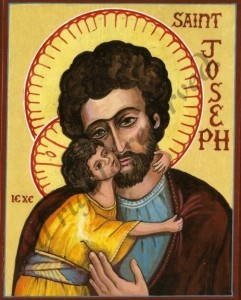
Emulating Joseph

The Feast of St. Joseph

Today in our service, we are gathered to honor St. Joseph, the earthly father of our Lord, about whom we know so very little.

Joseph has always gotten something of a short shrift in the Gospels. He’s not mentioned often – 18 times total, more than half indirectly; he never gets to speak … and then he disappears.

But there are some things we do know about him:

•We know he was of the right lineage – Luke says he was of the House of David and a son of Heli, Matthew places him squarely in the lineage from Abraham to David to Jesus.

•We know he built things, that he was a carpenter – Matthew and Mark tell us that, at times obliquely.

•We know he lived in Nazareth – Matthew and Luke say he raised Jesus there, John says he came from there, a reference apparently made so that the disciple Nathaniel can disparage that mountaintop village.

•We know Joseph was a righteous man – Matthew’s Gospel stresses that, both directly: Joseph was a “righteous man,” and indirectly, through the stories Matthew tells us.

•And we know that when God spoke to him through God’s angel, Joseph was obedient. Three times, the angel delivered God’s instructions: Once when Joseph learned that Mary, his betrothed, was pregnant, and not by him; once when the angel told him to flee to Egypt, because Herod was on a murderous bend; and finally when the angel told Joseph it was safe to return to his homeland, that Herod was dead and the child entrusted to Joseph was safe. Three times, Joseph listened. Three times, Joseph obeyed.

So although we might not know much of Joseph, and although we never get to hear Joseph’s story (although the legends about him are legion – really, you could spend hours on the Internet reading things about Joseph, all of which are speculation), there are many similarities in our lives to his:

•Like Joseph, we, too, are of the right lineage, because we have been baptized into the Body of Christ, and thus are heirs of Christ’s eternal kingdom.

•Like Joseph, we, too, are called to build — to build up the Kingdom of God in God’s very good creation.

•Like Joseph, we, too, are called to be righteous people, to live in right relationship with God, to delight in God’s will and walk in God’s ways, not for our own glory, but for the glory of God who loved us into being.

•And like Joseph, we, too, hear God speaking to us, giving us specific instructions that God asks us to obey.

(Now, about that Nazareth piece? Not so much in the way of similarities … not unless you are from one of the many places in the world called Nazareth, which not many of us are, I suspect …)

But setting that minor detail aside, what we end up honor and indeed celebrating this day is this:

God has chosen usGod … has chosen … us … to carry out God’s dreams and God’s desires in God’s very good creation.

God is speaking to us … through all of God’s various messengers … and asking us to listen.

God is entrusting to us, God’s beloved children, the love and care of all of God’s beloved children, our brothers and sisters in Christ, who are related to us not by the blood of their birth but by the waters of their baptism.

Take note, please, that the requests that God made of Joseph?

The request to keep Mary, even though she was pregnant and not by him?

The request to protect the newborn child, by fleeing to Egypt?

The request to return to the land of Israel, so that the Scriptures could be fulfilled?

All of these requests were hard ones. They were difficult.

But they were not impossible.

Refusing to set aside Mary even though the Law-with-a-capital-L said he should do so, to save his honor and punish her for her iniquity … that was difficult. If Joseph knew she was pregnant, you can be sure that others knew as well. His honor was on the line. The Law-with-a-capital-L was at stake.

But Joseph listened to God, not to man, and did the right, the honorable, the loving thing.

Hard, but not impossible.

We are called to do the same: to do the right, the honorable, the loving thing.

Fleeing to Egypt to avoid Herod’s troops? Who wants to leave your homeland, to be a stranger in a strange land, where you know you will be despised and treated poorly?

But Joseph went anyway, in order to protect his wife and the child entrusted to him.

Hard, but not impossible.

We are called to do as Joseph did: To go to the place that God will show us and stay there as long as God needs us there.

Returning home so that the Scriptures could be fulfilled?

I suspect this one was not as hard, that after two years in a strange land, Joseph was more than ready to go home, so this one was probably not as hard, probably did not seem as impossible.

But regardless of the difficulty, Joseph obeyed. He took his family to Nazareth, which decades later would be derided by the disciple Nathaniel, apparently because it wasn’t such a great place to live after all, and certainly never had been mentioned as blessed or as the place from which the Messiah would come.

And in this case, we, too, are called to emulate Joseph, to once again pick up our lives and go again to the place that God sends us, not necessarily to Nazareth but certainly to the place God needs us to be so that the Scriptures can be fulfilled.

In honoring Joseph this day, my friends, we are making a commitment – a commitment to live lives of obedience and righteousness, a commitment to listen to God.

Because God is speaking to us. God is telling us what to do: to live lives of wild, radical, inexplicable, inexhaustible love.

We can debate how to do this until the cows come home, go out and come home again, but in the end, that’s what it all boils down to: Loving.

Our call this day is to be more like Joseph, who heard and obeyed and worried not about how famous he would be, about what he might get in return for his faithfulness, and less like those who argue, who debate, who endlessly question what to do and why and how.

I know Joseph gets short shrift in the Scriptures. He doesn’t get to say anything. He only is asked to listen, and then to act.

But his actions speak louder than his words.

My prayer for all of us this day is that we will become more and more like Joseph, that we will listen more and speak less, and then act upon the instructions God has given us, trusting that God indeed knows what God is doing.

Amen.

A sermon preached at the Diocese of Southwestern Virginia MDG Day 2011, 19 March 2011, on the Feast of St. Joseph, at St. John’s, Waynesboro, Va.

Share this:
Share this page via Email Share this page via Stumble Upon Share this page via Digg this Share this page via Facebook Share this page via Twitter

Who and whose are you?

Matthew 4:1-11: A bilingual sermon for the First Sunday in Lent

Whenever I read of Jesus’ temptation in the desert, of Ha Satan, the Adversary, tempting Jesus with food, with great spectacle, with power, daring Jesus to become someone he is not,[1] I think of TV commercials.

Siempre que leo de la tentación de Jesús en el desierto, de Ha Satanás, el Adversario, tentando a Jesús con los alimentos, con gran espectáculo, con el poder, atreverse Jesús a convertirse en alguien que no es – pienso en comerciales de televisión.

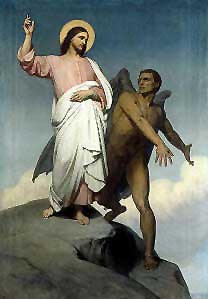
The Temptation of Christ, Ary Scheffer, 1854

I’ve never liked most ads on TV. The ones that are trying to sell me something? They drive me nuts.

Nunca me ha gustado la mayoría de los anuncios en la televisión. Los que están tratando de venderme algo? Me vuelven lo.

“What?” I think to myself, “do these people think I’m stupid? Do they really think I’m going to fall for their tricks?”

“¿Qué?” Creo que a mí mismo “¿Estas personas piensan que soy estúpido? ¿Realmente crees que voy a caer en sus trampas?”

You know the commercials I’m talking about, right? The ones assuring me that if I buy their products, I’ll be richer, more popular, thinner, sexier, “in”?

Ustedes saben los anuncios que estoy hablando, ¿verdad? Los asegurándome que si puedo comprar sus productos, voy a ser más rico, más popular, más delgada, más sexy, “en”?

So I reject their advances. I turn off the sound. I refuse to be drawn in by an advertisement that promises more than it can deliver, that tries to divert me from the fact that not only do I not need that which they are selling, not only do I not want that which they are offering, I do not believe them.

Por lo tanto, rechazar sus avances. Puedo desactivar el sonido. Me niego a ser atraídos por un anuncio que promete más de lo que puede dar, que intenta distraerme del hecho de que no sólo no hace falta que los que están vendiendo, no sólo que no quiero que los que están ofreciendo, yo no les creo.

Because I know that most advertisers are not telling the truth. They are bending the truth, trying to make me believe that if I buy what they’re offering, I’ll be someone I am not.

Porque yo sé que la mayoría de los anunciantes no dicen la verdad. Se trata de doblar la verdad, tratando de hacerme creer que si yo compro lo que están ofreciendo, voy a ser alguien que yo no soy.

To me, most advertisers rank right up there with Ha Satan, the Adversary who tried to dare Jesus to be someone he is not.

Para mí, la mayoría de los anunciantes en el mismo escalafón con Ha Satanás, el Adversario que trató de Jesús se atreve a ser alguien que no lo es.

Because I know that driving the fastest, biggest, most expensive car in town won’t make me a better person.

Porque yo sé que la conducción más rápida, más grande, más caro coche de la ciudad no me hará una mejor persona.

So what if my hair has turned grey? I don’t need to color it to be me.

¿Y qué si mi pelo se ha vuelto gris? Yo no necesito el color a ser yo.

And frankly, I like the laugh lines around my eyes and mouth – they say something important about me.

Y francamente, me gusta la líneas de expresión alrededor de los ojos y la boca – se dice algo importante acerca de mí.

I do not believe the advertisers because I know who I am – I am Lauren, a beloved child of God.

More importantly, I know whose I am – I belong to God.

No creo que los anunciantes porque yo sé quién soy – Soy Lauren, una hija amada de Dios.

Más importante aún, yo sé cuya soy – Yo pertenezco a Dios.

So my answer to all those Tempters out there?

Away with you, Satan!

Así que mi respuesta a todos los tentadores por ahí?

Vete, Satanás!

Jesus didn’t have to face television advertising in the days when he walked the earth. But he did have to face Ha Satan, the Adversary who tried to tempt him into becoming someone he was not.

Jesús no tenía para hacer frente a la publicidad televisiva en los días en que estuvo en la tierra. Pero sí tienen que hacer frente Ha Satanás, el Adversario que trató de tentarlo para convertirse en alguien que no lo era.

Satan tried to tempt Christ, James Tissot, 1895


Immediately following his baptism in the River Jordan, immediately after hearing God confirm who he was (the Son of God) and whose he was (God’s beloved, in whom God was well-pleased),[2] Jesus went out into the desert. That’s what people did in those days, when they wanted to get closer to God. They turned heir backs on the hurly-burly of their lives and spent some time alone, doing their best to come face to face with God.

Inmediatamente después de su bautismo en el río Jordán, inmediatamente después de escuchar a Dios confirmar quién era él (el Hijo de Dios) y que cuya (de Dios amado, en quien Dios estaba muy complacido), Jesús se fue al desierto. Eso es lo que hizo en aquellos días, cuando quiso acercarse a Dios. Se volvieron la espalda heredero en el bullicio de su vida y pasó algún tiempo a solas, haciendo todo lo posible para encontrarse cara a cara con Dios.

After 40 days and 40 nights all alone with God, when Jesus was at his weakest, the Tempter, Ha Satan, showed up.

Después de 40 días y 40 noches a solas con Dios, cuando Jesús estaba en su más débil, el Tentador, Ha Satanás, se presentó.

And what did he do?

He didn’t just tempt Jesus.

He called Jesus’ very identity into question!

¿Y qué hizo?

Lo hizo no sólo tentar a Jesús.

Llamó identidad de Jesús en tela de juicio!

If you are the Son of God[3] turn stones into bread, so that you may eat.

If you are the Son of God[4]throw yourself down and let the angels catch you.

If you will fall down and worship me[5] I will give you power and dominion over the whole world.

Si eres el Hijo de Dios … las piedras se convierten en pan, de modo que usted puede comer.

Si eres el Hijo de Dios … lanzarte hacia abajo y dejar que los ángeles te atrapen.

Si se va a caer y me adoras … yo te daré poder y dominio sobre todo el mundo.

Silly Satan.

Satanás loco.

Did he really think he could get Jesus to give up his very being, just for a little bread, a little thrill ride, a little power?

¿Realmente cree que podría conseguir a Jesús a renunciar a su propio ser, sólo por un poco de pan, un paseo de emoción poco, un poco de poder?

Denying Satan, Carl Bloch, 1850

Jesus’ answer to the Tempter – Away with you, Satan! – is the original model for the “Just Say No” campaign, the campaign to which all of us are called in this holy season of Lent.

La respuesta de Jesús al Tentador – Vete, Satanás! – es el modelo original de la “simplemente decir que no” de campaña, la campaña a la que todos estamos llamados en este tiempo santo de Cuaresma.

Yes, my friends, it is the season of Lent, the 40 days and 40 nights in which we are called to Just Say No to the things that tempt us away from God. This is the time of year when we as Christians are specifically called to do as Jesus did, to turn our backs on the hurly-burly of our lives so that we can focus – really and truly focus – on who we are and whose we are.

Sí, mis amigos, es la temporada de Cuaresma, los 40 días y 40 noches en la que estamos llamados a decir “no” a las cosas que nos tientan lejos de Dios. Esta es la época del año cuando nosotros como Cristianos están especialmente llamados a hacer como lo hizo Jesús, a su vez en la espalda en el bullicio de nuestras vidas para que podamos centrarnos – real y enfoque realmente – en lo que somos y que nos pertenecen.

Now I know that Lent is not a popular season. It is not, as commentator David Lose says, something we look forward to, like Christmas. (Who asks, he points out, how many days there are until Lent?)[6]

Ahora yo sé que la Cuaresma no es un tiempo popular. No es, como dice el comentarista David Lose, algo que esperamos, como la Navidad. (¿Quién pregunta, señala, ¿cuántos días hay hasta la Cuaresma?)

Indeed, Professor Lose believes that because Lent is not popular, it is in trouble.[7]

De hecho, el profesor cree que perder porque la Cuaresma no es popular, Cuaresma tiene problemas.

It is in trouble, he says, because “it feels like this strange, weirdly anachronistic holiday that celebrates things we don’t value and encourages attitudes we don’t share.”[8]

Tiene problemas, dice, porque “se siente como esta fiesta extraña, extrañamente anacrónico que celebra las cosas que no valoramos y alienta actitudes que no comparto.”

But Lent doesn’t have to be in trouble.

Because Lent is really God’s gift to us.

Pero la Cuaresma no necesita tiene problemas.

Debido a que la Cuaresma es realmente un regalo de Dios para nosotros.

It is a gift because it gives us the time to think again, to know again, that we are beloved children of God, that we belong, from before time began until the ages of ages, to God.

Es un regalo porque nos da tiempo a pensar de nuevo, para saber más, de que somos hijos amados de Dios, que nos pertenecen, desde antes de los siglos hasta que siglos de los siglos, a Dios.

Lent is our time to say “no”… “no” to all the things that get in the way of knowing God’s love, that get in the way of our delighting in God’s will and walking in God’s ways.

La Cuaresma es nuestro tiempo para decir “no” … “no” a todas las cosas que se interponen en el camino de conocer el amor de Dios, que se interponen en el camino de nuestro deleite en la voluntad de Dios y caminar en los caminos de Dios.

Lent is our time to reject that which tries to redefine us, to reject the false advertising of our lives – the advertising from outside us that says, Just do this and you will be … famous, rich, happy, thinner, sexier, “in.”

La Cuaresma es nuestro tiempo para rechazar lo que nos trata de redefinir, de rechazar la falsa publicidad de nuestras vidas – la publicidad de fuera de nosotros que dice: Haz esto y serás … famoso, rico, feliz, más delgado, más sexy, “en.”

It is our time to reject those things that challenge our very identity, that draw us away from identifying ourselves first and foremost with and by God.

Es nuestra hora de rechazar las cosas que desafían nuestra propia identidad, que nos alejan de la identificación de nosotros mismos, ante todo, con y por Dios.

• • •

When I was in Sudan, in an area dominated by one tribe but populated by 15 other tribes, I frequently was asked, because tribal identification is still so very important in that war-torn country, “What tribe do you come from?”

Usually, my questioners wanted me to identify with their tribes, with the Dinka or Nuer, with the Shilluk or the Moro.

Cuando estaba en el Sudán, en una zona dominada por una tribu, pero poblada por 15 tribus otros, con frecuencia se le pidió, porque la identificación tribal es todavía tan importante en ese país devastado por la guerra, “¿De qué tribu vienes?”

Por lo general, mis interrogadores querían que se identifican con sus tribus, con los Dinka o los Nuer, con los Shilluk o los Moro

But I had friends in each of those tribes, and I refused to identify with just one of them.

Pero yo tenía amigos en cada una de esas tribus, y se negó a identificarse con uno de ellos.

It took me a while – a couple of years, actually – but one day, confronted yet again by an aggressive questioner, I heard myself answer:
“I belong to the tribe of God.”

Me tomó un tiempo – un par de años, en realidad – pero un día, se enfrentó una vez más por una pregunta agresiva, me oí responder:

“Yo pertenezco a la tribu de Dios.”

In truth, that tribe – God’s tribe – is the only tribe that counts. And we all belong to it.

En verdad, esa tribu – tribu de Dios – es la única tribu que cuenta. Y que todos pertenecemos a la misma.

The color of our skin? Our country of origin? Who our parents are? The language we speak? The clothes we wear? The jobs we have (or don’t have)? The world may think these things matter, but they do not.

They … do … not … matter.

El color de nuestra piel? Nuestro país de origen? Quiénes son nuestros padres? El idioma que hablamos? La ropa que usamos? Los puestos de trabajo que tienen (o no tienen)? El mundo puede pensar que estas cosas son importantes, pero no lo hacen.

Ellos … no … estan … importa.

The only thing that matters is that we belong to God’s tribe, the tribe of beloved children, created in God’s image, loved from before time until the ages of ages.

Lo único que importa es que pertenecemos a la tribu de Dios, la tribu de los hijos amados, creado a imagen de Dios, amado desde antes de los siglos …  hasta que las edades de las edades.

This holy season of Lent?

It is our time to discover anew our membership in that tribe.

Este tiempo santo de Cuaresma?

Es nuestro tiempo para descubrir de nuevo nuestra pertenencia a esa tribu.

We are not defined by what we own.

We are not defined by what we wear … or what we eat … or how powerful we are in this life.

We are defined only by this:

We are God’s beloved children.

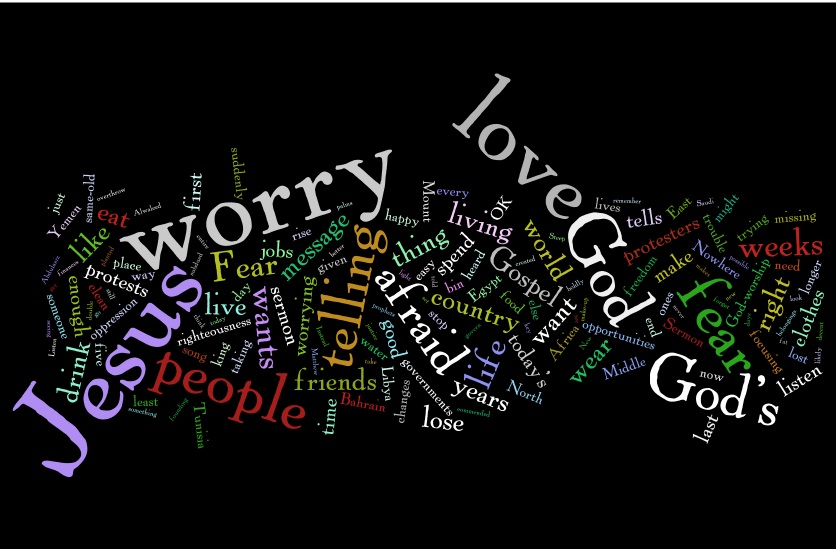
Wordle art of this sermon, courtesy of wordle.net.

And we belong to God.

No están definidas por lo que tenemos.

No se define por lo que usamos … o lo que comemos … o lo poderoso que estamos en esta vida.

Nos están definidas por sólo por esto:

Somos hijos amados de Dios.

Y nosotros pertenecemos a Dios.

If we want to enjoy this gift that is Lent, we will have to be strong. We will have to turn our backs on the temptations that lead us astray from this tribe. We will have to reject the false advertising that says we can be something we are not. We will have to renounce those things that rear up their ugly heads and keep us from seeing God, and seeing ourselves in God.

Si queremos disfrutar de este regalo que es la Cuaresma, vamos a tener que ser fuerte. Tendremos que dar la espalda a las tentaciones que nos llevan por mal camino de esta tribu. Vamos a tener que rechazar la falsa publicidad que dice que puede ser algo que no lo son. Vamos a tener que renunciar a esas cosas que se alzan sus cabezas feas y nos impiden ver a Dios, y vernos a nosotros mismos en Dios.

This is our time. Our time to be with God. Our time to revel in God’s closeness. Our time to open ourselves up – completely and intimately – to the God who created us in love, the one who loves us now, the one who will love us forever.

Este es nuestro tiempo. Nuestro tiempo para estar con Dios. Nuestro tiempo para deleitarse con la cercanía de Dios. Nuestra tiempo de abrirnos – completo e íntimamente – al Dios que nos creó en el amor, el que nos ama ahora, el que nos va a amar para siempre

The next time someone tries to tempt you away from God? Tries to convince you that you are not popular enough, thin enough, sexy enough, “in” enough? Tries to sell you a faster car, a cooler phone? Tries to tell you that you are not eating in the right restaurants or working in the right offices?

Do what Jesus did:

Renounce them! Tell them to go away!

La próxima vez que alguien trata de tentarlo lejos de Dios? Trata de convencerlo de que no son lo suficiente popular, lo suficiente delgada, lo suficiente sexy, lo suficiente “en”? Trata de venderle un coche más rápido, un teléfono más fresco? Trata de decirle que usted no está comiendo en los restaurantes de derecha o de trabajo en las oficinas de derecho?

Hacer lo que hizo Jesús:

Renunciar a ellos! Dile que se vayan!

Because those people? They are not telling the truth. They are Tempters. Adversaries. They stand against God.

Debido a esas personas? Ellos no están diciendo la verdad. Ellos son tentadores. Adversarios. Ellos están en contra de Dios.

Instead, listen to God, who says to you:

You are my beloved. I created you because I love you.

Closeup of the Creation of Man, Sistine Chapel, Michelangelo

And you belong to me … from before time began … until the ages of ages.

En cambio, escuchar a Dios, que te dice:

Tú eres mi amado. Te he creado, porque Te amo.

Y tú me perteneces … de antes de los siglos … hasta que las edades de las edades.

You belong to me.

Tú me perteneces.

Amen.

Bilingual sermon preached on the First Sunday in Lent, 13 March 2011, Year A, at St. Paul’s, Bailey’s Crossroads, Falls Church, Va.


[1] Professor David Lose, Marbury E. Anderson Biblical Preaching Chair Luther Seminary, “Into Temptation,” via WorkingPreacher.org, posted 7 March 2011, http://www.workingpreacher.org/dear_wp.aspx?article_id=462

[2] Ibid.

[3] Lose, “Into Temptation.”

[4] Ibid.

[5] Ibid.

[6] Professor David Lose, “The Trouble (and Blessings) of Lent,” on The Huffington Post, 7 March 2011, http://www.huffingtonpost.com/david-lose/why-lent_b_830968.html?ref=fb&src=sp#sb=1522119,b=facebook.

[7] Ibid.

[8] Ibid.


Share this:
Share this page via Email Share this page via Stumble Upon Share this page via Digg this Share this page via Facebook Share this page via Twitter

Get your Lent on!

Updated …

Today is Ash Wednesday, the beginning of the 40-day season of Lent, the time when as Christians we are asked to step back from the hurly-burly of our lives to reflect on our relationship with God and the knowledge that indeed, we are dust, and to the dust we shall return.

For many people, Lent is a time of fasting: from chocolate, cigarettes, meat, alcohol, you name it. With the rise of social networking, many are now choosing to fast from Facebook and e-mail and Twitter as well, because, as some have said, any of those things is addictive and therefore gets in the way of their relationship with God. Others are using Facebook especially for their prayer time. One person suggested that as you go through your Facebook feed, you stop and pray for each person who has posted. That’s sacramental networking on a massive scale.

But for others, Lent is an opportunity to go out into the world and preach the Gospel in new or alternative ways.

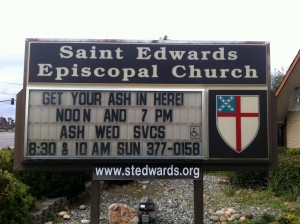
St. Edward's Episcopal Church, San Jose, Calif.


Exhibit A: Playing with words

My friend Tom Sramek Jr. is rector of St. Edward’s Episcopal Church in San Jose, Calif. Look at what he posted on his parish’s sign out on the street. (And “yep,” he says, “it’s on both sides.”) According to Sramek, his “facebook friends” made him do it. If so, those friends should be thanked, because this is a creative way for going out into the world and letting people know, “Hey! Something important is happening today. Get in here!” Now that approach may not work for everyone; I’m certain there are some who are scandalized by this delicious play on words. But some days, that’s what it takes to get people’s attention. Some people say it’s being cute – or worse, too cute – but in reality, all we’re doing is taking what people expect to see, changing it just enough for their subconscious to take note, and bingo! We’ve gotten the message across. We’ve preached, sometimes in very short form, the Gospel. I’ve often advocated that we engage in word play in our advertising: Holding a midweek service at 12:12, for example, instead of 12, or 12:05, or 12:15. People expect the latter times; 12:12 throws them for a loop, which means they notice, which means they think about it, even for a nanosecond, which means they’ve at least seen the invitation, which is Good News indeed.

Exhibit B: Hitting the streets

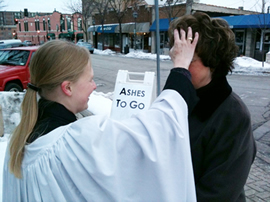
From a variety of sources comes the news of parishes taking their ashes to the streets. No, this is not some big protest by uptight Episcopalians who object to using cute phrases for advertising. This is the Church at work in the world. This is the Church recognizing that the world cannot always come to it, and that frequently, the Church needs to go out into the world.

The Rev. Emily Mellot, rector of Calvary Episcopal Church in Lombard, Ill., imposes ashes on the streets of Lombard. (Photo courtesy of the Diocese of Chicago)

The Diocese of Chicago has an Ashes to Go initiative, which started a few years ago and in which my friend Lane Hensley participated last year when he was rector of the Church of the Transfiguration in Palos Park, Ill. The initiative focuses on going to where the people are on Ash Wednesday – in this case, commuter rail stations, Starbucks and other businesses and business areas – and offering to make the sign of the Cross on their foreheads with ashes. More than two dozen parishes in the Diocese of Chicago are participating in this effort, according to Episcopal News Service.

Now Lane is rector of St. Margaret’s Episcopal Church in Palm Desert, Calif., and he’s taking his ashes on the road there, too. Hensley’s goal: Reaching out to those “who aren’t members of a church, or maybe have been members but pulled away for whatever reason.”

“The ashes,” Hensley told the Desert Sun newspaper, “are indicative of our admitting that we understand the futility of our existence and that we’re not self-sufficient or masters of our own fate.”

The Episcopal Church of St. Andrew and Holy Communion distributed ashes this morning in the streets of South Orange, N.J.

In San Francisco, as Sara Miles writes for EpiscopalCafe.com in this morning’s Daily Episcopalian, members of St. Gregory of Nyssa Episcopal Church are going out into their neighborhoods, bringing ashes and prayers to all whom they meet. Miles is the founder and director of The Food Pantry and Director of Ministry at St. Gregory of Nyssa, as well as an accomplished author of several books, including Take This Bread: A Radical Conversion and Jesus Freak: Feeding, Healing, Raising the Dead. Read her books and you’ll see that she knows a thing or two about going into the world.

From her column this morning:

“We touched the foreheads of commuters, and the gang kids on the corner, and little children, and a bunch of obnoxious drunks. I was pausing to impose ashes on an older lady when some guy pulled up in a truck, put on his blinkers, and threw open the door — “Oh! can I have those? Wait, my mom is in the back seat, can you go give her some?” Deb led me into the library, and a librarian said “I saw your sign that said forgive more. That’s what I need in my life right now. I need to forgive more.” At the taqueria, a cook said, “Oh…did you come because you knew we couldn’t get to church, so you came to us?” Deb was transfixed. “It’s so intense,” she told me. “Whenever your fingers touch the forehead, it’s like time stops, over and over and over.” Deb stood watching, her mouth open, in the Italian bakery, as a big woman in an apron, holding a three-layer birthday cake in her arms, leaned over the counter toward me. The woman closed her eyes and said, quietly, “Please.” I told her she was dust. We walked through an alley, where a teenaged drug dealer grinned at us and lifted his cap to show the cross already marked on his forehead. “I never thought I’d be walking along the street censing trash cans and storefronts,” Deb said. “and so many people would come toward it.” I know,” I said. “I think people might want a lot more church than we generally give them.”

Many people can’t get to church on Ash Wednesday; they work, they have to go to school, they have no transportation, their lives are too busy, they don’t know what Ash Wednesday is or why they should participate. But when the Church goes to those people where they are, and offers them that moment of sacramental living, lives change.

Our mission as beloved children of God is not to sit inside our churches and wait for people to come to us. If you build it, they will come hasn’t worked for the Church for a very long time. Instead of waiting, let’s get our Lent on by going out into the world. The people are there, and if the events described above are any indication, they need us.

An update from Palm Desert, Calif., via the Palm Desert Patch:

Guard Boots Rector, Pastor From Gardens On El Paseo

The clergy were ushering in the Lenten season by putting ashes in the sign of the cross on foreheads of willing passerby.

A Palm Desert Episcopalian priest and Lutheran pastor administered ashes to about 200 people Wednesday along El Paseo on the first day of the Lenten season, but not without some trouble.

The Rev. Lane Hensley of St. Margaret’s Episcopal Church and Pastor Derek Fossey of Hope Lutheran Church started at the Gardens on El Paseo, but quickly were told  by security personnel they were not welcome as the area is private property.

“I asked if it was OK to do this in the courtyard area,’’ Hensley told Patch.com, adding that he brought the tradition to the desert for the first time this year from his parish in Chicago.

Ashes are traditionally put on the foreheads of parishioners as part of Ash Wednesday, which ushers in the first day of Lent, the 40-day preparation in protestant and Catholic churches for Easter Sunday, April 24.

Being asked to leave didn’t stall the men, who went along other parts of El Paseo.

“Many of the employees of the stores came out to receive ashes,’’ Fossey said, adding that people, even non-Christians, seemed to enjoy it.

“People would pull up and ask if I could give them ashes in the car,’’ Fossey said, adding he happily obliged.

Toward the end of their rounds just before 2 p.m., Hensley and Fossey were on the sidewalk near the True Religion store when another guard asked them to leave, saying even that area was private property.

“Where does the property end?” Hensley asked.

“The property ends at the stoplight to the stoplight down there,’’ the guard said, pointing from San Pablo Avenue to Larkspur Lane.

The men wrapped up the event, but not before a dozen more people asked for the ritual.

After the priest and pastor left, a guard who only identified himself as a supervisor said he did not have a comment on the church leaders being barred from the sidewalk along the Gardens.

“See these bricks right here. Does that look like the sidewalk across the street?” he said before threatening to call the police if Patch.com’s reporter did not leave the sidewalk.

Sara OFlynn, marketing director for the Gardens on El Paseo, said she had no comment.

Share this:
Share this page via Email Share this page via Stumble Upon Share this page via Digg this Share this page via Facebook Share this page via Twitter

‘Stronger together than apart’

From the Anglican Communion News Service this morning comes a report of a meeting of 19 bishops from around the world who met in Dar Es Salaam, Tanzania, at the end of February.
The essence of the meeting: “We really need each other. We are stronger together than apart.”
The essence of relationships, of community, of being created in the Image of God: We really do need each other, because we are stronger together than apart.
Any time a group of people gathers, there is the opportunity to build the community for which we were created. Any time those people take the time to listen to each other, to hear each other’s stories, to learn about each other, there is the opportunity to build that same community. As the bishops point out in their statement: “Dialogue is about turning to one another with openness.”
Talking with each other is not always easy. Even when a so-called “common” language is used, there is the opportunity for misunderstanding, willfully or unintentionally. That’s why dialogue – not just the conversation between two or more people, but the “exchange of ideas or opinions … with a view to reaching an amicable agreement or settlement,” as the dictionary defines it – is so important.
When you tell me your story, you express you understanding of that story, you teach me to see the world through your eyes. When you then let me do the same with you, we have created a relationship. We may not see things the same way, we may not agree, but at least we will know how each other thinks, how each other approaches an issue or situation, and that understanding alone can be enough to build community.

A world map showing the Provinces of the Anglican Communion (Blue). Also shown are the Churches in full communion with the Anglican Church: The Nordic Lutheran churches of the Porvoo Communion (Green), and the Old Catholic Churches in the Utrecht Union (Red).

These bishops deserve kudos for their work in building up the beloved community of God.

From the ACNS report:
By ACNS staff

Nineteen bishops of the Anglican Communion this week announced that the Communion was stronger together than apart and that its members needed one another.

In a joint statement issued after a “Consultation of Bishops in Dialogue” meeting held in Dar Es Salaam, Tanzania the church leaders said they had shared testimonies about partnership mission work.  Through this a common thread had emerged “our experience of finding ourselves in each other.”

“Across the globe, across the Communion, we actually really need one another,” the bishops’ statement said. “We are stronger in relationship than when we are apart. This, we believe, is a work of engaging in Communion building rather than Communion breaking. In the words of the Toronto Congress of 1963 we are engaged in living in ‘mutual responsibility and interdependence’ (Ephesians 2:13-22)”.

The bishops hailed from Sudan, Botswana, Malawi, Burundi, Ghana, Kenya, Tanzania, South Africa, Canada, the United States and England. They met at the end of February as a group of partner pairs and triads and discussed a range of issues including human sexuality, slavery and tackling poverty . …

“We have been engaged in a process of patient and holy listening, as Anglicans, coming from a wide diversity of contexts and theological positions, who have chosen to listen to one another (Colossians 3:12-17). …

“We have found that in the wider context of conflicts around sexuality in the Anglican Communion, the conflict has provided us an opportunity to build bridges of mutual understanding to us as we choose to turn face to face with each other. We know that this topic requires the best of us in our dialogue: our mutuality and humility and prayer in listening and in speaking as we seek together for God’s wisdom (1 Corinthians 2:6-16). ….

“We are aware that when we talk, the words we use may not be heard in the same way as we intend and we do not always understand language in the same way. We are engaged in a quest for language that will bring us to common understanding and to better dialogue. That does not mean that we agree or that we seek an agreement on particular issues. …”

To read the ACNS story, with the full text of the statement attached, look here.

Share this:
Share this page via Email Share this page via Stumble Upon Share this page via Digg this Share this page via Facebook Share this page via Twitter

Helping refugees in Ecuador

Episcopal Relief & Development sent word today about the work it is doing in the Diocese of Central Ecuador, working to help meet the basic material needs of Colombian refugees in Quito, Ecuador’s capital.

From its statement: ERD is calling this move a “temporary expansion of relief services … to cover a gap in services usually provided by the office of the United Nations High Commissioner on Refugees (UNHCR), which has suspended its operations during a period of restructuring. Blankets, sleeping mats and personal care kits will be distributed to an estimated 100 families during the coming month.”

ERD is one of those organizations that doesn’t put 1,000 volunteers on the ground to do the relief and development. Instead, it partners with various organizations and works with Episcopal and Anglican partners who are already in place, who know the needs of the people, and who guide the whole process.

In working this way, ERD serves as a good model for how we truly can be partners and friends with our brothers and sisters in Christ around the world. Listening to the needs and desires of the people is more important than problem-solving in a vacuum.

I worked with ERD extensively after the earthquake in Haiti, and know how hard it is some days to listen first, and then act. But if we truly want to be partners with others around the world, we have to take the time to listen. And we have to respect those who speak.

Read more from ERD’s work in Ecuador here.


Share this:
Share this page via Email Share this page via Stumble Upon Share this page via Digg this Share this page via Facebook Share this page via Twitter

Love and mission in Honduras

Episcopal News Service has a great article today by Lynette Wilson on Ministerios Nuestras Pequeñas Rosas, Our Little Roses, in San Pedro Sula, Honduras.

Our Little Roses is a home for girls who have been abused, abandoned or orphaned. It is one of the best ministries I’ve ever seen – a refuge of love and care for those who are in such great need, most of all, to be loved. Diana Frade, the founder of OLR, is a friend of mine, and I’ve been privileged to visit and serve at Our Little Roses five times.

Twenty-five years ago, Diana started this ministry, as the article recounts, because she saw a need – for love – saw a way to meet that need, and made it happen. That’s mission. Diana and all those who have been involved in OLR are great role models for all of us, most of all because everything they have done, and everything they are doing, comes out of the bounty of their love.

From the ENS article:

Ministry empowers Honduran girls for life

[Episcopal News Service – San Pedro Sula, Honduras] Ministerios Nuestras Pequeñas Rosas began 25 years ago in a three-bedroom rental house in this gritty, factory town four hours from the capital, Tegucigalpa, because its founder, Diana Frade, recognized the need to educate and empower at-risk girls.

“I visited a boys’ home in Tegucigalpa, and could see the girls on the street,” said Frade, the founder, president and executive director of Ministerios Nuestras Pequeñas Roses, or Our Little Roses (OLR). “I thought, if the church is doing this for boys, why not for girls?”

Adhering to protocol, Frade introduced a resolution aimed at helping girls at a diocesan convention, but it failed – but she’d already promised judges (the court system manages child placement in Honduras) in Tegucigalpa a home for girls. So with $80,000 – part memorial gift, part matching grant – she rented a house and took in the first girl. By the end of the first year, there were 23 girls, a cook and two tias, or aunts, who at OLR handle the everyday needs, rearing and discipline of the girls living in the home, she said.

There are an estimated 200,000 orphaned children in Honduras, according to government statistics. Honduras, a Central America about the size of Tennessee, has a total population of about 8 million, close to 50 percent under the age of 18.

The first building, in Villa Florencia, was built in 1992 on property donated by the city’s mayor on two conditions, Frade said: OLR would be the legal name and listed on the legal documents, and the buildings would be designed in the style of San Pedro Sula. The home came first, and then came the infrastructure – water, sewer, electricity – and the neighborhood, she added.

Today, OLR covers 2.5 acres in Colonial Villa Florencia, five minutes from the central city, and includes Holy Family Bilingual School, serving the surrounding community; a residential home, where currently 56 girls, toddlers to teens, live together with their tias; and an off-site transition home for girls who have left the residential home and who are working and/or studying at a university. OLR Ministries also includes a medical clinic, a dental clinic staffed by Dr. Jensey Maldonado, who came to OLR with her sister when she was 9, and a recently completed mountain retreat and conference center, Our Lady of the Roses, in Santa Barbara, about an hour outside the city. ORL also has a Spanish-language school, offering instruction for students and housing on a weekly basis.

It was United Thank Offering, Episcopal Church Women and Daughters of the King who backed OLR from the beginning and it has been women, who recognize that “when you educate women you can change the future,” who have continued to support OLR, said Frade, who is married to the Rt. Rev. Leo Frade, bishop of the Episcopal Diocese of Southeast Florida.

“The women were so excited and got behind it,” she said. “This ministry is really quite unique, putting women and girls first; when you put women and girls first, you’re changing the generation to come.”

Click here to read the rest.

Share this:
Share this page via Email Share this page via Stumble Upon Share this page via Digg this Share this page via Facebook Share this page via Twitter

Claiming our voices

For EpiscopalCafe.com’s Daily Episcopalian:

Finally, finally, FINALLY, I went to see The King’s Speech.

I did not see this movie because of the cast – although Colin Firth and Helena Bonham Carter and Geoffrey Rush all do magnificent jobs.

I did not see it because it is nominated for awards everywhere.

I saw this movie because as a child, I, too, had a speech impediment, and from one line I head in an NPR interview with director Tom Hooper – the King yelling, in Westminster Abbey, “I have a voice!” – I knew this movie was telling part of my story as well.

Unlike King George VI, I did not stutter. I had a lisp. It was an awful lisp some days, which I had until I was in seventh grade, and for which I was made fun of by classmates and playmates and even my siblings at times.

When the NPR interview last November began, I wondered: “A movie about the King of England during World War II? He had a speech impediment? Really? I thought he lifted up his people with all kinds of speeches on the radio?” I knew that George VI wasn’t supposed to be king, that his brother David abdicated the throne to marry Wallis Simpson, and that as king, George inspired his people.

He had a stutter?

And then I heard that powerful line – “I have a voice!” – and shivers went down my spine and I thought, “I HAVE to see this movie!”

The King's Speech, from The Weinstein Group

I had to see it because I remember thinking, in my childhood, when people where making fun of me, “Just because I lisp doesn’t mean I can’t speak. Listen to me!”

The lisp was the result of losing my two front teeth when I was 2. I was in a car accident, caused, I’m told, by a drunken driver who ran a red light and plowed into our station wagon. It was back in the early ‘60s, when no one thought to put their children in car seats, and seat belts weren’t a huge priority. I was, I’m told, standing on the back seat, clinging to the front bench seat and doing what 2-year-olds do: goofing off. When our car was hit, my mother told me, I flew into the nice metal strip that was on the back of all bench seats in station wagons in those days (don’t ask me why they were there … they just were).

Now these were my baby teeth that I lost; my adult teeth weren’t due in for years. We didn’t do implants in those days (again, don’t ask me why) or spacers. So what happened?

I spent the next four years without my front teeth. Which meant that I had problems whistling (this was huge in my family), and I developed a nice, pronounced lisp. It was so pronounced that at times, my stepfather would joke about taking me down to the woodshop in the basement and fitting me with wooden teeth, like George Washington supposedly had (I learned later that his teeth were made from hippopotamus ivory). That threat used to scare the bejesus out of me.

And then there was the jealousy factor: one of my older brothers got to sing All I Want for Christmas is My Two Front Teeth when he was in first grade. But he HAD his front teeth, so it had no meaning for him. Me? I was soooo excited about getting to sing that as well … until my front teeth finally came in just weeks before it was my turn, and the song lost its significance.

But the coming of new teeth did not end the lisp. It hung in there for years, until at last, my mother put me in speech therapy. I had to do “exercises” involving strings and small weights, and others pronouncing letters and sounds, and every day, I literally had think about my tongue and where it was positioned in my mouth, not just when I was speaking but also when I first woke up … when I was watching TV … when I was sitting in class. I had a little notebook and had to record, with smiley faces and frowns, where I found my tongue at any given moment. (To this day, I still catch myself checking my tongue placement.)

When my friends found out what I was doing, they made even more fun of me. I was mortified on the playground at school when I found some of them imitating my therapy exercises. I’ll never get over this, I used to think. Never!

But all those exercises paid off. Within a year, I was lisp-free. And when I conquered that lisp, I truly found my voice. I no longer had to worry about what I would sound like when I was speaking. Instead, I could concentrate on what I was saying.

Now, to be honest, I haven’t thought about the days of my lisp in years. I’m a public speaker now; anyone who knows me will tell you that I’ll preach the Gospel at the drop of a hat, and that getting me to shut up can be very hard indeed. For me, my lisp was a thing of the long-ago and forgotten past.

Until I heard that one line – that powerful, spine-tingling scream from the movie – and all of my frustrations and fears and tears came back, and I realized: I have to see this movie!

Not to relive those frustrations and fears and tears, but to see this message that yes, we DO each have a voice, and yes, our voices, individually and corporately, ARE important.

God gives each of us that voice, and God wants to hear it. God wants us to raise our voices to the heavens, to proclaim God’s love and glorify God’s name and strengthen and inspire God’s people and, yes, to tell our stories.

Even when we stutter.

Even when we lisp.

The Rev. Lauren R. Stanley is a priest of the Diocese of Virginia and church consultant who served for five years as an overseas missionary.

Share this:
Share this page via Email Share this page via Stumble Upon Share this page via Digg this Share this page via Facebook Share this page via Twitter

Losing our fear

For the last four weeks, the world has been transfixed by the events taking place in North Africa and the Middle East.

After 23 years in Tunisia and 31 years in Egypt, the people rose up and through mostly peaceful but still costly protests overthrew their leaders. In Libya, 42 years of oppression have brought about more protests, ones that have turned brutally violent, in an attempt to overthrow their own leader, Col. Moammar Khadafy.

Protests are also taking place in Bahrain, Morocco, Yemen, Iraq, Iran, Oman and Jordan. In Syria, President Bashar al-Assad is making changes to avoid the same kind of protests. The grandson of the founding king of modern Saudi Arabia, Prince Alwaleed bin Talal bin Abdulaziz Al-Saud, acknowledged publicly – in the New York Times no less! – that changes need to happen, that the governing philosophy of same-old, same-old no longer will suffice.[1]

In each country, the people have said that they are tired of their governments ignoring them. They want, the people say, jobs, freedom, opportunities to grow. They want to govern themselves.

But none of these demands are new. The people who are changing the world aren’t suddenly being confronted by a lack of jobs, or freedom, or opportunities. Those issues have been the order of the day for decades.

So what changed?

What happened to make people who for years were oppressed and subdued suddenly rise up and topple governments that were seen as secure?

If you listen to the protesters in each country, they all say the same thing:

“We have lost our fear.”[2]

In country after country, the people were able to rise up against injustice and oppression because, they said, they had lost their fear.

• • •

My friends, for the last five weeks, we have been immersed in Jesus’ magnificent Sermon on the Mount, where he has told the people, in every way possible, that it is time for them to lose their fear.

Nowhere in this sermon does Jesus actually use those words. Nowhere does he proclaim, as angels and prophets before him have proclaimed, “Fear not!”

But a key underlying message to this sermon truly is just that: “Fear not!”

And what is Jesus telling us to not fear?

Love.

Do not be afraid … to love.

To love God and love one another.

Those blessings Jesus laid out at the beginning of this sermon, in the Beatitudes? Those were given to people who were afraid – afraid that they were not loved, and afraid in turn to love.

That saltiness and light that Jesus commended us to be? If that’s not a message of “fear not,” I don’t know what is.

Those legalisms, all those Law-on-steroids[3] that we have heard for the last two weeks, the “you have heard that it was said … but I say to you” directions? That wasn’t Jesus trying to be more Pharisaic than the Pharisees. That was Jesus telling the people: Go beyond the Law … to love!

And now we come to today’s Gospel, the end of our five weeks of the Sermon on the Mount, in which Jesus tells us, “Do not worry” … about what we are to eat or drink or wear … or even about tomorrow, “for today’s trouble is enough for today.”

If we listen to this Gospel on its own, considering not that which preceded it, it would be easy to equate this message with Bobby McFerrin’s. You remember his song, right?

(sung) Don’t worry … be happy.[4]

In every life we have some trouble

When you worry you make it double

Don’t worry … be happy.

It’s a happy-go-lucky song that makes you feel good, right?

Now that I’ve planted those lyrics in your head – Don’t worry … be happy – go back and read the Gospel from Matthew again, and you can see how easy it is to think, “Why, they’re both about the same thing: ‘Don’t worry’!”

But my friends, Jesus is not telling us we should never worry … and that’s a good thing, because if he were telling us that, the truth is, most of us would not listen.

Because we do worry.

We worry about our health … our finances … our families … our friends … the economy … jobs … safety … We worry about the food we eat (“Is this good for me?”), the water we drink (“Is it clean?”), the clothes we wear (“Does this outfit make me look fat?”).

If we’re honest with ourselves, we’ll admit that on any given day, we probably spend at least a few hours of it worrying.

So when Jesus tells us, “Do not worry …” our first reaction most likely, at least in private, is, “Yeah, right …”

But if we do that, we’re missing the point.

Because he’s not telling us to worry not.

He’s telling us to lose our fear. He’s telling us to be like those protesters in Tunisia and Egypt and Bahrain and Yemen and Libya, where protesting has cost many of them their lives.

Jesus wants us to stop being afraid all the time and to start focusing on the things that really matter.

He’s telling us to “strive first for the kingdom of God and [God’s] righteousness.”

Because when we do that – when God’s justice rolls down like waters and God’s righteousness like an everflowing stream[5] — then indeed, we will not have to worry about what we are to eat or drink or wear (“Does this outfit make me look fat?”).  Because in God’s very just and righteous world, all of us will have enough food to eat, clean water to drink and decent clothes to wear, for then we shall no longer live in a world where scarcity is king. Instead, we will inhabit a creation where God’s abundance reigns.[6]

Listen to how Biblical scholar Eugene Peterson has translated today’s Gospel in The Message:

If you decide for God, living a life of God-worship, it follows that you don’t fuss about what’s on the table … or whether the clothes in your closet are in fashion. … What I’m trying to do here is to get you to relax, to not be so preoccupied with getting, so you can respond to God’s giving. … Steep your life in God-reality, God-initiative, God-provisions. Don’t worry about missing out … Give your entire attention to what God is doing right now.[7]

When we spend all of our time worrying about what we have and don’t have, we are not living a life of God-worship. We’re living a life of fear.

Fear that what we have is not enough.

Fear that someone else might have more than we do, or something better than we do.

Fear that someone else might try to take away what we have.

Jesus wants us to stop being so afraid that we lose sight of what God wants for us. He wants us to set aside our fear and remember God’s promise to us: “Yet I will not forget you. See, I have inscribed you on the palms of my hand.”[8]

Jesus wants us to love – boldly … passionately … wildly … radically – the way God loves us.

When we worry … when we are afraid … when we spend our days focusing only on ourselves and our belongings, and not on God and God’s other beloved children, and what they need, we cannot love.

It’s OK to worry … we’re human beings, and worry is part of our genetic make-up.

It’s not OK to let those worries consume us, to keep us from seeing God’s abundant love in our lives – and from acting on that love, from living that love.

My friends, we are created by God to love.

We are created … by God … to love.

That’s what Jesus is saying to us: Live in love.

And if we want to live in love, if we want to live as Jesus tells us to live, not worrying but loving, the first step we have to take is become like those protesters all over the Middle East and North Africa, the ones who have inspired us and kept us glued to our TV sets for weeks on end.

First, we must lose our fear.

Thenthen … we can love.

Amen.

————————————————————

A sermon preached on the Eighth Sunday after the Epiphany, 27 February 2011, Year A, at the Episcopal Church of Our Savior, Montpelier, Va.


[1] Prince Alwaleed bin Talal bin Abdulaziz Al-Saud, chairman of the Kingdom Holding Company and the Alwalaeed bin Talal Foundations, “A Saudi Prince’s Plea for Reform,” The New York Times opinion page, 25 February 2001, http://www.nytimes.com/2011/02/25/opinion/25alsaud.html?scp=2&sq=alwaleed%20bin%20talal%20bin%20abdul%20aziz%20alsaud&st=cse

[2] Sarah A. Topol, aolnews, “Egyptian protesters vow they will remain: ‘We lost our fear,’” http://www.aolnews.com/2011/02/03/egyptian-protesters-vow-they-will-remain-we-lost-our-fear/ (See also numerous other reports in February from Egypt and Bahrain.)

[3] David Lose, Marbury E. Anderson Biblical Preaching Chair, Luther Seminary, on http://www.workingpreacher.org/dear_wp.aspx?article_id=452

[4] Bobby McFerrin, Don’t Worry, Be Happy, released September 1988, lyrics from http://www.lyricsondemand.com/onehitwonders/dontworrybehappylyrics.html

[5] Amos 5:24

[6] Paraphrase from Lose, “Picture This,” at WorkingPreacher.org, http://www.workingpreacher.org/dear_wp.aspx?article_id=458.

[7] The Message (MSG), © 1993, 1994, 1995, 1996, 2000, 2001, 2002 by Eugene H. Peterson, via http://www.biblegateway.com.

[8] Isaiah 49:15b-16a.

Share this:
Share this page via Email Share this page via Stumble Upon Share this page via Digg this Share this page via Facebook Share this page via Twitter

Living with the poor

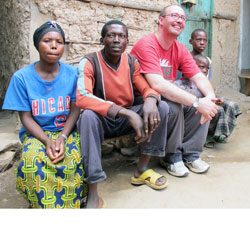
This morning brought an e-mail from a former bishop in Rwanda, The Rt. Rev. Venuste Mutiganda, of a marvelous article published today in the New Times of Kigali. The article tells the story of two British diplomats – the High Commissioner to Rwanda, Ben Llewellyn Jones, and the Director of the Department for international Development (DfID), Elizabeth Carriere – who spent three days living with rural families in Rwanda.

Why?

So they could experience “firsthand what it means to live off less than one dollar a day.”

Fortunate Ntawoyangire, left, wife of Theophile Manayiragaba, center, and Ben Llewellyn Jones, right, the UK High Commissioner, sharing a light moment with his hosts. (By D Umutesi of the New Times of Kigali)

The article, found here, explores how these two high-ranking diplomats got to know the people, and what their lives are like, first-hand.

This was no “grin-and-grip” visit, whereby the officials showed up in big cars, looked around, shook some hands, hand their photos take and then left.

This was life – real life – experienced at its most basic. Llewellyn Jones, the High Commissioner, got up at 5 in the morning and tilled a field with a hoe and then planted some beans. Carriere, the Director of DfiD, stayed with two sisters whose parents were killed in the 1994 genocide.

The visits were arranged and facilitated by ActionAid Rwanda, an NGO that is a “country programme of ActionAid International (AAI) – an anti-poverty agency working with poor and voiceless people and communities and with like-minded partners worldwide. ActionAid is a non-partisan, non-religious development organisation that has been working in Rwanda as a full country programme since 1997 to eradicate poverty and injustices with focus on tackling the root causes of poverty rather than just meeting people’s immediate needs.”

In other words, in order to lift people out of poverty through charity alone, ActionAid works on helping people lift themselves out of poverty.

One way to get out the message: Getting high-level diplomats, many of whom have never quite experienced deep poverty, to go live among the people, and develop relationships with them, at the most basic level.

We are all called to do this: to development relationships at the most basic level. To live together, to eat together, to work together, to struggle – together. When we do so, we no longer look at people as “other.” When we have shared a small space, tilled the land by hand, gathered water and lived in extreme poverty – when we have done that personally – we no longer see the world as “us” and “them.”

Then, we see the world as “us.”

When the visit was over, Carriere and her host both “cried uncontrollably.”

A new relationship was born, a relationship based in our common lives together.

This is what mission is all about, folks. It’s not about “saving” people, or simply handing out our treasures. It’s about relating to each other as God relates to us – in love.

Living with the poor – as they live, experiencing their lives every day – takes us outside of our own lives, our own perceptions (and misperceptions) and helps us to see all people as God’s beloved. Far too often, we see the extreme poverty of the world, we see people – from a distance – who have so little, and we throw up our hands and say, “Well, the poor we’ll always have with us.” Or we wonder, sometimes aloud, sometimes right in front of those poor people, why they haven’t done more to help themselves.

But living in poverty is not a sin.

Poverty itself is the sin.

Not for those who experience it, but for those of us who have enough and allow others to not have enough. That’s the sin.

Will these little visits change everything overnight in Rwanda? Nope.

But will they help two high-ranking British diplomats view the world differently? Most likely.

Relationships do that to you. They change you.

These relationships, this change, has all the hallmarks of the good mission into which God calls each of us.


Share this:
Share this page via Email Share this page via Stumble Upon Share this page via Digg this Share this page via Facebook Share this page via Twitter