Pansies and ‘pistos’

John 20:19-31

Last Wednesday night, I was at an Episcopal church for the installation of the new rector. I sat in a pew with the rest of the clergy, and at one point during the service, the priest next to me reached over and pulled out a card that had been filled out by someone and returned to the pew holder. It was a newcomer’s card – you know, the kind where the parish welcomes you and asks you to share some information about yourself. These cards are supposed to go into the offering plate, but this person put it back in the holder. Because the writer didn’t actually offer the usual information.

This note was actually a plea:

The Doubt of St. Thomas, by He Qi.

“Can anyone tell me if Jesus is real? (it read).

“Can anyone prove to me that Jesus is real?

“I’m sitting here surrounded by people who believe, people who have faith … and I don’t know if I can believe.

“I want to believe, but I can’t.”

This plea was written on Sunday morning, on the first day of the week – on Easter morning. There this person sat, in the third pew on the Gospel side, surrounded by hundreds of other people shouting, “The Lord is risen indeed! Alleluia!”, not knowing how to believe!

I do not know who wrote this note – it was signed, “Anonymous.” Below that, the author had written, “I’m learning to believe.”

I do not know if this person was male or female, black or white or Latino or Asian, young or old, gay or straight.

All I know is that on Sunday last, on Easter, Thomas showed up at an Episcopal church and in the midst of celebration, surrounded by believers, said, “Wait just a darned second …”

We call today “Doubting Thomas” Sunday. Poor Thomas. Just because he wasn’t in the upper room when the Risen Lord first appeared to the disciples, we mock Thomas for wondering what was going on, and we hang an epithet on him – “Doubting” – as though nothing else he had ever done – none of the faithful following of Jesus, none of the declarations of “let’s go also, that we may die with him” – ever happened or even matter.

But a little warning here:

Nowhere in John’s presentation of the Risen Lord’s appearances in the upper room does the word “doubt” appear.[1]

The Risen Lord does not say to Thomas, “Do not doubt, but believe.”

What Jesus says, instead, is that Thomas is apistos – without trust or faith. He was just like those other disciples, who had been apistos as well. They were untrusting just like Thomas (remember, when Mary Magdalene came to them that very morning with the news of the Resurrection, they for darned certain didn’t trust or believe her, because if they had, they wouldn’t have still been huddled behind locked doors in that upper room, praying no one would find them!). They had not been pistos – faith-filled – until the moment the Risen Lord had bid them his peace and showed them his wounds.

So when Jesus showed up the second time, a week later, what Jesus literally says to Thomas is, “Do not become untrusting (or faithless) but trusting (or faithful).”[2]

So you see, it’s not that Thomas doubted. It’s that he wasn’t quite ready to trust again – not this soon.

Remember, Thomas had been with Jesus for a large part of Jesus’ ministry. He had walked with Jesus, heard him preach, seen the miracles, felt the hope, saw the love, reveled in the joy …

And then …

Well, then, Jesus was arrested, tortured, killed.

And all those words, all those miracles, all that hope, that love, that joy … all of that had died on the cross and been laid in the tomb, and now … now … just three days later, the other disciples want Thomas, who has given up all hope, to hope again? They want Thomas, who saw his trust violated, to trust again? Just three days later?

You know what Thomas was thinking, right?

Give me a break!

Thomas needed more than just the word of the other disciples – because he had believed once and been burned, and he wasn’t going to get burned again, at least not that easily. It took another appearance by the Risen Lord to convince him.

Sounds just like that person who showed up at that church on Easter Sunday, doesn’t it?

Can anyone prove to me that Jesus is real?

Thomas two thousand years ago … an anonymous person on Easter Sunday 2011 … they’re asking the same questions, they’re caught in the same bind.

They want to believe.

They just can’t.

Which leads to the question:

How many witnesses do you need to believe the truth?

How many witnesses do you need?

Let’s do a little experiment in faith, shall we?

Let’s see what happens when together, we do something rather unbelievable, and you have to convince others – let’s say, the people at the 8 a.m. service, because I wasn’t here for that – that what is about to take place actually took place here this morning.

Do you see these flowers here?

They are pansies – I know this because I went to a nursery yesterday and specifically asked for them.

They’re pretty, are they not?

They’re lovely harbingers of spring.

They come in an assortment of colors, which I have carefully chosen, because believe me, colors make a difference.

Why?

Let me show you …. (eat pansies)

Mmm … quite tasty, actually.

And yes, just to let you know, it is perfectly safe to eat pansies. Not so much other flowers, but pansies are fine.

Now … if one of you were to call someone who came to church at 8 o’clock this morning and tell that person, “You’re not gonna believe it! The preacher ate pansies in the pulpit!” that person probably would not believe you.

Because unless I’m sorely mistaken, preachers do not normally eat pansies in the pulpit. It simply isn’t done.

But that’s what I’m doing, isn’t it? (eat more pansies)

Now … if, say, ten of you were to call that same person who came to church at 8 o’clock this morning and tell that person, ““You’re not gonna believe it! The preacher ate pansies in the pulpit!” there’s a good chance that person still won’t believe you. Because, after all, ten of you could be pulling off an elaborate joke, right?

But what do you think would happen if all of you were to call that person who came to church at 8 o’clock this morning and proclaim, “The preacher ate pansies in the pulpit!”?

Do you think they would believe? Because all of you were witnesses, and all of you proclaimed the truth?

My friends, I assure you: If enough of you testify to the truth, others will believe.

And the truth is, this morning, I am eating pansies in the pulpit.

So again, the question: How many witnesses do you need to believe the truth?

Going back to the Scriptures and the Resurrection of our Lord and Savior Jesus Christ, how many witnesses do you need to believe the truth of the Lord’s Resurrection? Because we have witnesses. We have lots of witnesses.

We have the women who went to the tomb on the first day of the week and met the Risen Lord.

We have the disciples, hiding in fear in the upper room.

We have Thomas, who eventually did trust enough to believe.

We have the various other followers of Jesus, who met the Risen Lord on the road to Emmaus … in their villages … out in the open …

We have the 500 to whom the Risen Lord appeared at once …

And then we have Paul, who then was still Saul, who was on a murderous mission to persecute those who claimed to have seen the Risen Lord, and who met the Risen Lord while sitting on his butt in the middle of the road to Damascus …

Exactly how many witnesses does it take to convince you that the unbelievable is believable?

What does it take to make us move from Thomas’ “I do not trust your story and therefore will not believe” to Thomas’ proclamation, “My Lord and My God!”?

Do I need to eat more pansies to make the unbelievable believable?

Because I will, if that’s what you need.

Just as the Risen Lord made many more appearances to his disciples, which John did not write in his book, because that’s what those disciples needed.

To have their trust restored, to be able to believe again, to become pistos again, Jesus came back, again and again, so that his disciples could know, beyond the shadow of any doubt, that he was raised from the dead.

My friends, we are not the witnesses to the actual Resurrection.

But there were witnesses – lots of witnesses, hundreds of witnesses – who saw the Risen Lord, and because of that they became pistos – they trusted again, they believed again.

And because they trusted and believed, we trust, we believe.

That’s why we’re here this morning – because we trust and believe their eyewitness accounts, the ones they have been passed on to us.

So what are we going to do with this trust, this faith that we have received?

How are we going to tell the story in such a way that those who do not yet believe – like that anonymous person who wrote that poignant note last Sunday – can indeed learn to believe?

How are we going to proclaim the Good News of God in Christ Jesus?

We don’t get to hear the story of the Resurrection just so that we can put that story in our back pockets. We hear the story, we become pistos, so that the whole world can hear the story, so that all can become pistos.

It’s kind of like me eating these pansies in the pulpit.

It’s a good story, but it doesn’t mean much if you don’t do something with it.

So here’s what I want you to do. I want you to go home and pick up the phone and call someone from the 8 o’clock service (let’s call him “John”) and I want you tell him that the preacher ate pansies in the pulpit. I want you to convince him that this really happened.

And then, I want you to talk a little Gospel. Talk about where you have seen the Risen Lord in your life, today, and everyday. Convince him that the Lord is risen indeed. And talk about where he sees the Risen Lord in his own life.

I guarantee you, there are more Thomases out there. Thomas might even sitting right here this morning. Any one of us could be Thomas.

Whoever Thomas is, wherever Thomas is, he needs to hear from us. He needs to hear that the Lord is risen indeed.

Our mission is to tell the story in such a way that those who are apistos can become pistos, those who aren’t sure, who don’t trust, who want to believe but can’t quite get there, become certain, dare to trust and do believe.

I’ll even give you some pansies, if that will help. (eat pansies)

Amen.

Sermon preached on the Second Sunday of Easter, 1 May 2011, Year A, at Holy Cross Episcopal Church, Dunn Loring, Va.


[1] This discussion is based on Brian P. Stoffregen’s Exegetical Notes on Crossroads Christian Resources, http://www.crossmarks.com/brian/john20x19e2.htm, accessed 26 April 2011.

[2] Stoffregen’s translation, along with The new Greek-English InterLinear New Testament, United Bible Societies’ Fourth, Corrected Edition, 404.


Share this:
Share this page via Email Share this page via Stumble Upon Share this page via Digg this Share this page via Facebook Share this page via Twitter

Tweeting Resurrection

A couple of weeks ago, a friend of mine asked on Facebook what we would say if we had to Tweet the Good News of God in Christ Jesus on Easter morning.[1]

You all know what Twitter is, right? It’s that instant messaging service in which you can say whatever you want in 140 characters or less, including spaces and punctuation.

I have to be honest: I have not been a fan of Twitter. I find it to be terribly narcissistic, that most of what goes out to the world is useless, vainglorious nattering.

But Twitter now has a place in our lives. Look at the role it has played in the Arab Spring … in Tunisia, Egypt, Morocco, Yemen, Bahrain, Lebanon and Syria. More than 26 million Americans alone use Twitter … tens of millions more people use it around the world, and tens and tens of millions more people follow it without every posting a thing.

Which means that if we can come up with a really, really, really great Tweet on Easter, we could reach tens of millions. And if our Tweet is really, really, really, really great, we can reach maybe even hundreds of millions of people!

All we have to do is figure out what to say about the Risen Lord in 140 characters or less … including spaces and punctuation.

So here’s our challenge on this Easter morning:

What should we say?

How should we announce the greatness of this day?

The Women arriving at the Tomb, by He Qi.

Should we edit Peter down and say, “Jesus Christ is Lord of all, raised from the dead on day three. He is ordained by God as judge of all. All who believe receive forgiveness”? (That’s 138 characters, by the way.)

Meh … too complex.

Perhaps we could turn to the Psalmist: “The right hand of the Lord has triumphed! The right hand of the Lord is exalted! This is the Lord’s doing, and it is marvelous in our eyes.”? (That’s 139 characters.) But … that’s not quite clear, is it? And it is very triumphalist. So this won’t work either.

Now we could quote Paul, the apostle who never met Jesus in the flesh, only the Risen Lord on the road to Damascus. His Tweet could read: “You have been raised with Christ. Set your minds on things above where Christ is. For you have died, your life is hidden with Christ in God.” (Ha! That one is exactly 140 characters!)

Um … I’m thinking this isn’t the good news we were looking for.

So what about quoting the Risen Lord himself? “Jesus says: Do not be afraid; go and tell my brothers to go to Galilee; there they will see me.” (Ninety-five characters – pretty concise.) Unfortunately, it doesn’t tell people that Christ is risen, does it?

There’s the message from the angel: “Do not be afraid. He is not here. He has been raised.” That’s fairly straight-forward, and it only takes 53 characters.

It is Good News, but is it enough? Does it really convey what we want it to convey? Is it enough to convince people that this is the Good News of their lives? I don’t think so.

So even though we know what the Gospel, the Good News of God in Christ Jesus, is and what it means, we still don’t have a message to Tweet that is good news for our readers.

And we do want to convey good news, because this is our job. We don’t just get the Good News this morning … we have to give it as well. That’s what Jesus meant when he said, on the day he died for us, “It is finished.” He was saying that his work on this earth was done, and now he was turning it over to us.

Make no mistake: This is our job. We have to spread the Good News to a world that does  not know the Good News is even there! There’s a whole world out there that hasn’t quite gotten the message. For far too many people, this day isn’t about resurrection. It’s about Easter eggs and chocolate bunnies!

But Jesus gave us this job, and we’d better get working.

So tell you what.

Let’s roll up our sleeves, and let’s build a Tweet together.

Let’s figure out how to share with the whole world the Good News we receive on this holiest day of our lives.

We can start with the words of the ancient song, the Exsultet, which can only be sung on Easter.

The Empty Tomb, by He Qi.


(chant)

Rejoice now, heavenly hosts and choirs of angels,

And let your trumpets shout salvation

For the victory of our mighty king.

Rejoice and sing now, all the round earth,

Bright with a glorious splendor,

For darkness has been vanquish’d by our eternal King.

Rejoice and be glad now, Mother Church,

And let your holy courts, in radiant light,

Resound with the praises of your people.

That’s a pretty good message, don’t you think?

A little long, though … it kind of blows the 140-character limit.

So let’s reduce it down.

Let’s just make the first part of our Tweet say, “Rejoice!” That’s eight characters – still plenty of room to work with.

But to be effective, we have to be clear why we’re rejoicing.

What is it that makes us so happy on this holy day?

Is it the knowledge that Jesus died for us? For each of us? Personally?

Yes. But what does that mean?

That God loves us, perhaps?

That is why Jesus died for us, you know – because he loved us.

So I think that might be the next part of the message.

God loves you.

That’s another 14 characters, so we’re still in good shape.

But even though that message has been repeated many times before, there are still some people who don’t quite believe that God loves them. Some people don’t believe Jesus died for them, and others say, “Yeah, OK, he died for us, but how does that prove that God loves us?”

Well, we have that answer, don’t we? It’s pretty simple, actually:

Jesus’ tomb is empty.

(chant)

This is the night,

When Christ broke the bonds of death and hell,

And rose victorious from the grave.

The women went to the tomb on the third day so they could anoint Jesus’ body, but he wasn’t there. He was gone. It was the angel who told them the God’s-honest truth: He has been raised from the dead – just like he told you.

In that rising, my friends, God proves his love for us by not just defeating but by annihilating the one thing we fear the most: death itself.

Jesus loved us so much he died for us – for each one of us, right here.

God loves us so much he destroys death for us – for each one of us, right here.

So let’s make that the next part of our Tweet:

The tomb is empty! Jesus Christ, who died for us, is risen!

That takes us up to 83 characters. Meaning, we still have some room to get more of our message across.

So let’s explain some more why this is all Good News.

(chant)

Easter Morning, by He Qi.


This is the night,

When all who believe in Christ

Are delivered from the gloom of sin,

And are restored to grace and holiness of life.

How blessed is this night,

When earth and heaven are joined,

And man is reconciled to God.

And there you have it.

The gloom of sin, which leads to death – emotionally, spiritually and physically – has been lifted. Our lives, which sometimes can seem so empty, so pointless, so difficult, so draining, are restored to grace and we are made holy again.

Any separation from God that we may have experienced in our lives is over and done with. We have been reconciled to God. Our relationship has been put to right, we have been brought together, our accounts have been squared. We are reunited with God, and all our differences have been patched up and resolved.

By dying for us, Jesus wiped the slate clean.

By raising Jesus from the dead, God keeps that slate clean … forever.

And that is Good News indeed. Why, it’s such Good News that I think we ought to praise the Lord for it.

So let’s put an “Alleluia!” in our Tweet. We’ve got the room.

And look! We still have some room left.

He Is Risen, by He Qi.

So let’s go back to where we started. Let’s put in another “Rejoice!

Put it all together, and I think we just might have our Tweet. I think we are ready to proclaim to all the world what makes us so very happy on this Easter morning.

Rejoice! God loves you! The tomb is empty! Jesus Christ, who died for us, is risen! All of us are reconciled to God! Alleluia! Rejoice!

And we did it in 135 characters, thank you very much! I think my friend on Facebook would be pleased.

Yeah.

We have Good News to share this morning:

God loves us, and we can prove it. The tomb is empty, Christ is Risen. Alleluia!

And you can Tweet that!

Amen.

Easter sermon, preached at Trinity Episcopal Church, Arlington, Va., 24 April 2011, Year A.


[1] The Rev. Mark Delcuze, Rector, St. John’s Episcopal Church, Beverly Farms, Mass., “Tweeting the Resurrection,” 13 April 2011, https://www.facebook.com/mark.delcuze?sk=notes


Share this:
Share this page via Email Share this page via Stumble Upon Share this page via Digg this Share this page via Facebook Share this page via Twitter

A man on a mission: ‘It is finished’

Good Friday 2011

“It is finished.”

If you had been standing at the foot of the cross and saw the man you called “Lord,” the man you believed was the Son of God, crucified and dying, what would you think those words meant?

If all of your hopes and dreams were pinned on this one man, the one you had followed throughout Palestine, the one you listened to so closely, the one you watched cure the sick and raise the dead … what would you think those words – “It is finished” – meant?

Would all your dreams be dying up on that cross with him? Would all your hopes die up there as well?

Mary stood at the foot of the cross – Mary, Jesus’ mother. Surely she thought this was the end of all her hopes and dreams, watching her child die.

Mary the wife of Clopas and Mary Magdalene stood there. Surely they heard those words and thought, “It’s over.”

The beloved disciple stood there. He must have thought, with great heartbreak, “We were wrong.”

What would you have thought, if you had been at the foot of the cross that day 2,000 years ago, outside the gates of Jerusalem, when you heard Jesus say, “It is finished”?

(sing)

Were you there when they crucified my Lord?

Were you there when they crucified my Lord?

Oh, sometimes it causes me to tremble, tremble, tremble.

Were you there when they crucified my Lord?

My brothers and sisters in Christ, on this Good Friday, 2,000 years after that day when Jesus died, we are standing at the foot of the cross.

I want you to pay no attention to the fact that we already know (or, we think we know) the rest of the story. Forget about Easter morning for a moment, and concentrate on what it is like to stand at the foot of the cross.

Stand there … with Mary, the mother of Jesus, and Mary, the wife of Clopas, and Mary Magdalene, and the Beloved Disciple …

Stand right next to them …

And think about what Jesus meant when he said, “It is finished.”

(sing)

Were you there when they nailed him to the tree?

Were you there when they nailed him to the tree?

Oh, sometimes it causes me to tremble, tremble, tremble.

Were you there when they nailed him to the tree?


As you stand there, with all your hopes and dreams dying, remember:

This is John’s Gospel.

This is the way John tells the story.

Which means …

Which means …

There’s a different take that we have to examine on this particular Good Friday.

In Matthew’s and Mark’s Gospels, we hear the wounded and suffering Jesus call out, “Eloi! Eloi! Lema sabachthani?” “My God! My God! Why have you forsaken me?”

In Luke’s Gospel, Jesus promises paradise to the thief crucified with him, and then cries out in a loud voice, “Father, into your hands I commend my spirit!”

But in John’s Gospel, Jesus simply says, “It is finished.”

This is no sigh of defeat. This is not a cry of despair.

This is Jesus as John saw him, Jesus a man on a mission from God, a man who knew, from the beginning, exactly who he was, and what he was doing, and why he was doing it.

In John’s Gospel, we see a triumphant Jesus hanging on the cross, doing exactly what he was called to do, clear-minded, with a single, driving vision of which he never lost sight, from which he never wavered.[1]

Nowhere in this Gospel do we hear any pleas for release, any prayers to “remove this cup.” Nowhere does Jesus doubt that this moment on the cross is exactly what God planned, exactly what he was supposed to be doing.

John’s telling of the arrest, torture and crucifixion of Jesus is confident … vibrant … even a bit sassy.

Remember, at the Last Supper, he said, “One of you will betray me.”

At the Garden where they came to arrest him, he identified himself as “I AM,” taking for himself the name of God.

Standing before the high priest and Pilate, he practically taunted them: “You say that I am.”

He gets no help carrying the cross to Golgotha.

On the cross itself, he takes care of last things: To his mother, he says, “Woman, this is your son.” To his disciple, he directs: “This is your

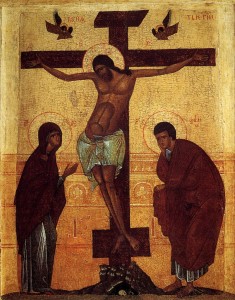
16th century icon

mother.”

After that, knowing that it was finished, he said, “I thirst” – in order to fulfill the Scripture.

He sucked the wine out of the sponge, then proclaimed, “It is finished.”

And then he bowed his head and breathed his last.

Do you hear anything of defeat here?

Any doubt?

Any hesitation?

No!

Because this is John’s Gospel, and in John’s Gospel, Jesus knows exactly what he is doing, every step of the way, every moment of the day.

“It is finished” is not a plea of defeat.

It’s Jesus cry of triumph!

(sing)

Were you there when they pierced him in the side?

Were you there when they pierced him in the side?

Oh, sometimes it causes me to tremble, tremble, tremble.

Were you there when they pierced him in the side?

Now … understanding that in John’s Gospel, Jesus is a determined man on a mission from God … standing there at the foot of the cross with the women and the Beloved Disciple … now tell me, what exactly do you think Jesus meant when he said, “It is finished”?

Yes, Jesus died a terrible, painful, brutal, humiliating death. Do not lose sight of that.

But Jesus didn’t look at it that way – not in John’s Gospel.

For Jesus, “It is finished” is a statement of glory.[2]

As commentator David Lose writes,

“The great irony of John’s passion is that in Jesus we see God’s strength, majesty and might revealed amid the pain and humiliation of crucifixion. … John’s depiction of the Passion of our Lord reminds us that, ultimately, Jesus is Lord. Through him, God overcomes any and all obstacles – including death – in order to redeem and restore us.”[3]

Which means that when we hear Jesus say, “It is finished,” what he’s telling us, from that pain-filled place on the cross, is that his job is over.

He has shown us how to live – in love.

And he has given us a vision – the vision – on which we are called to focus, every moment of our lives.

Everything Jesus did, everything he said, everything he taught, every miracle he performed and prayer he prayed was done in the sure and certain knowledge that this is what God wanted done.

Just as Jesus never wavered, so we are not to waver.

(sing)

Were you there when they laid him in the tomb?

Were you there when they laid him in the tomb?

Oh, sometimes it causes me to tremble, tremble, tremble.

Were you there when they laid him in the tomb?

Yes, we are called to witness the crucifixion this day, to wonder and cry.

And we should be filled with trembling. We should be trembling all over!

Because Jesus just turned the whole job over to us! He’s given us the whole shebang!

Everything he did? All that preaching and teaching and healing and bringing back to life?

He’s done with that.

Now it’s our turn.

Yes, we should be trembling right about now, because now …

… Now we are the ones who have to do what he did, we are the ones who have to take up our own crosses, we are the ones who have to die to all the things that get in the way of our lives in God!

Now we have to preach the Gospel, the Good News of God in Christ Jesus!

Now we have to teach the world how to live in unity and peace, instead of discord and war!

Now we have to heal the sick and bring life – new life – to all those who live in death! We are the ones who are to give hope to the hopeless, who are to love the unloved, who are to fulfill the dream of God.

So yes, we should be trembling right now, because Jesus just put all his work on our shoulders and in our hearts. And that frightening thought should make us tremble!

Robert Fulgham once famously said, “All I really needed to know I learned in kindergarten,” and in many ways, that is true.

But the reality is, everything we really need to know? We learned it all from Jesus.

That’s why Jesus was so triumphant on the cross.

That’s why Jesus said, “It is finished.”

Because his part – his earthly part of teaching us, of training us, of inspiring us? That’s done.

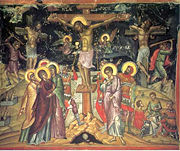
Crucifixion by Theophanes the Cretan

Jesus had a job to do and he did it.

Now, he’s given the job to us – and trusting us to do it.

So, yeah, we should be trembling – heck, we should be quaking in our boots right about now!

Because we have no more excuses.

Jesus was a man on a mission from God, and he wants us to go on that mission as well.

“It is finished”?

It means that from now on, we have to do the work that Jesus did, because Jesus has called us, because Jesus trusts us, because Jesus is counting on … us.

We are on a mission from God, my friends.

It’s not Jesus’ job any more. His part? It is finished. Over with. Done. Fini.

Now? Now it’s all up to us.

Amen.

Sermon for Good Friday, 22 April 2011, Year A, Trinity Episcopal Church, Arlington, Va.

[1] Professor David Lose, Marbury E. Anderson Biblical Preaching Chair, Luther Seminary, St. Paul, Minn., “Commentary on the Gospel,” Good Friday, 22 April 2011,


Share this:
Share this page via Email Share this page via Stumble Upon Share this page via Digg this Share this page via Facebook Share this page via Twitter

Tongues of teachers

Isaiah 50:4-9a | John 13:21-32

God, Isaiah tells us, has given us the tongues of teachers, so the question we have on this Wednesday night in Holy Week is this:

What are you going to teach?

What word are you going to give to sustain the weary?

God has told us the Good News that he wants proclaimed. He has given us the words that need to be spoken, especially in this intense period of time, when we are about to face our deepest fears and experience our harshest terrors and most intense grief.

God has called us – each and every one of us here – to speak the truths that need to be spoken, to proclaim the grace that so many are dying to hear.

This is our holy calling, something of which we need to be reminded in this Holy Week.

For God gave us the tongues to teachers in order that we may speak God’s message of love and reconciliation, of justice and peace. God has given us the tongues of teachers so that we can proclaim to the world, to all of God’s creation, God’s dream for us, a dream of lives lived in love, not hatred; of lives filled with enough instead of lives lived in desperation; of fairness for all the people, and not just the select few.

We have been given the tongues of teachers so that we can teach

… even if it costs us … our jobs, our homes, our families, our freedom, our lives.

And God knows, it will cost us to speak God’s word to the world. We know that it will cost us … because we know the world (and sometimes, remember, that means us) does not want to hear God’s message, does not want to listen to what God wants, does not want to live in love or peace, and refuses to give justice, or even just enough, to those in need.

Jesus knew this particular truth. He knew the powers-that-be did not want to hear what he had to say, because then the powers-that-be wouldn’t be in power, would they? For they would have to give up all that they had in order to received all that God had to give.

So Jesus knew what was coming – he told everyone repeatedly that he would die for what he proclaimed, for what he represented, for what he was.

Facing his death, knowing how awful this whole sad affair would be, Jesus said “Yes” to God. Knowing that it would be painful beyond belief, that he would suffer beyond endurance, he still said, “Yes.”

The Lord God opened his ear, and he was not rebellious, he did not turn backward.

Even when he was betrayed by one of those whom he had called to discipleship.

And this is our call in Holy Week as well:

To be faithful, even when we feel betrayed.

Even when we are mocked.

Even when the world rejects us, spits on us, tries to beat us down.

We have nothing to fear. Isaiah assures us of that, proclaiming:

Who will contend with me? Let us stand up together.

Who are my adversaries? Let them confront me.

It is the Lord God who helps me; who will declare me guilty?

God has called us – each of us and all of us – to proclaim God’s word, God’s will, God’s dream for all of God’s very good creation.

The Last Supper by Simon Ushakov

Our call, especially in this week, this holy week, when much of the world is either looking for chocolate eggs and giant white rabbits or is too frightened and weary to do much of anything but cower in despair, our call is to stand firm in our faith, to proclaim the Word and the love of the Lord to all people, to do the right thing no matter what.

It’s a weary world out there right now, folks. Trust me – bad news batters us daily, the economy scares us, our enemies are trying to terrorize us into submission.

God is calling us to sustain that world.

God has equipped us to do so.

So in this Holy Week, be strong, speak boldly, and live in the love that God has given us.

Amen.

A sermon preach on Wednesday in Holy Week, 20 April 2011, Year A, at The Church of the Good Shepherd, Burke, Va.


Share this:
Share this page via Email Share this page via Stumble Upon Share this page via Digg this Share this page via Facebook Share this page via Twitter

Who are you in this Holy Week?

Matthew 26:14- 27:66

In the past two weeks, I have received news of the deaths of two men who were beloved to me, news that shocked me and caused tears to form immediately in my eyes and in my heart.

One friend was the priest who raised me up to priesthood, who in his sometimes gentle and sometimes gruff ways formed me to be the person and priest I am today. Last Sunday morning, I served at the church where he celebrated for more than two decades, and for the first time I was privileged to sing the Eucharist at the table where he taught me so much. As I sang, I thought of Bob, and I smiled, and later told others, “Now I know why he loved to sing at that table so much – it’s holy.” By the time I finished singing the Eucharist, unbeknownst to me, Bob was in the hospital, having suffered a heart attack.

Three days later, he was dead.

The other man was a friend who had counseled me through some tough times, advised me through some marvelous times, and who could talk baseball with the best of them. Russ had served as the chancellor of the Diocese of Virginia for more than two decades and was beloved by all in that diocese. Whenever we met, he would stop whatever he was doing, turn his full attention to me, bestow that marvelous Southern gentleman smile upon me, and wrap me a hug. He had cataract surgery two Tuesday mornings ago.

At home, resting up afterwards, he suddenly died.

I’ve spent a lot of time thinking about Bob and Russ since they died. I know who they were in my life, but as I grieve their loss, I am left to wonder who I was in their lives.

This, my friends, is an important question for all of us to contemplate, this question of who we are. Who are we in each other’s lives, in God’s life, in Jesus’ life?

It is an especially important question to ask today, on the Sunday of the Passion: Palm Sunday, as we move from exultation to devastation, from life to death.

Who are we – who exactly are we – in this Holy Week?

Take a moment and consider:

Who are you in this Holy Week? …

Are you one of the people cheering Jesus on as he rides into Jerusalem, waving palms and throwing your cloak on the ground, pinning all your hopes on this man, proclaiming him the Messiah?

Is that who you are?

Or are you one of those in the crowd five days later, caught up in the bloodlust, screaming in a frenzy, “Crucify him! Crucify him!”?

Who are you in this Holy Week?

Are you Judas, a faithful disciple – and make no mistake, he was faithful. Jesus called him, Judas followed, and Judas was with Jesus for a substantial portion of his ministry. Judas was there for the miracles and the healings, the preaching and teaching, on the road and in the Temple. He was present at the Last Supper.  And then … he betrayed Jesus … because Judas’ vision of the Messiah blinded him to the vision of the Messiah.

Judas wanted a Messiah all right … but Jesus wasn’t the Messiah Judas wanted.

Is that who you are?

Or are you Simon, now called Peter, the Rock, who like Judas followed Jesus when Jesus came calling, who like Judas sat at table with Jesus and broke bread with him, who like Judas was in the synagogues and on the street, who just like Judas failed Jesus at the most critical moment, and who just like Judas betrayed the Lord …?

Is that who you are?

Perhaps you are Caiaphas, the High Priest, threatened by this upstart, ragged, itinerant preacher, worried that if he continues to preach this scandalous gospel of his, your people might die as a result?

Or maybe you are Pontius Pilate, who is already having a hard time controlling these stubborn Jews who refuse to honor Caesar (for God’s sake, couldn’t they just go along to get along?), worried that if you don’t do something with yet another so-called Messiah, if you don’t satisfy this bloodthirsty crowd, you will lose both your job and your head?

Is that who are you in this Holy Week?

Are you Barabbas, the murderous zealot already condemned to death and suddenly set free, asking no questions, but taking your freedom and running for the hills?

Or are you Simon of Cyrene, the man who came to town to sell merchandise for the high holy days and who suddenly is dragged into this drama and forced to help this man you’ve never met, about whom you know nothing?

Perhaps you are one of the disciples, so committed to the Lord that you gave up everything to follow him everywhere – except to the cross?

Or are you one of the women, risking your very life to stand at the foot of the cross, knowing that Roman law said you, too, could be executed for the crime of simply knowing Jesus?

Maybe that’s who you are!

Maybe you’re one of the thieves crucified with Jesus, one on his right and one on his left, mocking him to the end, because in the end, all three of you are going to die anyway, and you might just as well get in your licks while you can, right?

Or are you one of the Roman soldiers who beat, taunted and crucified yet another unruly Palestinian causing trouble, not caring about who this man is because you are just following orders?

Are you possibly one of the people in the crowd – a chief priest or a scribe or an elder – taunting Jesus because he refuses to save himself, even though he saved so many others?

Is that who you are?

Are you the Roman Centurion and his cohort, feeling the earth move and seeing the rocks split and the tombs come open, and in great terror proclaiming at the last, “Truly this man was God’s Son!”

Or are you Joseph of Arimathea, helping to take down the body of your beloved Jesus, and laying him your own tomb, wracked with grief because all your hopes have come to an end?

Who are you in this Holy Week?

….

On this Sunday of the Passion: Palm Sunday, in this sacred week of our lives, I can tell you who you are. I can tell you who we are.

Each of us, at some point in our lives, is every single one of the players just named in this incredible drama.

At some point in each of our lives, we have rejoiced and shouted the praises of the Lord: Hosanna in the highest! And at some other point, we have rejected God … or wondered where God was … or cursed God … or betrayed God …

At some point in our lives, we’ve all put our families, our wants, our needs, our desires, our dreams ahead of God. We’ve made God wait and we have presumed to tell God that God is wrong …

The good news is, those given moments? They are not God’s final answer to our question.

Because God’s final answer is this:

We are beloved children of God.

We can be faithful stalwarts one moment and falling-down failures the next, but it won’t change the essence of who we are, the core of our being.

We are God’s beloved.

And God loves us so much … so much … that God not only sent his only begotten son to live with us, God sent his only begotten son to die for us. For each of us. For all of us. That’s God’s final answer to our question of who are we in this Holy Week.

My two friends, who died so recently, Bob and Russ?

They taught me a lot of things. They taught me that I wasn’t always perfect, that I didn’t always do just the right thing, that there were days when I fell down and days when my friendship faltered – but because they loved me, they never gave up on me. They never abandoned me.

The same is true with God, and this week, this Holy week, is the week when God teaches us the same thing.

We will not always be perfect – even the disciples weren’t.

We will not always do the right thing – even the disciples didn’t.

We will fall down – like Caiaphas and Pilate.

We will falter in our faith – like Peter and the frenzied crowds.

But God does not give up on us. God does not abandon us just because we have failed in some way, great or small.

As you try to figure out who you are in this holiest and most important week of your life, remember the lesson that my two friends taught me.

Remember that no matter what role you play – that of faithful follower or brave witness or even miserable betrayer –

Remember:

God already knows the answer to our question:

We are God’s beloved.

Amen.

A sermon preached at St. Paul’s Cathedral in Syracuse, N.Y., on the Sunday of the Passion: Palm Sunday.

Share this:
Share this page via Email Share this page via Stumble Upon Share this page via Digg this Share this page via Facebook Share this page via Twitter

Dear Members of Congress: Stop it!

(Written for McClatchy-Tribune News Service)

Dear Members of Congress:

Apparently, you did not receive the last memo I sent you. So I am writing again, in the hopes that perhaps you will begin to listen a little more carefully to the vast majority of the people of the United States, who are tired unto death of the games you are playing.

Trust me on this: We the people despise being held hostage to someone else’s ideology in general, and right now, we truly despise being held hostage to your ideology.

That little game you played last week, taking us to within an hour of shutting down the federal government?

Not good.

And not professional.

Ladies and gentlemen, we did not elect you to go to Washington so you could play games with our lives. And yet, that is exactly what you are doing.

Many of you claim that you want to “balance the budget,” with which we the people in general agree needs to happen.

But we did not ask you to do this on our backs alone!

Do some programs need to be cut? Sure they do. But is anyone up there paying attention to the fact that some of those programs you, in your ideological fervor, are so eager to cut are the very ones that help us, the people?

Think about it: Cut out funding for Planned Parenthood, which some of you knowingly disparage and about which some of you knowingly make up facts (as though we the people had no idea of the truth) so that you allegedly can protect the unborn and allegedly cut the rate of abortions? Really? First, let’s deal with reality: Less than 5 percent of Planned Parenthood’s funding goes to abortions; not 80 percent, as some of you have claimed, not 90 percent, but less than 5 percent! The rest of their funding goes to prevent abortions! So … if you cut that funding? You run the risk of increasing the rate of abortions!

This isn’t balancing the budget.

This is ideological warfare.

Those of you who are proponents of this cut? Stop it. Stop playing games with women’s lives, stop threatening to cut out the very care they need to protect their reproductive health.

Stop it!

And let’s look at another one of your favorite targets: Public broadcasting. Those of you advocating for this loudly proclaim that NPR is too “liberal.” Fine. So be it. That’s your opinion and you are entitled to that.

But if you cut out NPR, scores of radio stations in areas that have no other options will go off the air.

Now let’s think about this: You make this cut, those stations go off the air, and somehow you still think you can get your opinions out? Who is going to air those opinions? There are no other options!

So, please: Stop it. Just because the whole world does not agree with you does not mean you get to control the world.

Stop it!

What about these proposals to cut funding for Medicare and Medicaid and health care and children’s health care and education, that would undermine labor, that would making going to college harder and tell the poorest of the poor, “Tough luck”? You claim to want to build the economy, and yet you are targeting the very things for which people need help. If we don’t get this assistance, how, pray tell, do you think we’re going to be able to build up this economy?

It is hard enough to get a job and keep one these days (and in case anyone has forgotten, let me give you a basic economics refresher: Jobs, jobs, jobs! You want a functioning, healthy economy? Then we all need jobs!). Cut education initiatives, cut out health care, undermine labor, and pretty soon, you won’t have anyone working for you. No work, no pay. No pay, no purchases. No purchases, and boom! There goes the economy again! So please, stop this nonsense.

Stop it!

Oh, and could we talk for a moment about the environment? Do you recall that God specifically, in creation, asked us to be good stewards of God’s creation? (Note, please: That’s what it means to have dominion over the earth and all the creatures upon it – not to harm it recklessly, but to care for it on behalf of God.) And yet you want to cut the power of the Environmental Protection Agency to enforce the laws that you passed, so that corporations can do whatever they want to God’s very good creation?

Tell us, please, how this is good stewardship. Explain to us, if you can, how this will help the economy. Because even we, who are not elected to serve in Congress, know that refusing to care for the environment means that more people will end up ill, with life-threatening, and in some cases, life-taking illnesses.

Surely you understand that this will not help the economy, right? Face it, the more people you have who are ill, the fewer people you have who are working and thus putting money into the economy. From a purely economic standpoint, this is one of the more ridiculous ideas anyone in Washington has had in decades. Economically (and notice, please, that here I am not bombarding you with moral or theological arguments – we’re just talking about money, plain and simple) this is nonsense! It is cutting off our noses to spite our faces. Economically, this is stupid.

So stop it!

And please, tell us: Are you really serious about this idea of permanently extending tax breaks to the wealthiest people in this land? Even when dozens of those people have said that this should not be done? Is there any decent economic reason for this, any rational explanation?

Please do not try to tell us, once again, that when the rich are richer, their wealth will trickle down to the rest of us. We’ve seen these tax breaks for more than a decade now – and two-plus years ago, while the wealthiest were enjoying their gift from the government, our economy tanked!

Where was the trickle down then?

Where has the trickle down ever been?

Stop it!

And while we the people are on such a tear, let’s talk about one more thing:

Stop playing with the lives of the people of Washington, D.C.!

The District of Columbia is not your personal playground. You attached riders to the latest continuing resolution that told the people in D.C. that they cannot spend their own tax money the way they want.

Excuse me?!

Did I miss something?

You can’t do this with your own states, your own districts, so you decide to take it out on the last colony the federal government owns?

This is shameful, ladies and gentlemen, simply shameful.

I know that President Obama agreed to this; shame on him for this as well.

The people of the District of Columbia are not your slaves. They are not colonists, even though they do live with taxation without representation. Just because you are terrified of giving them the vote does not give you the right to muck about in their lives, in their decisions, whenever you need to score an ideological point for your people back home.

So stop it!

Now, listen: You say you want to cut deficits and balance the budget.

We the people agree.

But we want you to do this the right way.

We want you to find the duplication of programs and funding, and find a way to end that.

We want you to stop the ridiculous funding for defense programs that even the Pentagon says it doesn’t want. If the military doesn’t want it, don’t build it!

We want you to stop these ridiculous tax breaks for the richest of the rich, and for the corporations. We want you to close some of those ridiculous loopholes that allow the richest and biggest corporations to pay little or no taxes, while we the people have to pay our fair share (and often what feels like a heck of a lot more than our fair share).

We want you to invest in the future, which is all of ours.

We want you to keep the covenant that you made with us, the people – the average Joe and average Jane – that you will work on our behalf.

And we the people want you to understand: We do not believe that it is a right or good thing, or our wish, that our assistance to our brothers and sisters overseas should be cut. We don’t spend much overseas anyway, not in the overall scheme of things, but what little we do spend has tremendous impact. Those anti-malarial programs? They save lives. The HIV/AIDS initiative? Ditto.

Again, you want to balance the budget on the backs of those least able to afford it, while sparing yourselves (and yes, we do know that many of you qualify for those grand tax breaks you keep extending – don’t think we haven’t put that together). Economically, morally, ethically and theologically, this, too, is wrong.

So stop it!

Stop attacking those with whom you disagree. Stop your ad hominen attacks on those who work for the federal government. Stop talking about “out-of-control federal bureaucracies” as though you had no part in creating them, and no part in running them. Congress created most of these bureaucracies; Congress makes the laws about what they can and cannot do; and Congress throws a fit when something goes wrong.

Hint: You are Congress!

So, please … pleasestop this nonsense!

The Apostle Paul tells us, “We know that all things work together for good for those who love God …” (Romans 8:28a).

We the people would like you, the Members of Congress, to remember this.

We did not put you there to play ideological games. We are not pleased to be held hostage to your egos.

So, one more time:

Stop it!!!

X X X

(The Rev. Lauren R. Stanley is a priest of the Episcopal Diocese of Virginia.)


This column was written for and distributed by McClatchy-Tribune News Service.

Share this:
Share this page via Email Share this page via Stumble Upon Share this page via Digg this Share this page via Facebook Share this page via Twitter

Set free to love and serve the Lord

John 11:1-45

In 1988, a controversial movie, The Last Temptation of Christ, was released. It was based on a novel written in 1960 by Nikos Kazantzakis, and is, in reality, the author’s and director’s great “What if …?” exploration of the life of Jesus. “What if,” they ask, “Jesus had given in to temptations offered him? What if he hadn’t died on the cross?”

I can tell you that many, many people were quite upset about this movie, because it is very challenging to them. The question of “What if …?” forces you to examine your faith, and to examine everything you know about Jesus.

But regardless of how you feel about the movie as a whole, there is one scene in it that is absolutely stunning in its power, the scene of the resurrection of Lazarus.

In this scene, Jesus goes to the grave of his friend Lazarus, the one whom he loved, led by Mary and Martha, followed by his disciples, surrounded by mourners. Once there, he orders the people there to remove the stone at Lazarus’ tomb.

Remember, Lazarus has been dead for four days by now; Lazarus’ sister, Martha, objects, warning Jesus of the stench. (I do so love the King James Version of this Gospel: “Lord, by this time he stinketh!”) And indeed, when some of the men open the grave, the stench of Lazarus’ rotting body causes everyone present to gasp and cover their noses and mouths, and watching, you find yourself waiting for that next scene, showing people becoming ill.

But that doesn’t happen.

Instead, Jesus takes a deep breath, goes to the entrance, to this black hole cut into the side of a hill, says a prayer to his Father in heaven, and calls to Lazarus: “Lazarus, come out!”

Unlike in today’s Gospel, where Jesus cries out in a loud voice but one time, Martin Scorsese, the film’s director, has Jesus call twice, in a much gentler voice: “Lazarus. Lazarus! Come out. Come out!”

But nothing … happens … So Jesus crouches by that black opening of the tomb, staring into the darkness while the silence – and the tension – builds. The only noise is that of the flies, buzzing around the body in that lightless tomb.

For 15 … seconds … nothing happens.

Jesus stares into the darkness and twice more, very gently, calls out: “Lazarus … Lazarus …”

Still, nothing happens … for another … 10 … seconds …

And then … suddenly …

… a hand shoots out of the grave!

Everyone jumps back in shock, including Jesus …

… who then reaches into the grave with a trembling hand, takes Lazarus by his decaying hand, and begins to pull him out. But Lazarus resists and actually pulls Jesus part-way into the tomb. So Jesus uses both of his hands and braces himself and tugs Lazarus out of the darkness of death and back into the light of life …

… Thus proving, in no uncertain terms, that it is never too late …

… It is never too late for Jesus to reach into the darkness of our lives, into the graves in which we find ourselves buried, to resurrect our lives and to give us new life.

It is never too late for Jesus to unbind us from all that holds us in our graves and in the darkness and set us free

Even when we have been in the graves of our lives so long that decay has set in, even then, it is never too late for Jesus, because we are never beyond his reach.

• • •

Russian Icon. The Raising of Lazarus. 15th century. Novgorod school. The Russian Museum, St. Petersburg, Russia

This recounting of Lazarus’ death and resurrection, which appears only in John’s Gospel, is a story of resurrection, of new life, of being set free – by God – from everything that buries us, from everything that binds us, everything that separates us from the love of God in Christ Jesus, everything that keeps us from living the life that God dreams of for us.

Face it, we all spend time in the grave, we all live in darkness at times, we all find ourselves bound up … by fears, by anxiety, by grief and mourning, by despair and loneliness.

This is the Washington Metro area, and we know what it means to live with anxiety. We’ve been stuck at Orange Terror Alert since September 2001. We know that, right? For us, it’s just the norm. But anyone who comes here to visit from someplace that is not under Code Orange wonders if there’s something going on that they should know about.

How many of you pay any attention any more?

And how many of you drive on (Interstate) 95, or 395 or 495, and see those signs, “Report suspicious activity”? Really? How do you define “suspicious”? I’d love to report people speeding and weaving in and out of traffic, but I don’t think that’s what Homeland Security has in mind.

How many of you here ride the Metro? I know we take the Code Orange level for granted, but how would you feel if you saw someone get off one of the trains and leave behind a knapsack under a seat? Would you feel anxious? More anxious than normal?

And how many of you receive a paycheck from the federal government? Or have someone in your family, or know someone, who gets one? Talk about anxiety and fear! I don’t get a paycheck a federal paycheck, and I was checking every 10 minutes on Friday night, waiting to find out if the government was going to be shut down, or if an agreement could be reached. How much anxiety and fear did you experience on Friday, wondering if you would have enough money to pay your mortgage come Tuesday, or whether you would be able to make the down-payment on the tuition so your high school senior could go to the college of her choice? Or feared you would not be able to pay your credit card bill? All because our leaders seem to have forgotten that they are supposed to be servants of the Lord, and are not Masters of the Universe?

And then at the last possible second, just in time for the 11 o’clock news, our leaders announced that they would not shut down the government and we could all breathe a sigh of relief.

Oh, yes, we know anxiety here and we know how it can plunge us into the depths of darkness and feel like a grave to us. We know what it means to be bound up.

But I am telling you, Jesus is standing right here … right here … this very minute, with us, calling each of us by name, reaching into the graves of our lives and pull us out of that darkness, using both hands if necessary, so that we can be restored to the light.

Jesus is right here, because he loves us just as he loved Lazarus.

And he is crystal clear: “I am the resurrection and the life.” And all who believe in him have life … because he loves us.

Now, I don’t want you to leave this place today and say that the preacher told you could wander through life, throwing your arms in the air and proclaiming to everyone, “Jesus loves me! Isn’t life great?”

Because Jesus does not pull us out of the grave just so we can wander around and practice happy-clappy Christianity. Because Christianity is not supposed to be happy-clappy. And for darned sure that isn’t what it means to be an Episcopalian. Resurrection is serious business.

Jesus is the Resurrection and the Life, and he is in our lives, giving us the same gift he gave to Lazarus: new life so that we can go forth into the world to love and serve the Lord!

This new life that Jesus gives us is a life of service. It’s a call to us to delight in God’s will, to walk in God’s ways to the glory of God’s name!

Being set free is not about us – it’s about God and God’s dream for us.

We are set free so that we can exactly what God is calling us to do …

… to feed the hungry and give water to the thirsty …

… to make the blind see and the deaf hear and the mute sing and the lame leap with joy …

… to proclaim the year of the Lord’s favor not once every 50 years, but every year!

Jesus is standing at our graves, my friends. He has said the prayers over us. And he is calling us – each of us – by name.

He is reaching into the darkness of our lives, grasping our already decaying hands and pulling us … tugging us … dragging us out of our graves …

He is taking us out of that darkness that binds us, and setting each one of us free.

He is calling us …

Lazarus!

Lazarus!

Do you hear him?

Amen.

• • •

A sermon preached on the Fifth Sunday of Lent, Year A, 10 April 2011, at St. George’s Episcopal Church, Arlington, Va.

Share this:
Share this page via Email Share this page via Stumble Upon Share this page via Digg this Share this page via Facebook Share this page via Twitter

Let’s be scandalous!

John 15:12-17

Ba ism al Ab wa al Ibn wa Roho al Kudus, Allah wahed.

En nom de Dieu unique, Pere, Fils, et Sancte Esprit.

In the name of one God, Father, Son and Holy Spirit. Amen.

On the morning of Feb. 23, 1992, I was received into The Episcopal Church at St. George’s, Arlington. I had first come to that parish more than a year before, full of fear and trembling, for I was born and bred to the Roman Catholic Church, raised by Dominican nuns, trained by Jesuits priests, and I knew, on that first day I entered St. George’s, that what I was doing was a sin. I was turning my back on my heritage, my ethnicity, my training and my faith as a Catholic to worship – fully and freely – in a Protestant church.

On that morning in 1992, I listened carefully as The Rt. Rev. Peter James Lee, the 12th Bishop of the Diocese of Virginia, preached about what it meant to be a Christian.

“To be a good Christian,” he said, “you have to be boundlessly happy, entirely fearless and always in trouble.

To be a good Christian – one who lives fully into the scandalous message of Jesus – you have to be boundlessly happy, entirely fearless and always in trouble.

You are boundlessly happy, my friends, because God loves you, and what more could you possibly want to know, to experience, in your life? Isn’t that what we all want to know: That we are loved, from before time until the ages of ages?

The good news that Jesus brought in his scandalous message is just that: You are loved. I am loved. Each of us is and all of us are loved. Which makes us happy.

You are to be entirely fearless because the worst thing that will happen to you is that you will, one day, wake up and have breakfast with Jesus. And isn’t that what we pray for each time we pray the Nicene Creed? That we will have breakfast with Jesus?

The good news that Jesus brought us in his scandalous message is that because we are loved, we will indeed have breakfast with Jesus. So be fearless!

And you are to be always in trouble because, let’s face it, Jesus was always in trouble. It’s why his message of unconditional love was so scandalous. The sermons he preached – “Today the Scripture has been fulfilled in your hearing.” – the miracles he performed – raising the dead, curing the sick, restoring lepers and shamed women to full membership in their communities – the parables he told – And who is your neighbor? – the people with whom he spoke and ate – the Samaritan woman at the well, Wee Zaccheus the tax collector – all of that was troubling to the powers-that-be, because the powers-that-be don’t like surprises, they don’t like having the apple cart (OK, it was probably a date cart) upset, they don’t like it when someone comes along and challenges the way things are. Because when the way things are are thrown out of whack, the powers-that-be no longer are in control, and that is very, very scary – for them.

The good news that Jesus brought us in his scandalous message was so troublesome that it cost him his life – and it is going to cost us ours as well, if we listen, if we act.

But not to worry: Because we are loved from before time began to the ages of ages, and because we will have breakfast with Jesus, so ….

Let’s get in some trouble.

Let’s be scandalous!

You know what the most scandalous thing was that Jesus said?

Listen, my friends … listen:

This is my commandment, that you love one another as I have loved you. No one has greater love than this, to lay down one’s life for one’s friends. You are my friends if you do what I command you. … You did not choose me, but I chose you. And I appointed you to go and bear fruit …

(Sung)

Will you come and follow me if I but call your name?

Will you go where you don’t know and never be the same?

Will you let my love be shown?

Will you let my Name be known?

Will you let my life be grown in you and you in me?[1]

This is our call in life, my friends: Following Jesus, who is calling us – each of us – by name, asking us to go to places we don’t know – far away or close by – so that God’s love can be shown, so that God’s name can be known, so that God’s life can be grown.

And that, my friends, is scandalous!

Because it means that if we are faithful, we will end up in places we have never been (Samaria? Sudan? Haiti? The poor side of town? The other side of the tracks?) … we will meet people we never thought we would meet (The Samaritan woman at the well? The poor? The sick? The disenfranchised? Those people?) … we will let God’s name be known (as St. Francis is alleged to have said, “Preach the Gospel always … if necessary, use words.”) … and if we do all these things, God’s life, God’s love will be known.

Are you ready to live your life in this way?

Are youeach of you and all of you – ready to be scandalous?

(Sung)

Will you leave your self behind if I but call your name?

Will you care for cruel and kind and never be the same?

Will you risk the hostile stare should your life attract or scare?

Will you let me answer prayer in you and you in me?[2]

If we decide that we are ready to say “Yes!” to Jesus, to answer his call, to live scandalously, upsetting the apple carts and overturning society’s ways – ways that make the rich richer and the poor poorer, ways that deny basic medical care to people, that leaving people starving when our storebins are overflowing – if we’re ready to do all this, then indeed we will live scandalous lives.

Mother Teresa, who knew a thing or two about being scandalous (touching the untouchables, welcoming the unwelcomed, loving the unloved),

Mother Teresa

offers us this advice:

The good you do today (she said) may be forgotten tomorrow.

Do good anyway.

Honesty and transparency make you vulnerable.

Be honest and transparent anyway.

What you spend years building may be destroyed overnight.

Build anyway.

People who really want help may attack you if you help them.

Help anyway.

Give the world the best you have and you may get hurt.

Give the world your best anyway.

I can assure you: The most radical thing we can do in our lives is to love. The most dangerous action we can take is to love. The most scandalous deed we can perform is to love.

But … radically, dangerously, scandalously loving one another as Jesus loves us is exactly what we are called to do … no matter how hard it is, no matter how many obstacles we encounter, no matter what other people say, because really, in the end, the only thing that matters is love.

Doing this will not be easy. We will try to love, and find our love rejected. Others will heckle us and wonder if we’ve lost our mind and our way. We will be accused of tilting at windmills and called Pollyanas. But we know what Jesus is calling us to do, don’t we? We know that we are the ones who are called …

… to make the blind see, the deaf hear, the mute sing, and the lame leap for joy! And yes, we are called to raise the dead, and to proclaim the year of the Lord not every 50 years but every year, to set the prisoners free!

In this case, with this charge, it really does become all about us, because Jesus is talking to each one of us. This is not a message for the guy next door, the stranger down the street or around the world. This is a message for us.

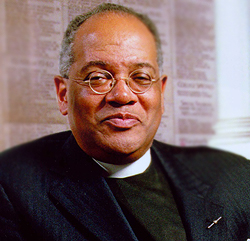
The Rev. Dr. Peter J. Gomes

Peter Gomes understood that. Listen to what he has to say on this subject, this subject of God calling us:

The question should not be “What would Jesus do?” but rather, more dangerously, “What would Jesus have me do?” The onus is not on Jesus but on us, for Jesus did not come to ask semi-divine human beings to do impossible things. He came to ask human beings to live up to their full humanity; he wants us to live in the full implication of our human gifts, and that is far more demanding.[3]

God is calling us. God is telling us – again and again – that we are not created to live in a world where the people are hungry, either for food or for love. We, my friends, are created in the image of God, which means that we are created to live in love in community.

Being created in the image of God means, first and foremost, that we are created in the image of love. We know this because we know that we are not necessary to God. God is necessary to us, yes, but we cannot possibly be necessary to God, because God was before we were, and God will be after we are, so God does … not … need … us. Therefore, God must have wanted us, God must have desired us, God must have loved us into being.

And being created in the image of God means that we are created in community because we are Christians, and in our understanding of the Scriptures, of the Word of God, God the Father, God the Son, and God the Holy Spirit never work apart from each other. Since we are created in God’s image, we are created in the image of community as well.

Which means …

… That we are created in love and community to live in love and community.

Pretty scandalous, eh?

To have our whole lives dictated by the fact that like it or not, we are created to love? That we are created to love in community?

Now we could, if we wanted, be like one of my favorite literary characters and say, “It is hard to be brave,” said Piglet, sniffing slightly, “when you’re only a Very Small Animal.”

Because this is a seemingly overwhelming call that God is issuing to us.

It is hard to be brave …

But … unlike Piglet, we are not very small animals.

We are God’s beloved.

And we have a job to do, a mission to undertake: We are to love one another, not as just we love ourselves (trust me, on those days when I do not love myself, it is terribly easy for me not to love my neighbor!), but to love one another as Jesus loves us!

(Sung)

Will you let the blinded see if I but call your name?

Will you set the pris-’ner free and never be the same?

Will you kiss the leper clean, and do such as this unseen?

And admit to what I mean in you and you in me?[4]

Living scandalously, is not, as I said, easy. But it is our call, it is, in fact, the very reason for which we were created, it is our mission in life. This is why God put us on this earth: to live in love and community, which is a very scandalous thing indeed.

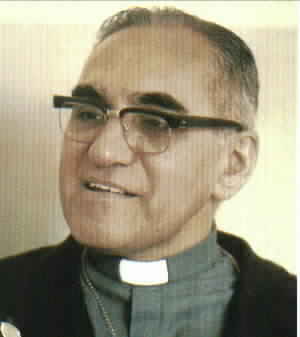
I want to leave us tonight with a prayer by Archbishop Oscar Romero, the holy man of El Salvador who put his life on the line – and who lost his life

Archbishop Oscar Romero

– because he dared to live a scandalous life, siding with the poor and downtrodden, challenging the powers-that-were in El Salvador to do the right thing all the time. For his courage, he was killed while celebrating the Eucharist – literally while elevating the wine and saying, “This is my blood” – on March 24, 1980.

Archbishop Romero’s prayer for all of us:

It helps, now and then (he said) to step back and take a long view.

The kingdom is not only beyond our efforts, it is even beyond our vision.

We accomplish in our lifetime only a tiny fraction of the magnificent enterprise that is God’s work.

Nothing we do is complete, which is a way of saying that the Kingdom always lies beyond us.

No statement says all that could be said.

No prayer fully expresses our faith.

No confession brings perfection.

No pastoral visit brings wholeness.

No program accomplishes the Church’s mission.

No set of goals and objectives includes everything.

This is what we are about:

We plant the seeds that one day will grow.

We water seeds already planted, knowing that they hold future promise.

We lay foundations that will need further development.

We provide yeast that produces far beyond our capabilities.

We cannot do everything, and there is a sense of liberation in realizing that.

This enables us to do something, and to do it very well.

It may be incomplete, but it is a beginning, a step along the way, an opportunity for the Lord’s grace to enter and do the rest.

We may never see the end results, but that is the difference between the master builder and the worker.

We are workers, not master builders; ministers, not messiahs.

We are prophets of a future not our own.

Archbishop Romero’s prayer for us is my prayer for you:

Go forth from this place, my friends, and be scandalous.

It is what Jesus wants.

Amen.

A sermon preached during the Preaching Mission: The Scandalous Gospel of Jesus, at Grace Episcopal Church, The Plains, Va.,

28 March 2011.


[1] Will you come and follow me … (v. 1) Words from the Iona Community © 1989 GIA Publications

Music Mary Alexandra, John L. Hooker, © 1996

[2] Ibid. (v. 2)

[3] Peter J. Gomes, The Scandalous Gospel of Jesus, page number uncertain.

[4] Will you come and follow me … (v. 3)


Share this:
Share this page via Email Share this page via Stumble Upon Share this page via Digg this Share this page via Facebook Share this page via Twitter

Being known … and still loved

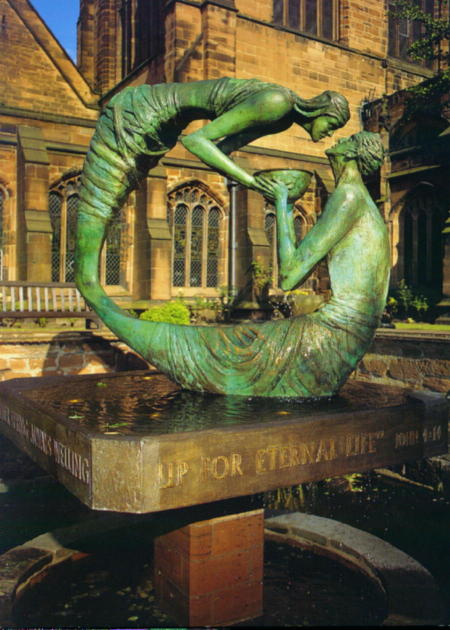
Stephen Broadbent's "Samaritan Woman at the Well," sculpture at Chester Cathedral, England. Sculpted in 1994.
How often have we looked at someone and in that one look, made a snap judgment, placing that person in her place because of the way she dresses, deciding that because he is so good-looking, he must be a good guy?

And how often have we had someone take one look at us and make a snap decision about who we are, because of how we look, where we are, how we act in that one second of our lives?

“You could just tell that she was …”

“I knew just looking at him …”

Snap judgments, we call them.

No matter how many times we discover — later on — that we were wrong, that the scruffy-looking one had a giant heart for helping others, that the good-looking one was really a cad, we still make snap judgments about people all the time.

The first day I dared to venture out on my own in Haiti – completely on my own, with only my newly learned Creole and my bravado to accompany me – I made it only one block before I was surrounded by Haitian men.

“Miss! Miss!” one very tall man yelled. “Buy my painting?”

Soon every single one of these men was saying the same thing: “Miss! Miss! Buy my painting? No, buy mine! I give you a very good price. American money, no problem!”

These men, who had never seen me before and who presumed that because I am white I was (a) American, (b) rich, (c) willing to part with my money, and (d) willing to part with way too much of my money because I was (a) American and (b) rich, made a snap judgment about me. They never asked my name. They never engaged me as a real person.

To them, I was merely a quick buck – a buck they desperately needed, to be sure, so that they could support themselves and their families – but a buck nonetheless.

When Jesus and the Samaritan woman met at Jacob’s well in Sychar, there was a whole lot of snap judging going on.

The woman made snap judgments about Jesus:

•Just another man used to ordering women around;

•An outsider (she didn’t know him, and trust me, in small villages, everyone knows everyone);

•A Jew (most likely because of his dress and perhaps his accent – otherwise, Samaritans and Jews pretty much looked and sounded alike);

•And therefore an enemy of sorts (Jews and Samaritans hadn’t gotten along for almost 600 years, ever since the Babylonian exile – it was an old theological argument about whose worship was better, purer, truer, more faithful …).

The disciples, who show up a tad later in the story, made their own snap judgments about the woman:

•A woman and therefore a lesser human being (sorry, ladies, that was a fact in the days when our Lord and Savior walked the earth);

•An enemy of sorts (remember what I said before about Samaritans and Jews – we’re talking about almost six hundred years of enmity here …);

•A brazen woman (men and women did not speak to each other in public if they didn’t know each other, and since Jesus was their Lord and Teacher, she obviously must have been the one to initiate the conversation, which only a brazen woman would have done);

•And an outsider in her own village (she was drawing water alone, something that women do in groups for all kinds of reasons, the first being the community that forms when people are doing arduous work together).

And Jesus? Well, he, too, made a snap judgment. But his was of a different sort, for he looked at this woman and instantly – instantly – saw who she was and what she was:

Jesus took one look and knew that she was a beloved child of God, in need of all the love and affirmation that only God could give her (because, obviously, her community wasn’t showering her with its love).

It was Jesus’ snap judgment that counted in the end … that overruled the snap judgments of both the woman and his disciples, that declared that despite what the woman thought of herself, despite what the disciples thought of her, despite what anyone thought of her, this woman was a beloved child of God.

So this woman, who came to the well to slake her physical thirst – to satisfy her need for actual water – ended up having her spiritual thirst, her need to be known and loved, satisfied instead.

She already was known – oh, my, was she known in Sychar. Everyone knew that she had had five husbands and was now living with another man – without benefit of marriage. Everyone knew that obviously, she had sinned in some way, for why else would she have been widowed so many times, or divorced so many times, or some combination thereof? And everyone knew that since she by living with a man without benefit of marriage, she obviously was a sinner!

But she didn’t want to be known that way. I mean, who would? Who wants to go through life having others look at you and find you wanting, in just a glance? Who wants to be thought of as a lesser human being, as a sinner, because of circumstances beyond your own control? Who wants to feel unloved in a world in which love is in such short supply as it is?

This Samaritan woman at the well? She was dying of thirst for a little bit of love. And here comes Jesus – an outsider himself, traveling through a foreign land – who looks at her and instead of finding her wanting, knows her to be a beloved child of God, loved from before time until the ages of ages.

He knows her story, he knows her life, so well … he knows that what she wants more than anything else is to know that she is loved, despite the circumstances of her life, despite any choices she has made, despite any sins she has committed. Jesus knows that God looks at her and makes God’s own snap judgment: I love you.

My friends, the bad news is: God knows you. God knows everything about you … everything.

The good news is: God knows you. God knows everything about you … everything.

And God still loves you.

Exactly as you are …

Even when you make mistakes …

Even when you sin …

Even when others do not appreciate you …

Even when others shun you …

God still loves you.

The only snap judgment that God makes about us – about each of us – is that we belong to God. And because we belong to God, we are known … and in that knowing, we are loved.

You want to slake the thirst you have, that we all have, to be known and loved?

Well, know this:

God knows you and God still loves you.

Now, I don’t want you leaving this place today and going home saying, “The Episcopal preacher at church said today that we can do whatever we want, because God loves us.” No! Don’t say that, because God does judge us! God has high standards for us. God’s desire, God’s dream for us, is that we become the people God has created us to be: People who love. People who love God, people who love each other, not just as ourselves (that’s hard enough to do on the days when we love ourselves, but on those days when we don’t love ourselves? Well, on those days, it’s really easy not to love our neighbors), but as Jesus loves us.

Which means that God wants us to live our lives as God’s beloved children in God’s community of beloved children.

Not by looking at each other and making snap judgments based on societal standards that could not care less about what God wants.

Not by shunning each other.

But by caring for each other.

By loving each other.

It’s a tall order, isn’t it? To love one another as Jesus loved us, as God loves us?

Living lives of love means that we have to stop making snap judgments and start living in community. We have to talk with each other. We have to listen to each other. We have to get to know each other, not on the surface, not by our looks or our dress or the color of our skin or our accents … but deep down, by our stories.

Because only then can we really know each other. Only then can we really love each other.

• • •

Patrick, Frantzy and Tony Fleresca, my good friends in Haiti.

Those young men on the street in Haiti, the ones who surrounded me and tried to sell me their paintings, who viewed me as nothing more than a quick buck to be made?

Their names are Frantzy. And Tony. And Patrick. And Enil and Hercules. And Ernest and Salwa and the other Enil …

After I convinced them that I was not going to buy art from them, that I lived there now and was not a rich American tourist or aid worker but a missionary and priest, we started to get to know each other. We told each other our stories. We began to look out for each other. We began to take care of each other.

When we stop looking at each other as objects and start getting to know each other, start learning each other’s stories … well, that’s when we begin to live into the image in which God has created us, an image of love and community.

Trust me:

God knows our stories.

And God still loves us.

And if that knowledge doesn’t slake your thirst, doesn’t satisfy your deepest needs, I don’t know what will.

We are known.

And we are loved.

Amen.

A sermon preached on the Third Sunday of Lent, 27 March 2011, Year A, at Bensalem United Methodist Church, Bensalem, PA.

Share this:
Share this page via Email Share this page via Stumble Upon Share this page via Digg this Share this page via Facebook Share this page via Twitter

The MDGs: This is God calling!!

Keynote address for the Diocese of Southwestern Virginia’s Millennial Development Goals Day 2011

One of the reasons I believe I was asked to be your presenter this morning is not just that I served as an Appointed Missionary in Haiti, nor that I served as an Appointed Missionary in Sudan … but because I have lived at the other end of the MDGs, the Millennial Development Goals, that I have seen the power and the hope that come from these goals, and that I can stand here, as a witness to tell you:

It is good.

It is good … that we gather here this morning to learn more about the MDGs, to spend time together discerning how we can help meet these goals, to network with each other so that our efforts are not overlapping or duplicated.

It is good … that we are listening to God’s call to us, through Moses and the Law and the Prophets, through God’s only-begotten Son, Jesus Christ, whom we follow.

It is good … that we center ourselves in this call, and discern how we are to live our lives through that call, not just until 2015 (which the United Nations set as an initial deadline when it developed this program), but for all of our lives.

Yes, indeed, my friends, it is good that we are here this morning, listening to God’s call to us.

Before we go any farther, I want to show you a movie on the MDGs, an overview, if you will, with all the statistics you will ever need to know. Afterward, I want to take some of your questions and see if together we can answer them, so that all of us have a common understanding of the goals and of what we as a community of God’s beloved children are attempting to accomplish. If someone could turn off the lights, please?

(Show Achieving the Millennial Development Goals – movie on YouTube)

Now, let’s spend some time on this idea that the Millennial Development Goals are God’s call to us.

To understand this better, let’s go back to the beginning, back to before there was a need for these goals, back to when God first called us.

In the beginning, after God created the heavens and the earth and all that is in them – the birds of the air and the fish of the sea and the cattles of the land – God created humanity. God said, “Let us make humankind in our image, according to our likeness;” … So God created humankind in his image, in the image of God he created them.”

Theologically, this means that being created in God’s image is the imperative behind our involvement in the MDGs, for to be created in God’s image is to be created first in the image of love, and what are the MDGs if not a visible sign of God’s love for all of us? We know that the first image of God is love because we are not necessary to God. God is necessary to us but we are necessary to God, for God was before we were, and God will be after we are, so we cannot possibly be necessary to God. Which means that God wanted us, that God desired us into being, that God loved us into being. So the first image in which we are created is one of love.

Because we are Christians, the second image of God in which we are created is one of community, for God the Father, God the Son and God the Holy Spirit never act independently of each other. In our reading of the Scriptures, all three persons of the Trinity are present from before the beginning, and they always work together. Which means that we are created in that image, the one of community, as well.

So what it all boils down to is this:

God created us in love and community to live in love and community.

And does that not sound exactly like the MDGs?

Isn’t living in love and community exactly what the MDGs hope to accomplish?

If you spend any time at all in the Scriptures, you will see that God indeed intends us to fulfill everything that the MDGs call for:

End poverty and hunger? How often does God call us to care for the needy, to not reap to the very edges of our fields, or gather the gleanings of our harvests, but instead shall leave them for the poor and for the alien? (Lev. 23:22)

Universal education? Does not God say that we are to put these words of God’s in our hearts and souls, that we are to teach them to our children, talking about them when we are at home and when we are away, when we lie down and when we rise? (Deuteronomy 11:18)

Gender equality? I know … there are many who would claim that the Bible says nothing about women being equal, but those who say that seem to ignore the fact that when God created humankind in the first chapter of Genesis, God created them, man and woman, in God’s image. I can’t give you a better example of all people being created equal than that.

Health care for both mothers and children, and combating HIV/AIDS? These are calls for basic health care for all people, especially for those who are considered the least of our brothers and sisters. God is clear that we are to care for the widow, the orphan and the stranger in our midst – in essence, to care for those whom society has deemed lesser. And hard as it is for us to hear this, in much of the world, women, children and those infected with HIV/AIDS are considered to be either lesser creatures or outcasts. Isaiah told us, and Jesus repeated it to us, in case we weren’t quite clear on the concept, that we are to give sight to the blind and hearing to the deaf and voice to the mute, that we are to make the lame leap for joy and yes, we are to raise the dead. Clearly God wants us to perform miracles … health care for mothers and children and those infected with HIV/AIDS in many countries – including our own, by the way? – that’s a miracle in and of itself.

Sustaining the environment? Did not God tell us to fill the earth and subdue it, and to have dominion over it and over all of God’s creatures, and does not dominion really mean not that we are to lay waste to creation or harm God’s creatures, but rather that we are to be good stewards of creation?

And finally, global partnerships. Is this not what it means to live – truly live – into the image of God in which we are created? To live in love and community?

Author and theologian Frederick Buechner, in his book Wishful Thinking, wrote:

We have it in us to be Christs to each other and maybe in some unimaginable way to God too—that’s what we have to tell finally. We have it in us to work miracles of love and healing as well as to have them worked upon us. We have it in us to bless with him and forgive with him and heal with him and once in a while maybe even to grieve with some measure of some grief at another’s pain and to rejoice with some measure of his rejoicing at another’s joy almost as if it were our own. And who knows but that in the end, by God’s mercy, the two stories will converge for good and all, and though we would never have had the courage or the faith or the wit to die for him any more than we have ever managed to live for him very well either, his story will come true in us at last. (p. 89)

We are called – and we are capable – of working miracles of love and healing in this world. We have it in us to bless each other, those whom we know and those whom we have never met and will never meet.

But that’s part of the problem, isn’t it?

The fact that we don’t know the people we are asked to help?

The fact that we probably never will meet them?

Never mind the fact that this whole MDG thing is so darned huge – so overwhelming – that it’s hard to wrap our hearts and minds and arms around it. (Face it: We are talking about changing the entire world here … the MDGs are probably the boldest vision ever set forth by the United Nations, by the 181 nations taking part in the program, which means that basically, this program is humongous.)

Sometimes, it’s hard to keep the momentum going on a project like this because we don’t know the people. We don’t know their names. We don’t know their stories. And because we don’t know their names or stories, there is a tendency to let our brothers and sisters in Christ, who are related to us not by the blood of their birth but by the waters of their baptism, to let all of God’s beloved children, slip onto the back burner of our lives. Without names, without stories, it’s hard to connect.

And if we can’t connect, we certainly can’t live as fully as possible into the image of God, can we?

One of the main questions we have to answer, not just today but every day of our lives, is how we are going to help make God’s dream – which theologian Verna Dozier identified as “a good creation of a friendly world of friendly folk beneath a friendly sky” – how are we going to make that come to fruition if we don’t know with whom we are walking under those friendly skies?

For many of us, these goals are, as I said, just too darned big. We want to take part … we want to make an impact … but … but … how? We’re just a few people (in the greater scheme of things) and there is so much need … what are we to do?

The best way to approach the needs of the world is to forget that these are the needs of the entire world, to stop thinking we need to save the world (that’s already been done, my friends, 2,000 years ago, outside the gates of Jerusalem) and to concentrate on what we can do, individually and corporately.

Remember, our mission is to live in love and community.

So let’s figure out how to do that … how to live in love in the community we have been given.

We are called to approach caring for all of God’s beloved children – no matter where they are, no matter their tribe or color or race or language or gender or faith – with the advice of Mother Teresa (a woman who knew something about taking on seemingly impossible tasks) ringing in our ears:

The good you do today (she said) may be forgotten tomorrow.

Do good anyway.

Honesty and transparency make you vulnerable.

Be honest and transparent anyway.

What you spend years building may be destroyed overnight.

Build anyway.

People who really want help may attack you if you help them.

Help them anyway.

Give the world the best you have and you may get hurt.

Give the world your best anyway.

In other words, do not worry about saving the world — that’s already been done, 2,000 years ago, on a Friday afternoon, about 3 o’clock, outside the gates of Jerusalem. Worry only about doing your part to live in love and in community, for that is how God created you.

A life well lived is not a life of complete and total success my friends. It is, rather, a life of trying. A life of falling down and getting back up. It is, most of all, a life of loving.

The MDGs? They’re not so much about success as they are about love. About loving others whom we do not know and might never meet, about building up community, about re-orienting the world away from power and dominion to love.

So how do we do this? How do we handle this monster task, with all its frustrations?

Listen to the late Rev. Peter J. Gomes, the Plummer Professor of Christian Morals and Pusey Minister in the Memorial Church of Harvard University, who preached:

The question should not be, “What would Jesus do?” but rather, more dangerously, “What would Jesus have me to do?” The onus is not on Jesus but on us, for Jesus did not come to ask semidivine human beings to do impossible things. He came to ask human beings to live up to their full humanity; he wants us to live into the full implication of our human gifts, and that is far more demanding.

God is not asking us to do impossible things.

God is asking us to do the simple things: To live in love and in community – which is why we are created! This is our mission in life. The MDGs? Those are just one path among many that we can take as we strive to do that which Jesus asks us to do.

We cannot, in our short time together today, answer all the questions, raise all the money or solve all the problems that the MDGs face.

What we can do together this day, however, is meet some people. We can meet each other, and we can meet people who are on the receiving end of the MDG work we do.

In other words, let’s make the MDGs personal.

Instead of approaching them as this humongous set of ideas and instructions that no one, not even a government, can fully embrace, let’s approach this the way God does. Let’s look at the situation through God’s eyes.

Let’s look at the people.

(Show movie, Not Strangers, But Friends – link to the movie)

(Narration to accompany the movie:)

The people you are see here are my friends – and through me they are your friends … in Sudan, in Haiti, in Honduras. They are people who have benefited from your generosity.

I want you to know:

Every time you go a fund-raiser for the MDGs, however you do it and for whatever goal you have chosen, you are not raising money for a stranger. You are raising this money

for a friend.

The people you see in this movie? I have lived with them. I have broken bread with them. We have worshipped together. We have laughed together. We have cried together. They are my family. And because I know them, and you know me, you know them as well.

Some of these students? They receive their education through your generosity … through your support of various organizations and churches. Some of these children attend schools sponsored by UNICEF. Some of them receive food from the World Food Program. Many of them have received help directly from your parishes.

These women? Many of them received help from parishes in this diocese, including for a microfinance project. And your support of health clinics.

Every time you give in a way that is connected to the MDGs, you help these people and so many others just like them.

These are not strangers.

These are your friends.

(End narration.)

I want to be crystal clear about one thing:

God is calling us to live in love.

God is calling us to live in community.

God, who called us into being because God wanted us, desired us, calls us to live in “ a good creation of a friendly world of friendly folk beneath a friendly sky.” A

And the only way we are going to be able to do this is if we all decide that God is right, that God knows what God is doing, and that it is possible to make sure that the hungry are fed and the thirsty given water and the sick have medicine and that our children are educated and HIV/AIDS is finally, finally, finally at least controlled until it can be wiped out … that we remember that God made each and every one of us, that God called each of us into being, that we are all members of God’s beloved community, which means that we are all equal, and that we will thrive only when we all work together, and finally, that we show respect to God for the wondrous things that he has made, including this fragile earth, our island home.

In Washington, D.C., between the end of the Memorial Bridge and Arlington Cemetery, there is a memorial to the Seabees, the U.S. Naval Construction Battalions, who build things under fire and in horrific conditions because that is what they do: they build.

At the base of the memorial, you will find this motto:

With willing hearts and skillful hands, the difficult we do at once;

the impossible takes a bit longer.

My friends, God has given us the skills we need to do everything that God has ever asked of us. Nothing is impossible with God, and God makes sure that in the end, nothing will be impossible for us.

We have the gift of faith.

We have the gift of courage.

We have the gifts of foresight … and planning … and imagination.

The MDGs are difficult – no doubt about it.

Impossible? So what? That just takes a little longer.

Amen.

• • •

Millennial Development Goals Day Keynote Address, 19 March 2011, The Diocese of Southwestern Virginia, St. John’s Episcopal Church, Waynesboro, Va.

Share this:
Share this page via Email Share this page via Stumble Upon Share this page via Digg this Share this page via Facebook Share this page via Twitter