Of puppies and missionaries …

This column was written for and ran on EpiscopalCafe.com on 21 April 2012.

We have a new addition in our household, a giant-pawed Great Dane puppy named Julian.

Julian at 10 weeks, right, with her Cavalier King Charles "brother" Gabriel.

She came into our lives recently as a 10-week-old, gangly, runt-of-the-litter, Brindle-colored baby and immediately wriggled her way into our hearts and minds.

Watching her adjust to her new surroundings, with three new people and two new dogs (who are, as they constantly remind us, Not. Amused.) reminds me of missionaries and the adjustments they go through when they arrive in a new land.

Just as missionaries need to leave behind all whom they love to live with new people, whom hopefully they will come to love, Julian had to leave behind her sire and dam and three brothers, as well as the breeders.

Just as missionaries have to learn to live in new housing situations (sometimes mud huts, sometimes tents, sometimes very Western-style apartments), Julian has had to learn to live in our house, which is very different from the farm where she was bred and spent the first 10 weeks of her life.

Just as missionaries need to learn a new language, with all of its colloquialisms, Julian is learning her own new language: “Come. Out. Sit. Down. Off. No bite. Leave it. No. Good girl!” It is not easy for missionaries or puppies to untangle the nuances of new languages.

You go into a new place, and everything is new: the people; the food; the customs; the language. It doesn’t matter if you are a missionary or a puppy, there’s still a lot of learning going on, and every day is a day of discovery.

Her first night with us, Julian did what most every puppy does when it was time to go to bed: She cried. She sat in her crate, with blankets and toys, and whimpering and cried for a long, long, long time. Eventually, she slept, mainly because she was so very tired.

My first night as a missionary in Sudan? I cried as well. Even though I had worked like the dickens to get to Sudan, even though I really, really wanted to be there, I still cried. Everything was new and foreign and I was so very far from all that I knew and loved. Like Julian, I cried myself to sleep that night. (And did so again when I moved to Haiti, four years later.)

No matter how hard you try, as a new person in a new place, you make mistakes. You go to the wrong places, say the wrong things, do the wrong things at the wrong time. Anyone who has had a puppy knows that puppies do all that – and more – all the time. Missionaries and puppies are constantly learning, constantly striving, constantly attempting to please, to fit in, to not be seen as an “outsider” who doesn’t belong there.

Julian at 6 months ... still growing.

Every day is a day of discovery and adventure, of new things to do, new people to meet. Every day also presents new opportunities to make mistakes, to get lost, to realize that what you “know” may only be what you thought you knew.

The more I watch this Great Dane puppy, the more I see my life as a missionary. Things that scared me at first, or that seemed too hard to do, became so normal that they stopped meriting a mention.

Julian grows at an astonishing rate. Where once she was the same size as the 10-year-old spaniels, she now towers over them. Where once she was confused and timid, she is now confident and bold. She still stumbles around a bit – she’s growing into her body, we like to say – but she stumbles a lot more boldly than when she first arrived. She knows she is loved and cared for, which gives her the confidence to go forth into the world, seeking new adventures, new friends, new challenges.

My life as a missionary was much the same. There was constant growth (not physically; I’d already grown into my body). I, too, was timid at first, and made lots of mistakes, not understanding what was happening to me or around me. But the longer I stayed, the more I learned, the bolder I became, and as I grew bolder, I was more willing to even more new things.

Yep, welcoming Julian into my life has made me realize: Missionaries could learn a lot from watching a puppy. Their lives are, more than I ever realized, so very similar.

Share this:
Share this page via Email Share this page via Stumble Upon Share this page via Digg this Share this page via Facebook Share this page via Twitter

It’s our turn

Luke 24:36b-38

Jesus doesn’t pull any punches, does he?

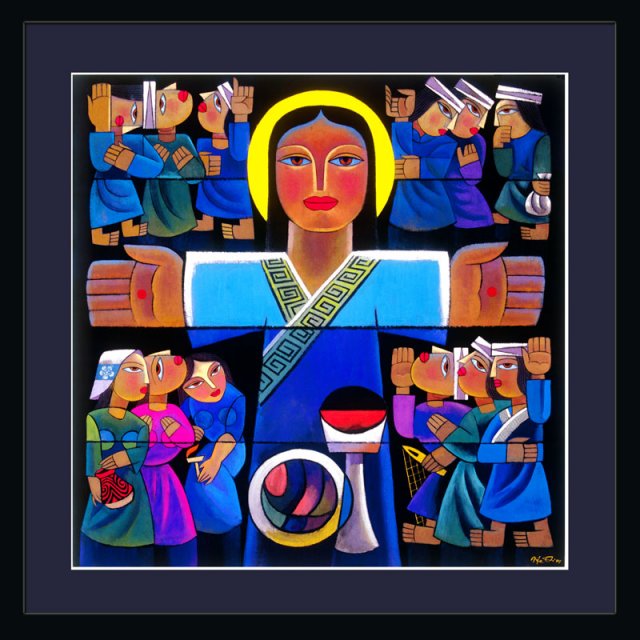
The Risen Lord, by He Qi

Here the disciples are, deep in shock and mourning because their Teacher, their Lord, the man they thought was their Savior, is dead … and two of their group are telling them this fantastical story about how they met the Risen Lord on the road to Emmaus, and boom! There’s Jesus … right … in … front … of … them!

Good Lord, they thought they were seeing a ghost!

How can this be?!

They saw (although from a distance) Jesus die on the cross!

They saw (again, from a distance) Jesus’ body laid in a tomb!

They’ve been in hiding for three days – three days! – because they know the Romans are really good at rounding up “known associates” and hanging them on crosses, too – just to teach the rabble a little lesson, don’t you know …

And, boom!

There’s Jesus, standing right in front of them!

And how does he comfort them?

But telling them, in essence: Your turn!

You are the witnesses, he says, to all these extraordinary things that happened when I was with you.

And you are the witnesses to the fact that here I am with you now, raised from the dead.

I’m not a ghost, he says, not a dream.

I am risen!

And now it’s your turn …

So go on. Get out of here. Go tell the story.

You.

And you.

And you.

You are the witnesses.

And I, the Risen Lord, am counting on you.

• • •

I am confident this is not what the disciples wanted to hear.

When you get right down to it, they have never been the ones to do all the work, have they?

After all, Jesus performed the miracles.

Jesus preached.

Jesus taught.

Jesus healed.

And now he’s telling them it’s their turn?

Their turn to tell the story, to witness to all they had seen and heard and learned and experienced?

Their turn to perform miracles?

Their turn to preach?

To teach?

To heal?

Them?!?!?

• • •

For us sitting here, 2,000 years after the fact, this sounds like a no-brainer, I know.

It’s easy for us to say, “Yeah, c’mon, disciples, go do your job! Go tell the story!”

And it’s just as easy for us to say, “Well, we know they did, because if they hadn’t, we wouldn’t be sitting here today. So good job, disciples!”

It is easy for us to say all that, and to sit back with a bit of satisfaction and perhaps even some smugness.

“Yep, those disciples. Didn’t get it at first, but man, when the Risen Lord challenged them, they finally got it, finally did what Jesus told them to do. A bit slow out of the blocks at first, but after that, yep, they did a good job, don’t you think?”

And then, of course, we can walk away from all that.

Because the job is done, right?

It’s over with, right?

My friends, the good news is that indeed, the disciples did  get over their shock, they did tell the story, and as a result, we are here today.

Sounds like the end of the story, doesn’t it?

Alas, I am here today to tell you:

No it is not the end of the story.

It’s just the beginning.

Sir Winston Churchill

As Winston Churchill said at the end of the Battle of Britain, “This is not the end. It is not even the beginning of the end. But it is the end of the beginning.”

And at the end of the beginning, it is now our turn.

Our turn to be the witnesses.

Our turn to tell the story.

Our turn to perform the miracles – to feed the hungry, give water to the thirsty, proclaim the good news that God indeed does love us … to make the blind see and the deaf hear and the lame walk and the mute sing with joy!

Our turn to teach and preach and tell the story.

Make no mistake, my friends.

The Risen Lord is not just talking to the disciples 2,000 years ago.

He is talking … to us.

Because we are the witnesses.

Now I know that a lot of people these days – perhaps even some of us sitting right here today – are not interested in preaching and teaching about the Good News of God in Christ Jesus. We are not interested in going throughout the world and proclaiming, “Alleluia! Christ is risen! The Lord is risen indeed!”

Not outside the doors of this church, at any rate.

But we really do not have a choice in this, do we?

Because Jesus, because the Risen Lord, the one we are here celebrating this very day, has given us our marching orders.

He is saying to us, right here, right now:

You are my witnesses.

So go on … go tell the story!

You.

And you.

And you!

• • •

Let’s do a little experiment.

Let’s figure out a way for you … for each of you … for each of us … to tell the story.

(Warning Number One: This is a little lesson in evangelism, which is part of mission, which is the very reason for which God created us. As Jesus said, “What are you afraid of?” It’s just a little evangelism …)

(Warning Number Two: I’ll tell you about that in a minute.)

Do you see these flowers here?

These are pansies.

Cute little things, aren’t they?

Harbingers of spring …

You see them all the time, all over the place.

Hardy little buggers, aren’t they?

I bet you did not know that in addition to being pretty, you can eat them.

Yes, you can.

You can pull the flowers right off the stem and eat them.

Mmmm, mmmm, good, as the commercial says.

(eat … eat … eat)

(Warning Number Two revisited: Before you go outside and starting pulling up flowers to eat, know this: You can’t eat most of them. Make sure you’re eating pansies, OK? Nothing else …)[1]

Now … if one of you were to call someone who is not at church today to witness the preacher standing in the pulpit eating pansies and told that someone that the preacher indeed did stand in the pulpit and eat pansies … do you think that person would believe you?

Most likely not.

I’m fairly certain this is not happening in a lot of churches this morning.

So if one of you were to call that one person and tell that person about what I’m doing, that person most likely would think you were doing nothing but telling a fantastical story.

You might even scare that person (who would be wondering, I assure you, not about me, but about you and your sanity).

Now, what if two of you were to tell the same story to the same person?

Do you think that person might believe two of you?

No?

Well, what if say, 10 of you were to tell the story … the exact … same … story?

That person might … or might not … believe you.

But … what if everyday here were to call that one person who is not here, and told the exact same story?

Would that person believe you then?

And what if all of you were to tell everyone you met … today, tomorrow, Tuesday, Wednesday … that your preacher stood in the pulpit and ate pansies?

Wouldn’t that be a great story to tell?

Wouldn’t that be a whole lot easier story to tell than just walking up to a friend (or heaven forfend, a stranger) and saying, “Listen, let me tell you about Jesus Christ, the Risen Lord”?

Wouldn’t you rather go up to a friend, or heaven forfend, a stranger, and say, “You’re never gonna believe what happened in church this morning? The preacher stood in the pulpit and ate pansies”? Doesn’t that make for a much easier story to tell?

Because then folks are going to ask you, “Where do you go to church?” And you can answer, “I go to St. Martin’s … you know, over on Jamestown road … right near the place that serves breakfast, lunch and antiques.”

And doesn’t it then give you the opening to tell the rest of the story?

I’m telling you:

Jesus doesn’t pull any punches.

The Risen Lord is standing right here in our midst, and telling us, in no uncertain terms:

You are my witnesses.

So go!

Go tell the story!

If that makes you nervous, fear not.

You can start by telling them about pansies in the pulpit first.

Heck, if you want, you can even eat some pansies yourself.

I guarantee you, people will listen.

So remember:

It’s our turn.

We are the witnesses.

And we’ve got one heck of a great story to tell.

Amen.

Sermon preached on the Third Sunday of Easter, 22 April 2012, Year B, at St. Martin’s Episcopal Church, Williamsburg, Va.


[1] Yes, you can eat other flowers. I know this. But for the purposes of talking to folks in the pew in church, the warning is simple: If it’s not a pansy, do not eat it!

Share this:
Share this page via Email Share this page via Stumble Upon Share this page via Digg this Share this page via Facebook Share this page via Twitter

No need to be afraid of the truth

Mark 16:1-8

For the past month, I’ve been working via a temp agency at a non-profit in Falls Church. We were at a staff meeting recently when the boss asked me why I hadn’t finished some work he had assigned to me.

“I don’t have all the information,” I said. “If I had the information, I could do the job.”

The boss looked at me and said, in some exasperation – for he did not have the information either, “Well, why don’t you just give me eternal life while you’re at it!”

Immediately, I shot back at him: “I can do that! I’m a priest! It’s a done deal! You already have eternal life! Now can I have my information?!”

My boss’ reaction to this was … well, it was a bit startled. In the month I worked there, he kept forgetting that I’m a priest, and that proclaiming the Gospel is a more important to me than anything else. He kind of laughed off my remark, and meeting went on from there, but I couldn’t help feeling that his remark is emblemic of the challenge that we face as disciples of Jesus these days.

For us, the Resurrection – the triumph of God’s life over mortal death – is a done deal. Happened 2,000 years ago, outside the gates to Jerusalem, on a Sunday morning. Been there, done that, got the T-shirt to boot.

But for so many, the Good News of God’s love is not a fact around which they center their lives.

For so many, it is … well, it’s a special brunch on a Sunday morning. Or an Easter Egg Hunt. Or a chocolate bunny.

You can’t really blame people for not knowing this Good News, for reducing it to off-hand comments like my boss, for making it seem impossible …

Not when you read Mark’s Gospel, you can’t.

Because Mark’s Gospel ends in such a way that it’s amazing anyone knows the Good News of God in Christ Jesus.

Really.

Women Arriving at the Tomb, by He Qi

Listen to it again:

So they (the women) went out and fled from the tomb, for terror and amazement had seized them; and they said nothing to anyone, for they were afraid.

You may not realize it, but this verse is considered the true ending of Mark’s Gospel. That’s it: The women left and said nothing to anything, for they were afraid.

No actual resurrection moment.

No Mary Magdalene going to the others to say, “He is risen!”

No disbelieving disciples.

No other appearances, not to the 11, not to the two walking along the road.

No charge to “go into all the world and preach the Gospel to all creation.”

Nothing.

For they were afraid.

How many of us are as afraid as the women to proclaim the Good News?

How often do we, who gather joyfully on Easter morning to celebrate, to say “Alleluia!” again, go out into the world and actually use that word?

How many of us are willing to overcome our fear and tell the truth, God’s truth?

The ending of Mark’s Gospel – the true ending, not what has been added on later – is as abrupt as its beginning. In his beginning, Mark doesn’t present a long genealogy like Matthew, he doesn’t tell a sweet story of the birth in the stable like Luke, he doesn’t engage in theological discussions like John.

Mark simply and brutally lays out the truth:

The beginning of the Good News of Jesus Christ, the Son of God.

Short and sweet and to the point. Just the facts, ma’am, thank you very much.

The ending is the same: He has been raised; he is not here. … And they said nothing to anyone, for they were afraid. Short and sweet and to the point. Just the facts, ma’am, thank you very much.

And if you think about it, wouldn’t you have been afraid, if you had been the first ones to go to the tomb, filled with grief, because the man you’ve followed for so long, the man you’ve seen done miracles, the man who preached a truth such as the world had never heard, if that man were dead, crucified by the cruel Romans in the cruelest way possible, in a way that in your own tradition was nothing less than total humiliation?

Wouldn’t you have been afraid, if when you arrived at that tomb, you discovered it was … empty? And that some young man … a man you do not know, whom you have never seen before … was sitting there, clothed in a white robe, telling you that Jesus was gone, that he had been resurrected (“What?” you think. “What does he mean, ‘resurrected’?), and that you are to go tell this improbable, this impossible so-called “truth” to the rest of the disciples?

Wouldn’t you have been, like those three women, scared to death?

And wouldn’t you, like those three women, have kept your mouth shut?

Well, thankfully, the women did not keep their mouths shut, nor did the disciples, because obviously someone girded up their loins and told the truth, God’s truth, and the world soon knew … with astonishing speed, if you think about it … that Alleluia! Christ is risen! The Lord is risen indeed! Alleluia!

Because – think about it – if no one had told the truth, God’s truth, we wouldn’t be here today, would we?

But that still leaves us with the question, on this Easter morning, of whether we are afraid, in this day and age, to tell that truth, God’s truth, ourselves.

Commentator David Lose believes that Mark intentionally ended the Gospel as abruptly as he began it “precisely to place the burden of responsibility for telling the Good News squarely on our shoulders. … By ending his account in this way, [Mark] invites us into the story, to pick up where these women left off and, indeed, go and tell the Jesus of Nazareth, who was crucified, has been raised, and is going ahead to meet us, just as promised.”[1]

In other words, no matter how afraid we might be, it is our job to tell this story, to finish it. It is our job to tell people, like that boss of mine at the non-profit, the meaning of Easter.

It is our job, my friends, to set aside our fear so that we can stand up for Jesus.

• • •

I remember the first time I tried to proclaim the Gospel, tried to tell the story of Jesus. I was a child in Catholic elementary school – I was probably in fourth or fifth grade at the time – and I, the little Roman Catholic who had cut my teeth on doctrine, tried to tell my little Protestant friends about Jesus. The problem was, I had cut my teeth on doctrine, and that’s about all I could proclaim, whereas my little Protestant friends had cut their teeth on the Bible and actually knew the story of Jesus. I can tell you, it was a good long time before I tried proclaiming the truth of God’s love in the Risen Lord!

So I know what it’s like to be afraid … I know what it’s like to be like those three women who went to the tomb very early on the first day of the week, and to be confronted with a truth bigger than I could handle.

Now, as you all know well, you can’t keep me from proclaiming the Gospel!

So … on this Easter morning, I am asking each of us to dig down and think hard and long:

What are we afraid of?

What is it that keeps us from proclaiming the truth, God’s truth, to the whole wide world?

If we can’t speak the words – He is risen! – in public, then can we at least live those words with our lives?

Can we do what St. Francis is purported to have said, to “preach the Gospel always, and if necessary, use words”?

Because, I can assure you, there’s nothing to be afraid of.

Because I can assure you, this is true: Christ is risen.

So let’s get to it.

Let us set aside whatever it is that scares us, let us stand up for Jesus, and let us proclaim that truth, God’s truth, to the whole wide world:

Alleluia! Christ is risen! The Lord is risen indeed! Alleluia!

Amen.

Sermon preached on Easter morning, Year B, at Church of the Good Shepherd, Blue Grass, Va., 8 April 2012.


[1] David Lose, Marbury E. Anderson Biblical Preaching Chair, Luther Seminary, St. Paul, MN, “Just the beginning,” on workingpreacher.org, http://www.workingpreacher.org/dear_wp.aspx?article_id=574, posted 1 April 2012.


Share this:
Share this page via Email Share this page via Stumble Upon Share this page via Digg this Share this page via Facebook Share this page via Twitter

Thirsting for life …

The Last Seven Words: “I thirst.” (John 19:28) 

For the last week, I have been staying at the house of a friend while she and her family are on vacation. My job is to care for the house without breaking too  many things, and to care for the family’s two dogs without letting them get away.

It is a lovely house in an older section of Arlington: Large, airy, filled with light, obviously much loved, and very much a home.

In the kitchen, there is one thing, however, that has completely captured my attention: a perpetual waterfall.

It is one of those things that is mounted on the wall, with a copper base that hides a small motor and water that flows continually down a slab of dark-green granite.

The waterfall flows day and night, making a gurgling, dripping noise that you can hear throughout my friend’s home.

I have not told my friend, and probably never will, but I can tell you:

This thing is driving me nuts!

I cannot stand the thing.

I know that it is a perpetual use machine, that the water is recycled constantly. I know that water is not being wasted.

Really. I do understand the mechanics of the thing.

And I know that this is supposed to be a soothing sound, the flow of water down the slab, the drip of the water when it hits the pool at the bottom …

I know all this …

And yet, the thing still drives me nuts.

Because more than most people, I understand the importance of water in our lives. I understand that without water, we cannot live.

A quarter-century ago, I was Peace Corps volunteer in Kenya. I was a water technician – meaning that I did water engineering projects sans the benefit of an engineering degree.

It was in Kenya, in the semi-arid portion of that nation in which I lived, that I learned more about water than I had in the previous 25 years of my life.

Like most of us here, I grew up with water – with clean water – readily available. Open a tap, and presto! There was life-giving water. Whenever I felt like it, whenever I was even mildly thirsty, I had water to drink.

In Kenya, I learned, first-hand, what it meant to live without water.

I learned what it was like to stand on the edge of the largest fresh-water lake in all of Africa, Lake Victoria, and not be able to take a drink.

I led a project that was bringing that water, with the assistance of two motors, up the steepest hill overlooking Lake Victoria, to a series of water tanks that my group built, and then flowing that water for miles – literally for miles, because the water tanks were on the highest ground around – so that people could have water.

And not only would they have water, but they would have clean water, because those three tanks I helped build would filter the water before it flowed out again, down the hill and across the plains to taps, where people would, many for the first time in their lives, be able to simply turn a faucet and … drink … water …  clean … life-giving … water.

One day, when we were still in the construction stage, mixing cement and placing rocks and building the walls of these tanks, my crew and I ran out of water to drink. It was a blistering hot day, which was the norm on the equator in Kenya, and I had taken three bottles of water with me, water that I had boiled the night before … but now, it was all gone.

And there I stood, on the beach of the largest fresh-water lake in all of Africa, knowing that if I drank that water, I would take ill and possibly die, and that if I did not drink that water, I would take ill, and possibly die.

One of the young men who worked for me, who was learning to become afundi wa maji – a water engineer, one of the most exalted positions in Kenya – looked at me and said, “We have to drink that water. We have to. You have to. Or you will get sick. And you might die.”

In sub-Saharan Africa, the people face this dilemma every day of their lives. They build up some immunities to the various parasites that abound in their waters, but still, they take ill all the time. And some of them, especially their children, die.

My worker, my friend, Baraka (whose name means “blessing” in DhuLuo, his native language), was indeed a blessing to me that day.

So we both bent down, we filled our water bottles, we drank deeply of Lake Victoria, we poured the waters of that great lake over our heads … and we went back to work.

Both of us indeed took ill – which is the chance you take in Africa.

Neither of us died, which only came about by the grace of God.

So I know something about water … and I know a lot more about being thirsty, about crying out, “I thirst,” about being so dehydrated that my body feels on fire, my brain begins to cease its proper functions, my skin crawls with tightness …

All of which is why that perpetual waterfall in my friend’s kitchen is driving me nuts.

Because, even though I know it is not a waste of water, it sounds like a waste.

And I, who have been thirsty nearly unto death, cannot abide by wasting water.

Whenever I go to a friend’s house – which I do a lot, because I am a missionary with no fixed address and no fixed income – I have to restrain myself from turning off the water. I use little when I’m washing dishes (which drives my friends crazy). I take the shortest showers possible. I refuse to let a tap run while I am brushing my teeth. Sometimes, in other people’s houses, I cannot help myself – I walk boldly up to the kitchen sink and turn off the water that they have left running while cooking, or cleaning, or even filling cups. My friends, God bless them, understand this about me. They always make sure I have water to drink, and they try, once they get to know me, not to waste water in my presence.

I learned even more about water, and about great thirst, when I served as a missionary in Sudan, living on the both the edge of the Sahara and the banks of the mighty White Nile River, the longest river in the world.

In Sudan, water is an even more precious commodity than in Kenya, for much of Sudan, especially the northern half, is the Sahara. In Sudan, water is the symbol of hospitality – to friend and enemy alike, you always, always offer water first.

The cruelest month in that arid land is April, when the Fall rains have longed ended and the Summer rains are but a dream in the far distant future. In April, the temperature routinely soars to 140 degrees, while the humidity dives down to 4 percent.

In April, nature itself is so desperate, so thirsty, that it sucks all that water out of you that it can, drying you out, turning you into a husk … and once that water is gone from you, nature sucks other moisture from you as well, so that you can be walking along – trudging is more like it – with the sun beating down on you so hard it feels like a 50-pound weight is sitting on your head, and suddenly, you have a runny nose, which startles you, because your sinuses long ago dried out, leaving you with a constant, pounding headache, and it is only when you go to wipe your nose that you realize you have a nosebleed, that nature is now sucking out your very life.

In April, no matter how much water you drink – no matter how much water you filter so that you can drink it – it is never enough. Daily, I would filter up to three gallons of the precious commodity simply so I could drink. Three gallons. And still, it was not enough. So I would drink the water that others would offer me, knowing, as I had in Kenya two decades before, that if I drank it, I would take ill and possibly die, and if I did not drink it, I would take ill, and possibly die.

So I drank the water that was offered to me in hospitality, by friend and enemy alike, and I did take ill, and I would return to the States with various parasites, so much so that I told my physician, who was constantly confounded by my diseases, “Don’t worry. I’m giving you more free continuing medical education than you ever dreamed of.”

And by the grace of God, I have lived through my ravaging thirsts.

As Jesus was hanging on the cross, wracked by pain and his own ravaging thirst, he, too, asked for a drink.

Some will say[1] that he did so because one of the intended by-products of crucifixion, a by-product of which the Romans knew well, was dehydration and powerful, body-wracking, brain-numbing thirst, and that Jesus’ cry was the fulfillment of Psalm 22, verses 14 and 15: “I am poured out like water, and all my bones are out of joint; my heart is like wax; it is melted within my breast; my strength is dried up like a potsherd, and my tongue sticks to my jaws; you lay me in the dust of death,” which is a terribly accurate description of a crucifixion, which, many say, was presaged in this particular psalm.

And some will say[2] that Jesus cried out, I thirst, because it was the fulfillment of Psalm 69, verse 21, “For my thirst, they gave me vinegar to drink,” even though the “vinegar” or “sour wine” they gave him was nothing more than the common wine that all people drank during the day – because they knew that their water, polluted as it was, would kill them, and that cheap wine would not.

And some, too, will say[3] that by having Jesus proclaim, with nearly his dying breath, that he was thirsty, the evangelist John was proving, once again, that Jesus was fully human as well as fully divine.

All of these interpretations may very well be true, alone or even together.

But I will say that Jesus, who knew more about life and giving life, actually was crying out for life itself. That his thirst was not just for water – he was dying, and he knew it, and no mere sip of water or wine was going to change that fact – that his thirst was for life itself.

The Crucifixion, by He Qi

And not just any life … not the life in which man oppresses man, and humanity turns its back on God and God’s desires … but the life that is nourishing and fulfilling and like that silly waterfall in my friend’s kitchen that drives me nuts, is perpetual.

Jesus’ thirst was more than just a human one brought on by torture and temperature and pain and agony.

His thirst, from the moment he first appeared on the banks of the River Jordan, was for a better life, for a life that was and is and ever will be centered in God, and in God’s great love for us.

At the end of his life, Jesus cared only for our lives.

He knew of the great thirsts that ravage our lives – pain, hunger, physical thirst, illness, oppression, war, hatred, division, poverty – and he desired to end all that.

His whole mortal life was lived as an example of how we could overcome those thirsts, lay aside our differences, unite in God’s love for us and our love for each other.

His thirst was for life.

For our lives.

Not as we know them.

But as they can be. As God declares they can be.

Jesus thirsted … even in those last, agonizing moments of his mortal life … for us.

• • •

Whenever I hear Jesus’ cry from the cross, I flash back to those days in my life when I, too, cried out, with great meaning and desire, “I thirst.” In the same moment, I am carried back into my own past, and to my old homes in Kenya and Sudan and to the people there, who still thirst every day, not just for water that will not kill them, but for the life that Jesus imagined for them, and as well into the future, to the place that can be, to the life that can be.

Jesus’ cry, for me, is not just about fulfilling the Scriptures, nor is it just about proving a theological point.

Jesus’ cry, for me, is about life.

God’s life – in us and through us and for us and with us.

Amen.

A sermon preached on Good Friday, 6 April 2012, Year B, at St. Francis Episcopal Church, Great Falls, Va., in conjunction with the Great Falls Ecumenical Council.


[1] The United Presbyterian Church of Middletown NY in ministry with Interim Pastor Jack Lohr, http://unitedinterim.blogspot.com/2009/04/good-friday-reflection-i-thirst-john.html, Friday, April 10, 2009.

[2] Ibid.

Share this:
Share this page via Email Share this page via Stumble Upon Share this page via Digg this Share this page via Facebook Share this page via Twitter

Out of death comes life

Matthew 6:1-6, 16-21

           Jesus stood on a mountain at the head of the Sea of Galilee and preached a sermon filled with wisdom and filled with love. He reached out to the multitudes who followed him and told them they were blessed. He assured them they were the salt of the earth and the light of the world. And, having offered words of love to these people – people who lived on the edges of society – he taught them how to live in love.

Follow the commandments that God gave to Moses, he said, but do more than that. Love everyone, enemy as well as friend, stranger as well as neighbor.

And then, Jesus cautioned the people:

To live a life of love, he said, is not to be ostentatious. Living in love, he said, is not about showing off. It’s about being faithful.

When you give alms, he said, when you pray – when you fast – when you do things that all faithful people are called to do – don’t do so in order to draw attention to yourselves. Don’t be ostentatious – don’t flaunt your faith simply in order to be seen by others.

For “your Father in secret who sees in secret” will see all that you do, and he “will reward you.”

Give alms quietly. Pray quietly. Fast quietly. Don’t be a show-off.

Because God knows everything you do.

So the question I have, on this Ash Wednesday in the year of our Lord 2012, is this: Exactly what are we doing here, about to have ashes put on our foreheads, so that we go forth marked for all the world to see our faith?

Isn’t this act we are about to undergo showing off our faith? And didn’t Jesus just tell us not to do that?

No matter how hard you look through the four Gospel accounts of the life of Jesus, you will not find one instance in which Jesus commanded his disciples, Put ashes on your foreheads on a certain day. Oh, you can find some references to using ashes for purification rite sin the Book of Numbers and in the Epistle to the Hebrews. But nowhere does Jesus tell his followers, You need to put ashes on your forehead so that everyone will know that you are going through a period of penitence, of praying and fasting, and of alms-giving.

* * *

It wasn’t until about the ninth century – nine hundred years after the death of Jesus – that the Church began using ashes to mark the beginning of Lent. The ashes were – and to this day remain – a symbol of mourning and penitence. The words that are said when the ashes are put on – “Remember that you are dust and to dust you shall return.” – remind us that we indeed are created beings who one day will die. We are reminded that we need to repent – to turn back to God – and to seek humility.

Are the ashes necessary? No.

Can we be penitent without them? Of course.

Can we become humble if we aren’t marked? Absolutely.

So I ask again: Exactly what are we doing here today, on this Ash Wednesday, about to have ashes put on our foreheads, so that we can go forth marked for all the world to see our faith?

* * *

In the plains of East Africa live a tribe called the Masai. They are a fierce people, these Masai: fiercely independent, fiercely warrior-like, fiercely nomadic. The Masai are known for these features and for one other thing: They believe that all cows under heaven have been given to them by God. That they are the stewards of all cows under heaven. It doesn’t matter where the cow lives – it could be anywhere. Even here. And it doesn’t matter who owns it – it could be you or me, or a member of one of the Masai’s neighboring tribes in East Africa. In fact, it could anyone. The fact is, in Masai belief, all cows under heaven belong to them. This belief even has been upheld in the courts throughout Kenya – Masai tribal law is more important, most of the time, than Kenyan national law.

Now the Masai – knowing that they have been given a special responsibility by God to care for all these cows – also know that they have to feed them. Which is a difficult thing to do, when you’re a nomadic tribe, wandering the plains of East Africa, competing with wildlife for sparse grass and pastureland.

So every year, in order to make sure they will have enough food for their cows in the coming year, the Masai carefully and intentionally set fire to the plains where their cows graze. Every year, right at the end of the dry season, the plains we know as the Serengeti and the Masai Mara are engulfed in flames.

The land that feeds their cows is covered in ash. Nothing survives there, except maybe some snakes and insects.

And then the Masai sit back and wait.

They wait for the long rains to come – rains that will pound the ash into the earth, that will turn the ash into fertilizer, nourishing the earth, so that the grass again will cover the plains, and their cows again will be able to eat.

It’s a risky thing to do – burning the Serengeti and the Masai Mara. If the rains come, all is well, the cows eat and the Masai are prosperous.

But if the rains don’t come – well, if the rains don’t come, the cows will starve – and so will the Masai.

But the Masai are willing to take that risk.

Because they know – they know – that out of death comes life.

Out of the ashes comes green grass, grass filled with nutrients, grass that will keep their cows alive, and in turn, keep them alive.

Out of death – comes life.

* * *

Today marks the beginning of Lent, the forty days of fasting, prayer and alms-giving; of self-examination and repentance; of reading and meditating on God’s holy Word.

And we begin that forty-day period by gathering together as a family of God. By praying. By listening to God’s holy Word. By celebrating the Eucharist.

And by marking our foreheads with ashes.

For us, as for the Masai of East Africa, we know that ashes mean death.

For us, as for the Masai, we know that out of that death comes life.

At the end of our forty days, we will be at death – the death of our Lord Jesus.

Three days later, we will encounter life anew – new life in the form of the risen Christ.

Out of Christ’s death comes our life.

We don’t mark our foreheads with ashes this day to show off in our faith.

We mark our foreheads with ashes because we know – just as the Masai know – that we can’t get to new life – to Easter – unless first we go through death – Good Friday.

We can’t get to resurrection without first stopping at the cross.

We mark our foreheads with ashes this day in order to begin the journey that will get us to that cross – that will get us to the death of our Lord and Savior.

Only then – only by encountering death up close and personally – can we then get to the new life offered us in Christ.

* * *

Go forth into this Lent, marked by the ashes of death.

Not to show off your faith.

But to get to the cross.

So that three days later, we can get beyond that cross.

To life.

Amen.

Sermon preached on Ash Wednesday at Good Shepherd, Blue Grass, Va., 22 February 2012, Year B.


Share this:
Share this page via Email Share this page via Stumble Upon Share this page via Digg this Share this page via Facebook Share this page via Twitter

Don’t be a Pekinese …

Mark 9:2-9

                 This past week, two news stories having to do with perfection captured my attention.

                  The first story was that of the 136th Westminster Kennel Club Dog Show in New York, where 2,000 dogs were primped and pampered, walked and watched, poked and prodded until, finally, one dog was judged Best in Show.

Now, I’m going to admit upfront: I did not like the results. The winner was a 4-year-old Pekinese named Malachy that to me looked like little more than a waddling dust mop. Me? I was pulling for the proud German shepherd … or the stately Doberman pinscher … or that gorgeous Irish setter. To me, those are dogs. But Pekinese, especially show-worthy Pekinese? Not my idea of perfection.

And make no mistake: The Westminster show is all about perfection. It’s about choosing which dog best exemplifies the written standard of “the ideal … of that breed, written by the breed’s national club.”[1]

By the time the dogs get to the group competition, they have been judged best in their breed. In the group portion, they are not competing against each other. They are competing against those written standards … choosing which of the best of each breed is, in turn, the best of that group.

In the final portion, they again are not competing against each other. They are competing against a standard … a standard of perfection.

That little Pekinese? The final judge thought he – and not the beautiful Irish setter, not the proud Doberman pinscher, not the exquisite German shepherd, and not the other three finalists (about which I truly didn’t care) – was as close to perfection as you could get this year.

The second news story that captured my attention appeared in The Washington Post on Friday morning under the headline: “Genome news flash: We’re all a little bit broken.” The reporter, David Brown, began the article in this way:

We’ve all had cars with a bunch of broken parts that get us where we want to go for years with no obvious problem. Does the human genome have the same tolerance for permanent damage?

The answer is: Sure.

A new study estimates that the average person goes through life with 20 genes permanently out of commission. With each of us possessing about 20,000 genes, that means 0.1 percent of our endowment is broken from the start – and we don’t even know it.

Whether being born with 20 broken genes is horrifying (“Get me customer service!”) or reassuring (“Whew, only 20!”) depends on one’s expectations of perfection.[2]

And there we have that idea of perfection again – this time, the news that unlike that little Pekinese that won the dog show the other night, none of us – none of us – is perfect! Each one of us, created in the very image of God, is flawed. Some parts of us are broken from the very start.

Now it turns out that the 20 genes (on average) that don’t work in our bodies don’t matter all that much. The ones that “go missing … aren’t involved in essential functions,” Brown wrote. “They control things that are nice to have (like a certain smell receptor) but aren’t required for survival (like an enzyme in a basic metabolic pathway).” The broken ones are, Brown wrote, “the radio and door lock, not the drive shaft and brake pedal.”[3] Which in the end really is good news for us. Our radios and door locks may not work, but as long as our drive shafts and brake pedals are fine, we’re good to go.

Perfection, it turns out, isn’t what we are all about.

And, it turns out, perfection is not what this day is all about.

This day, this Last Sunday of the Epiphany, the day when we celebrate the Transfiguration of our Lord, isn’t about us being perfect.

It’s about what the revelation of Jesus’ perfection means for us.

Jesus took three of his disciples and climbed up to the top of the mountain, where in their sight, he underwent a metamorphosis (that’s the word in Greek), a moment that revealed his inner essence.[4] That’s right: The Transfiguration is not about Jesus’ clothes turning a bright white, such as no one on earth could bleach them. That’s a by-product of Jesus’ transfiguration. And this day isn’t even about that. It’s really about the disciples being granted the glory of seeing Jesus in his truest, most glorious form … as God’s gift to us in human form. It was a stunning moment for Peter and James and John, the three chosen to witness this glorious glimpse of Jesus transformed and Moses and Elijah, representing the Law and the Prophets, standing on either side of Jesus and representing the fulfillment of the Law the Prophets. It was a moment that showed God’s complete connection with humanity and humanity’s complete connection with God.

It was, in other words, perfect.

But remember: That perfect moment is still not the point.

The point, the meaning, of the Transfiguration is not about three disciples seeing for themselves who and what Jesus really was and is. Because the full meaning of that moment didn’t reveal itself until after Jesus transformed.

Jesus went up the mountain, and that was important, yes.

Jesus was transformed, and yes, that was important, too.

But it’s what happened next, what happened after Jesus was transformed and his clothes became dazzling white, and Moses and Elijah stood there with him, and God’s voice boomed from on high, “This is my Son, the Beloved. Listen to him!” that is important.

Because afterwards, Jesus went down the mountain.

He left that place of transfiguration, of transformation, of metamorphosis …

… and he went right back to God’s people, to the ones God entrusted to him, to care for them, to feed them, to heal them, teach them, bless them, live with them and die for them.

Let’s be honest: Jesus could have stayed up on that mountain (and Lord knows, that’s what Peter thought was going to happen).

But he didn’t.

Instead, he came back down the mountain.

He came back down … to live out his mission in this world, a mission of living, of reconciling, of loving.

Transfiguration, whether for Jesus or for his disciples, or for us, is not a one-time event that takes place on a mountaintop and then is over.

Transfiguration … transformation … is about the revelation of our inner essence, the essence of being created in God’s image, the image of love and community, so that we can do something with it!

That’s what Jesus did: He did something with his inner essence.

He didn’t stay up on that mountaintop reveling in his perfection! He did something with it!

He came back “down into the mundane nature of everyday life,” as theologian David Lose puts it[5] — and listen to this, because it really is elegant writing. Jesus cam back “down into the nitty-gritty details of misunderstanding, squabbling, disbelieving disciples. Down into the religious and political quarrels of the day.” (Doesn’t that sound familiar?) “Down into the jealousies and rivals both petty and gigantic that color our relationships. Down into the poverty and pain that are part and parcel of our life in this world.”[6]

Which is exactly what we are supposed to do, when God’s perfection in us is revealed (not withstanding those 20 or so genes that are broken from before we were born).

We are called to back into the world in which we live and move and have our being – which is just as messy as the one in which Jesus lived and moved and had his being – so that we, by our very lives, can transform the world!

Our mission, should we choose to accept it, is to live into the image in which God created us, the image of love and community that God reveals to us …

… so we can live in love and community.

God does not create us in God’s very image just so we can look pretty! We are not champion Pekinese show dogs, primped and pampered so that we can be walked and watched and poked and prodded and then judged best in breed, best in group, best in show!

We are a bunch of broken human beings – even science tells us that now.

But in God’s eyes, we are perfect.

                  Each and every one of us is – in God’s eyes – perfect.

And God would appreciate it … God would very much appreciate it … if we would do something with our God-given perfection!

God would appreciate it if we would transform the world, just like Jesus did.

And we can do that, you know.

We can give food to the hungry and water to the thirsty.

It is entirely possible for us to give sight to the blind and voice to the voiceless and hearing to the deaf and hope to those who know no hope.

We can make the lame leap for joy! We can, should we decide to accept this mission, let justice roll down like waters, and righteousness like an everflowing stream!

In three days we will begin the season of Lent, the season of fasting from that which keeps us from God and God’s vision for us, the season of feasting on that which brings us closer to God. On Ash Wednesday, we will, once again, undergo our own transfigurations when the ashes of death – the death that no longer has hold over us, the death that no longer stings – are placed on our foreheads.

What shall we do with that moment of transfiguration, that moment of transformation, that moment when we are reminded of our own metamorphoses?

Shall we surreptitiously wipe those ashes from our foreheads when we leave this place (or whatever place we go to receive them), hiding our transformations not only from others but from ourselves?

Or shall we go boldly into the world to live the Good News that in God’s eyes, we are perfect, and with that perfection, we can change the world?

Transfiguration, my friends, our transfiguration, is not about being the prettiest one in the show. It’s not about fixing those parts of us that are broken from before we were born. It’s not about staying up on that mountaintop, refusing to engage in God’s very good creation.

Transfiguration, our transfiguration, is about taking that glimpse of glory that God reveals to us out into the world and doing something with it.

So what are we going to do?

Primp and preen and stay up on our mountaintops, satisfied with the vision?

Or shall we go into the world and get about the business of transforming it?

With this season of Lent upon us, I ask you … I beg you … please. Please. Don’t be a Pekinese.

Do. Not. Be. A. Pekinese.

Amen.

Sermon preached on the Last Sunday of the Epiphany, Transfiguration Sunday, Year B, at the Church of the Holy Cross, Dunn Loring, Va., 19 February 2012.


Share this:
Share this page via Email Share this page via Stumble Upon Share this page via Digg this Share this page via Facebook Share this page via Twitter

Come and see

John 1:29-42

            The man was walking alongside the river late one night, trying to get from one place to the next, neither of them being home, but needing to keep going. It was a cold night, clear and crisp, with the stars shining brightly above him and the waters flowing smoothly beside him and the path laid out easily below him. Other people were walking that path beside the river with him, people also intent on getting from one place to the next, hoping that they could end their journeys for the day sooner rather than later, for no one likes to be out at night, especially when they were not at home.

And then the man heard the young men in the group ahead of him singing, singing songs loudly and joyfully (what, he thought, was there to be joyful about on this night, when it seemed so dark and life was getting more difficult with each rising of the sun?), praising God (which God? he wondered) and telling some sort of story with their songs (what story? he wanted to know).

The man continued to walk along, following these singers, feeling better for hearing them but not understanding why.

Finally, he asked the young men: Who are you singing about? What God are you praising? What is the meaning of this joyful music? What do you have to be happy about? (For the man was hearing these songs and asking these questions at the very end of a long and brutal war, a war in which his people suffered mightily at the hands of a greater and very oppressive enemy.)

And then the young men began to speak, to tell the story of another young man, from a place very far away in a land barely known to them. They told of how angels had appeared in the sky, singing, “Glory to God on high.” They told of how this one young man was God’s Anointed One, the Messiah, who would save their people, who healed the sick and gave sight to the blind and hearing to the deaf, who made the lame not just walk but leap like deer, who raised people from the dead, who fed the hungry and who filled their hearts with joy … with love … and most of all, with hope. And they told him, “Whatever you are looking for, you will find it in this man from this faraway land.”

As the young men spoke, the man’s heart was filled with that love, and he began to feel the joy and for the first time in a very long time, he began to believe that he, too, would find hope in a world that for so very long had seemed so very hopeless.

Then he asked them, “Where are you staying?”

And they replied, “Come and see.”

So he went and he saw and he heard and he believed. All night long, they talked and sang and prayed, and before the sun came up on the new morning, the man who had been walking alongside the river on a very dark night believed. He had not seen the man who gave such promise to the world, he did not know the whole story, and yet … he knew enough, enough to believe. He continued to learn the story from the youths, and he went to church, and three years later, he was baptized, and seven years after that, he was confirmed, and then he, too, became an evangelist, he, too, became the one walking along the river, singing the songs, and one day, years later, he became a priest.

And now he is the one who tells the story and gives people hope, and he is the one who teaches and preaches and pastors and baptizes and marries and buries the people.

All because one night, one cold, crisp Christmas Eve night, in the deepest part of South Sudan, walking alongside the River Nile, he heard Christmas songs being sung and the Christmas story being told, and when the young men said to him, “Come and see,” he went and saw and he believed.

• • •

The group gathered on the dock by the Bay of Gonave in Haiti, looking across the 2-mile stretch of open water to the Isle of Gonave. They were going, some for the first time, to see the tiny church of St. Simon and St. Jude in a village precariously perched atop one of the island’s mountain ridges, a church that only a year before had been but a dream but now was ready to be consecrated.

Normally, the trip across the bay came via a two-hour ferry ride, but on this day, a non-governmental organization was loaning the use of a speedboat to take the group across. Forty minutes later, they landed on the island, a fairly desolate place smack dab in the craw of the western end of the island of Hispaniola, where in 1492, Christopher Columbus had sailed the ocean blue and landed, bringing Christianity with him.

Somewhere on the heights of Gonave was a tiny village, if it even could be called that, known as Platon Balai, a wind-swept place of rocks and scrub brush, with little fresh water, little arable land and a population of hardy souls who for years had wanted a church of their own but had no way to build one. Until a group of Christians arrived – some from Arkansas, some from Georgia. Over the years, a medical clinic had been built nearby. Then a school room. And now, finally, after intense story-telling followed by even more intense fund-raising followed by incredibly hard work, a church had been built, a real church, made of concrete blocks with a tin roof well secured to withstand the storms and hurricanes that routinely attacked Haiti.

All the people needed now was the Bishop of Haiti to come to consecrate St. Simon and St. Jude, the bishop to come and bless the place and the people, to celebrate a Eucharist and baptize and confirm.

So he came, this Bishop, who once had served as the priest on the island, caring for the few thousand hardy souls who lived there, planting parishes without church buildings, organizing the people, praying with them and for them. The bishop led the group of Americans over the water by speedboat, then across the island on sorry excuses for roads and paths in borrowed SUVs for two hours, and then on foot on a meandering path that cut back and forth through the brush and up the mountain for another hour until the donkeys that had been rented finally caught up, and then by donkey ride up the rest of the mountain for yet another hour.

“We go,” the bishop said, “where the people are. If we need to drive for two hours, then walk for an hour, then ride a donkey for another hour, that is what we do. We go,” he said, “to the people, and the church grows.”

At the summit, the group was greeted by 100 or so of the members of St. Simon and St. Jude, proudly showing off their new church, which they had built with their own hands, funded by churches – Episcopal, Presbyterian and Anglican – in Arkansas and Georgia. Those Americans had come to Haiti to meet the people, to listen to them. They had come and they had seen, and they had believed, and now, five years later, after multiple trips, after working hand in hand with the people of Gonave, they were here again, to see the fruits of their labors.

• • •

Come and see.

This is what Jesus said to the two disciples, Andrew and another, who were disciples of John the Baptizer, who had proclaimed Jesus as God’s Chosen One, as the Lamb of God, and who wanted to know where Jesus was staying.

Come and see.

If we want to live the Gospel of our Lord and Savior Jesus Christ, the same Gospel that called Andrew and then Simon and then the other disciples, and then the 3,000 and then Paul, and then the untold numbers who came after Paul, the same Gospel that eventually called those young men who sang as they walked along the river that Christmas Eve night in 1973, the same Gospel that called Father Paulo, the same Gospel that called the people of island of Gonave in Haiti, the same Gospel that called the people of Arkansas and Georgia  … if you want to live that Gospel, all of these people say to you: Come and see.

Come and see the Gospel as it lives in places where the people have nothing else, where war and oppression and famine and disease and nature itself claim their lives in untold numbers, where despite the hardship of their lives, the people believe. They believe in the man who came from a small village in a despised place, the man who walked the land as they walked the land, who came to them and lived with them and blessed them, even though the powers and principalities told them, day after day, that they were not blessed.

Come and see your brothers and sisters in Christ in Sudan and Haiti, who are related to you not by the blood of their birth but by the waters of their baptism, because it is only when you have seen, with your eyes and with your hearts and with your souls, the tragedies that are their lives that you can see, with your eyes, and with your hearts and with your souls, how alive they are in the Gospel of our Lord and Savior Jesus Christ.

For the Gospel is alive – in places like Sudan, now split into two countries, where the wars that raged for five decades continue to this day; in places like Haiti, where four hurricanes in five weeks in 2008 was just the way life was, where a devastating earthquake in 2010 took the lives of 300,000 people and displaced another 1 million people – one-tenth of the population, in 38 seconds.

Your siblings in Christ are beckoning you: Come and see the Gospel come alive in their parishes, their schools, their villages. Come and see the Gospel come alive in their church-run schools, where all the children are given the education that the state denies them, because they are poor or from the wrong tribe or speak another language.

Come and see the Gospel come alive in their church-run clinics, where every single person who comes in for treatment is treated with dignity, even if they cannot pay.

Come and see the Gospel come alive in their evangelism revivals, where they preach the love of God in Christ Jesus to all of the people and proclaim God’s peace, which passes all understanding, and God’s justice, which rolls down like waters, and God’s reconciliation, which brings about God’s kingdom on this earth.

Come and see the Gospel come alive when your brothers and sisters in Christ proclaim God’s hope, in lands where the powers that be long ago proclaimed that for the poor and the destitute, for the people from the wrong tribe or ethnicity, that there was no hope from generation to generation.

Your Sudani siblings in Christ and your Haitian siblings in Christ join together to beg you:

Come.

And see. And believe.

For the Gospel is alive and well in Sudan and in Haiti, and they want you to know this. They want you to know this because they believe that if you know this, if you see it, with your eyes and with your hearts and with your souls, then you will be, as they are, empowered by the Holy Spirit to do the greatest thing of all:

You, like they, will spread the love of God to all of God’s beloved children.

You, like they, will spread that love – that undefined yet powerful love – that captured Andrew and caused him to bring along Simon, who was to be called Cephas, which means Peter; the love that captured Paul and made him an apostle of Christ Jesus by the will of God; the love that on Christmas Eve 1973 captured your brother in Christ Paulo Ajang Thiel Lual; the love that captured the people on the island of Gonave in Haiti; the love that captured the people from Arkansas and Georgia, causing them to travel thousands of miles, by air, by water, by car, by foot, by donkey.

If this is what we do – if this is what we all do, spreading God’s love to those who are far off and those who are near, here in Newtown and there in Sudan and there in Haiti and everywhere in between – then we indeed will change the world, we indeed will bring about God’s kingdom here on earth.

Spreading God’s love, proclaiming God’s love, living God’s love … this is what we are called to do. It’s what they are striving and sometimes even dying to do in Sudan. It is what they are striving and sometimes even dying to do in Haiti.

Which is why they want you … to come … and see.

Amen.

Sermon preached at Newtown United Methodist Church, Newtown, Pa., 12 February 2012, Year B.


Share this:
Share this page via Email Share this page via Stumble Upon Share this page via Digg this Share this page via Facebook Share this page via Twitter

Occupy God!

Luke 2:1-20

                   In the summer of 1992, I was blessed to go to the Barcelona Olympics, to serve as an editor at that great sporting and cultural events. To do my job properly, I had to lug along one whole extra suitcase filled with reference books not for sports, but for the world – because this was in the days before the Internet, when Google wasn’t even a gleam in anyone’s mind.

The summer of 1992 was the culmination of some of the wildest three years in history. The Berlin Wall had come down, the Germanies were united, and the Soviet Union had collapsed. The map of the world was changing so fast we could barely figure out who was competing for what country, how old that country might be, which flags and anthems went with which new country, and who led each new nation. I swear to you that I was the only editor present who knew that Nursultan Nazarbayev was the president of the new country of Kazakstan.

Revolutions had made the world go crazy. Everything we knew – everything we had grown up with – was topsy-turvy, and it took that extra suitcase of books just to be able to edit a basic sports story.

We thought we would never see the likes of this confusion again.

Until this year.

When once again, the world turned upside down. Starting with the death of a vegetable-cart owner named Mohamed Bouazizi in Tunisia, we have seen the people of numerous lands rise up, dictators fall, civil wars break out – and in some cases, end – and, just like the late 1980s and early ’90s, confusion reigns.

The world once again has gone crazy with revolution, which eventually landed on our own shores, in the form of Occupy movement that started on Wall Street and spread like wildfire from city to city and across the ocean to London and cities throughout Europe and even, shockingly, to Russia.

The one thing that all these revolutions – those two decades ago, and those this past year – all have in common?

The dream of a better life.

The knowledge that life indeed can be different, that all it take is the unwavering conviction that if enough of us stand up, if enough of us band together, if enough of us can occupy the attention of the world, the attention of the powers and principalities that be, if enough of us work for the common good, we can change the world.

And isn’t that what Christmas is all about?

Changing the world?

Isn’t that why Jesus came? To show us that the world can be different, that life can be different, that it doesn’t have to be dog-eat-dog, I’ve-got-mine-and-I-don’t-care-if-you-ever-get-yours, that life itself can be better?

This is Christmas, my friends, the night when we celebrate anew the fact that God decided to become one of us. This isn’t like the 4th of July, when we commemorate the signing of the Declaration of the Independence. And it isn’t like a celebration of a birthday, where someone asks, “So … what’s it feel like to be (fill in your own age)?”

We aren’t just remembering an event that took place long ago!

This night, my friends … this night is about God making a revolution in our lives!

This is the night when God comes down to occupy the world, to occupy us.[1] As the Archbishop of Canterbury, The Most Rev. Dr. Rowan Williams, said recently,

Christmas doesn’t commemorate the birth of a super-good person who shows us how to get it right every time, but the arrival in the world of someone who tells us that everything can be different. [2]

Everything … can … be … different!

That’s the true meaning of Christmas … that God is occupying us, whispering in our ears, “Life can be different, my child. Life, my beloved, can be better.

God is willing, despite our faults and shortcomings and willfulness, to occupy us … because God loves us … each of us and all of us, wildly, incredibly, inexplicably and eternally.

It doesn’t make much sense, when we look at the world around us, when we look at how we treat that world … when we look at each other and look at how we treat each other some days.

But … despite every indication to the contrary, God still comes to us … this night … in a revolution of love, to occupy us.

And all God asks in return is that we occupy God.

Jesus came to be with us … as a little baby boy … born in a manger (which, I have to tell you, was not and to this day is not, that unusual) … so that we could, at last, see God in the flesh, see God living and moving and having his being among us as one of us, so that we could, through God’s incredible Occupy Movement, know that indeed, the world can be a better place.

If only we are willing to occupy God.

Now, I warn you, occupying God is not an easy thing to do. God occupying us? Piece of cake. God has occupied us from before time began, God is occupying us right this very second, in this very place, and God will continue to occupy us … whether we like it or not, know it or not, acknowledge it or not … until the ages of ages.

But us …. occupying God?

That’s a whole ’nother bailiwick.

Because to occupy God, we have to be willing to set aside all our own wants and needs and desires and demands. We have to be willing set aside our version of truth, and claim God’s version of truth.

If we want to occupy God, we’re going to have to let … go …

If we really want to see the great light that is shining upon us, if we really yearn to increase our joy, if we really desire to experience the endless peace that comes only from the Lord of hosts, we are going to have to move out of the darkness that envelops us – and Lord knows, in this day and age, with revolutions happening all around us all the time, we are engulfed in darkness – if this is what we really want, we are going to have to leave that darkness behind, and embrace that Light that God is sending into the world, into our lives, right here. And right now.

The salvation we so desperately desire in our own lives does not come from us. It is not ours to decide, ours to give, ours to take away. Salvation, we know – and in our best moments we do know this – salvation comes from God alone.

So on this night, when God comes to occupy us in the form of a little baby boy, on this night, this is what I want you to do:

I want you to look around at the people gathered here tonight … at your loved ones and your friends, at the people sitting next to you and in front of you and in back of you and across the church from you, at the choir and acolytes and lay ministers up here, at the ushers in the back … I want you to look at each person here.

I want you to look for God Incarnate – for Jesus, for the Christ child – occupying every single person here.

Go ahead.

Look.

Do you see the Word that became flesh among you? Do you see God occupying not just yourselves, but each other?

If not, look again.

And again.

And yet again.

I want you to look until you do see Jesus … occupying each and every person here.

And when you leave this place tonight, I want you to look for God occupying every single person you meet … the other people on the road, scurrying to or from a service. The FedEx and UPS folks, hurrying to deliver one more present … the clerk at the store … the neighbor whose name you do not yet know …

I want you to look at every single person you meet, every person whose path you cross, not just this night, but every night, and I want you to see God Incarnate in each one of those people.

Only when we spend our time looking for God Incarnate – for Jesus – occupying each other, only then do we truly occupy God ourselves.

It is a revolutionary thing to occupy God as God occupies us … greater than any revolution in Eastern Europe and the Soviet Union three decades ago, greater than any revolution taking place this very day.

Because when we decide to occupy God, we … change … the … world. We worry less about ourselves … and more about each other. We give grace … and we get grace. We see God’s love in each other … as we give God’s love to each other … as we receive God’s love from each other.

This is Christmas, my friends, the night when more than any other night in our lives, God comes to occupy us, in the form of the Christ child.

Look for that Christ child occupying each other, look for that occupation and honor that occupation, and I guarantee you, we will indeed be occupying God.

And when we do occupy God, I guarantee you this as well, the world will be a better place.

Let us pray:

How may God’s Love take shape in our world?

                  In dreams which move us to risk compassion for each other …

                  In a vision of a community whole and peace-filled …

                  In hope, which leads us to work for peace …

                  Lord of Hosts, King of Kings,

                  Occupy us … wholly, fully, eternally,

                  So that we may occupy you … wholly, fully, and eternally in return.

Amen.


Christmas Eve 2011 sermon preached at the Church of the Good Shepherd, Burke, Va., 5 p.m. service (a variation of this was preached at the 3 p.m. service.)


[1] “God’s occupation of the world in Jesus Christ.” The Rev. Michael T. Sniffen, priest-in-charge of the Episcopal Church of St. Luke and St. Matthew in Brooklyn, New York, arrested Saturday, 17 Dec 2011, at Duarte Square (the property owned by Trinity Wall Street), along with a retired bishop, numerous other clergy, and scores of laity for trespassing. (via The Rev. Dr. Elizabeth Keaton, “No Time For Anglican Circumspection,” Telling Secrets, http://telling-secrets.blogspot.com/2011/12/no-time-for-anglican-circumspection.html

Share this:
Share this page via Email Share this page via Stumble Upon Share this page via Digg this Share this page via Facebook Share this page via Twitter

Why not??

Philippians 4:1-9

OK, it is true confession time:

How many of you have something that Steve Jobs created? … How many of you have something that Steve Jobs created?  iTunes? An iPod? An iPhone? An iMac? A MacBook? An iPad?

Isn’t it amazing how ubiquitous those little things are?

In 1997, Steve Jobs returned to Apple, the company that he had co-founded with Steve Wozniak, the company that had fired him, and within a few years of his return, our world was a different place.

First he gave us the iPod, that magical little device that carried thousands of our songs.

Two years after that, he gave us iTunes, the fastest, cheapest way and most legal way to buy those songs.

Then he gave us the iMac, the first personal computer that was not steel gray. Then he gave us the iBook. And then the MacBook. And then iPhone. And then MacBook Air. And then the iPad.

In 10 years, one decade, Steve Jobs changed the world.

You know how he did it? He managed to change the world by refusing to settle. He would not settle for seeing things as they were and asking, “Why?” Steve Jobs dreamed of the way things could be and he asked, “Why not?”[1]

“Why not?”

Now whether you are a Mac person or not – and here is my true confession: I am – you have to admit that Steve Jobs, who died last Wednesday, changed the world. He did so because he always, always, was striving for the “Why not?” He was always striving for the pure, for the pleasing, and for the commendable, and whatever he dreamed, he made happen.

In many ways, Steve Jobs emulated what the Apostle Paul charges us with this morning in his love letter to the Philippians:

Finally, beloved, whatever is true, whatever is honorable, whatever is just, whatever is pure, whatever is pleasing, whatever is commendable, if there is any excellence and if there is anything worthy of praise, think about these things.

                   Now, I know that when we are listening to Paul’s instructions, they can be somewhat Pollyanish, they can seem like they are some over-the-moon optimism that completely, completely divorces us from the reality that is our lives.

Because when we take a good hard look at our lives right now, when we take an honest look at our lives right now, we know that life is not all that great.

To quote Jim Wallis from his God’s Politics blog on Friday:

“Tomorrow, almost 14 million Americans will still be unemployed.

“Tomorrow, the homes of more than 2,500 new U.S. families will enter foreclosure.

“Tomorrow, one in seven U.S. households still will not know where their next meal is coming from.

“Tomorrow, one in four American children under the age of six will still be living below the poverty line.

“Tomorrow, three billion people around the globe will still be living on less than $2.50 a day.

“Tomorrow, 400 million children will still lack access to clean water.

“Tomorrow, 300 children under the age of five will die in the Horn of Africa because of famine.”[2]

When you paint a portrait of the world with those numbers, the situation seems bleak.

And it seems very nearly impossible to find, much less name, that which is true, honorable, just, pure, pleasing, commendable. It seems even more impossible to find any excellence.

Quite frankly, when we use those numbers to paint the portrait of the world, most of us think that the world has already gone to hell in a handbasket. And that there’s not much that we can do about it.

And yet …

And yet … there is Paul, writing to us from prison, from a Roman prison, in chains, facing death and still demanding that we look for that which is true, honorable, just, pure, pleasing, commendable, and excellent.

Paul writes these instructions because Paul knew that all things come of God, and therefore, all things are good. Paul knew that each and every one of us comes from God, and therefore, each and every one of us is a beloved child of God.

Paul was looking at the world with God’s eyes, not with human eyes. He was not trying to advocate the “power of positive thinking.” He was not trying to get us to go with a “technique and persuasion”[3] that was Pollyanish. Instead, what he was doing was trying to show us how to fill ourselves with God so that we could go out into the world and take God’s life with us into that world. He didn’t want us to be a bunch of Pollyanas paying no attention to the truth! He was not trying to get us to turn a blind eye to the needs of the world! Or to make us pretend that there’s really nothing wrong, because “I’ve got mine and I don’t really care if other people got theirs.”

Paul is trying to get us up off our duffs and get us to go out into the world with God’s life in us and share God’s life with the world.[4]

Paul wants us to change the world.

To stop looking at things as they are and crying out, “Why, Lord, why???” and to start dreaming of things as they can be and saying, “Why not?!”

Why not?!

Why not focus on the good things and the holy things, the things that come from God and are blessed by God?

Why not build on God’s holy foundations, so that we can make the world a better place – not the guy up the street, us, so that we can make the world a better place!

Why not make the “why not’s” of our dreams and make them come to fruition?!

This is our moment, my friends.

This is our time …

It is our time to stop the negative comments that pass for conversation in our lives and to start enunciating every good, God-blessed thing that we can find in each other.

It is our time to give grace, even when nobody’s giving grace back!

It is our time to work together for the common good, not for our gain, but for the common good!

This is our time to change the way things are, so that we can make them the way they can be.

Right now, when the world seems to be in such desperate straits, when our public conversation is so nasty that we don’t even want to expose our children to it, when our leaders cannot even go one day – one day, one, measly day – without denigrating people on the other side of the aisle, right now, this is our time, this is our opportunity to change the world.

It is not enough for us to simply say, “Well, this is wrong, and this is bad, and this is awful!”

It is not enough to denounce evil, because “denouncing evil is a far cry from doing good.”[5]

What we have to do is dream of the way things can be and say, “Why not?”

And then go make those things happen!

And we can do this. We can focus on even the tiniest of things, that are true, that are honorable, that are just and pure and pleasing and commendable. If we spent more time looking for what is excellent and worthy of any praise, and less time looking for what we can tear down, we could make the world a better place!

This is our call.

And now is our time.

Now, is anybody here going to be the next Steve Jobs?

Anybody?

I know I’m not.

But that doesn’t mean that I can’t emulate him. That doesn’t mean that I can’t dream the way that Steve Jobs dreamed. That doesn’t mean that I can’t change the world.

We have an opportunity. We have an opportunity to dare to dream … as Paul dreamed … as Jobs dreamed.

And we have the ability to make those dreams come true.

Right now.

Why not?

Amen.

Sermon preached at the Church of the Good Shepherd, Burke, Va., on the 17th Sunday after Pentecost, Proper 23, Year A, 9 October 2011.


[1] Paraphrase of George Bernard Shaw, the Serpent to Eve, in Back To Methuselah.

[2] Jim Wallis, “Praying for peace and looking for Jesus at #Occupy Wall Street,” God’s Politics blog, http://blog.sojo.net/2011/10/06/praying-for-peace-and-looking-for-jesus-at-occupywallstreet/.

[3] paraphrase from William Loader, Murdoch University, Uniting Church in Australia, http://wwwstaff.murdoch.edu.au/~loader/AEpPentecost17.htm

[4] Ibid.

[5] “Denouncing evil is a far cry from doing good.” ~ Philip Gourevitch, author of We Wish To Inform You That Tomorrow We Will Be Killed With Our Families, the story of the Rwandan genocide.

Share this:
Share this page via Email Share this page via Stumble Upon Share this page via Digg this Share this page via Facebook Share this page via Twitter

Define yourself …

Philippians 3:4b-14

Who are you?

Who are you?

How do you define yourself?

When I was a child, back in the ‘60s (and yes, I’m telling you my age now) we used to define ourselves by our ethnicity … who was Irish, who was Italian, who was French, who was English. And while we might have been nice about the terms we used to define ourselves, we certainly were not nice when it came to defining others.

By the time I was 7, I think I knew every derogatory term out there. You name an ethnicity, and I knew the name.

And I used it.

Because that’s what we did in those days.

We used names – horrible names – to define each other.

I am one-half French, one-quarter Irish and one-quarter Russian. I got called names right along with the rest of my friends.

And I thought that was normal. Because that’s the way the world was in those days …

Thankfully, the world has changed somewhat in the last 40 years, to the point where a lot of the youths I know don’t even know what those derogatory names mean, much less use them.

Which is a good thing on every level, I admit, but in the long run, it turns out those names never meant a thing anyway.

Because those names? They don’t define us. Our ethnic heritage, like so many other attributes of our lives, is nothing more than an accident of nature.

What defines us … the only thing that defines us … is that we are beloved children of God, created in God’s image, called into being by God’s love for us … for each of us.

Everything else?

Whether we’re tall or short, black or white or Latino or Asian, blue-eyed or brown-eyed? The countries we come from? The countries our ancestors came from?

They don’t mean a thing.

Because they really are but accidents of nature.

Think about it: You don’t get to choose where you are born. You don’t get to choose the color of your skin or your eyes or your hair. Where your parents came from? You have no say in that. So these things … which so often seem so important to us … really do not define us.

What defines us … what really defines us … is that we are beloved children of God.

This is what Paul is trying to teach us this morning in his letter to the Philippians.

He is writing to a community – a new community – in Philippi, a city filled with people from all over the world, with Roman citizens and slaves, with Greeks and Romans and Jews and Africans and any other nationality you can think of. In that community, you kept to your own, as it were. Sometimes, your own was defined by your faith or ethnicity. More commonly, it was defined by your trade … so stone-layers belonged to an association of stone-builders. Tent-makers hung out with tent-makers. Each form of labor had an association of some kind, and that association was your community.

But the community to which Paul was writing was breaking those boundaries. Tent-makers and stone-layers and everyone else was all mixed together in this new community of Christ followers, this community that broke all the boundaries that normally fenced the people in in those days: boundaries of race and religion and work and citizenship.

Paul is telling the Philippians that it was OK to cross those boundaries, because they didn’t define the people any more. What defined them, Paul says, is their faith in Christ Jesus, which taught them, as they had never been taught before, that each of them was a beloved child of God.

To make sure that the Philippians understand this idea of radically realigning their lives, of radically and dangerously going against the grain that Roman society demanded, Paul lays out his own credentials first. He was, he says:

• “Circumcised on the eighth day” – meaning according to the Law, meaning, he came from a Law-abiding family.

• “A member of the people of Israel, of the tribe of Benjamin” – meaning that he was descended from Benjamin, Jacob’s youngest son, meaning that Paul’s parents were not some Johnny-come-lately Jews, but were descended from a long and faithful line of Jews.

• “A Hebrew born of Hebrews” – again, Paul was not a convert. He was born into the faith.

• “A Pharisee” – meaning that not only had he studied the Law with the very best teachers, but he could interpret the Law and then tell you how it applied to you.

• “A persecutor of the church” – remember, this is Paul, who once was Saul, who stood by and held the coats of the men who stoned Stephen, the first deacon to be martyred. This is Paul, who once was Saul, who was on that road to Damascus precisely so he could arrest these Christians and haul them back to Jerusalem to be tried, found guilty and stoned to death just like Stephen.

• “As to righteousness under the law, blameless” – This is Paul at  his arrogant best: I knew I was in right relationship with God.

Paul is explaining that he knew exactly who he was, defining himself through worldly standards (and yes, even the Law was, in Paul’s estimation, a worldly standard). And he was darned proud of who he was in the world.

But now, he says, now … all those definitions are gone. They no longer matter.

Because now, he says, he defines himself solely as belonging to Christ, he names himself a beloved child of God, saved through Christ, obedient to Christ, following Christ, every moment of every day.

Those old definitions? he asks.

They are nothing but rubbish. Garbage. Basura.

Because Paul knows, to the core of his being, that he belongs to God, and he defines his belonging through Jesus Christ.

The truth is, we are just like Paul.

Like him, we have been asked to give up our past – glorious or desperate, it matters not – asked to give up our worldly identities so that we can find, so that Christ can define us.

Everything in the past? Not important.

Because our future lies in the future, with God.

Now imagine what our world would look like if we took this definition to heart, if we really defined ourselves in this way.

How would we treat ourselves? What would it feel like to know that the single most important part of our identity is being the beloved?

Defining ourselves in God means that we accept people for who they are – beloved children of God – and then we act as though everyone – everyone – actually is a beloved child of God.

Imagine what the world would look like if we actually lived this way. If we actually dared to be as bold as Paul, to define ourselves not by the world’s standards, but by God’s standards, and then acted that way?

I can tell you what happens: The world looks at us and says, “You can’t do this. You’re a dreamer. You’re a fool.”

But what the world has to say about this is not important, because the world doesn’t get to make those decisions. God does!

And God, who created us all in God’s image, declares that all of us belong, that all of us are equal, that all of us are beloved.

So let’s do this:

Let’s be radical go out into the world today – and every day after today – and let’s live as the people we truly are: God’s.

And let’s treat everyone else as the people they truly are: God’s.

This is the greatest gift we can give to the world: To stop defining ourselves by accidents of nature and start defining ourselves by the only thing that matters:

We are beloved children of God.

Full stop.

Amen.

Sermon preached on the 16th Sunday after Pentecost at St. Paul’s Episcopal Church, Bailey’s Crossroads, Va., Proper 22, Year A, 2 October 2011.

Share this:
Share this page via Email Share this page via Stumble Upon Share this page via Digg this Share this page via Facebook Share this page via Twitter