Wise words on Haiti

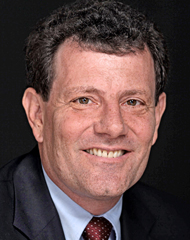
New York Times columnist Nicholas D. Kristof has an excellent column in this morning’s paper on Haïti.

His message: Help is more than emergency aid. Haïti needs jobs and trade and education as well.

“Ultimately.” he says,  “what Haïti most needs isn’t so much aid, but trade. Aid accounts for half of Haïti’s economy, and remittances for another quarter — and that’s a path to nowhere.

“The United States has approved trade preferences that have already created 6,000 jobs in the garment sector in Haïti, and several big South Korean companies are now planning to open their own factories, creating perhaps another 130,000 jobs. …

“Let’s send in doctors to save people from cholera. Let’s send in aid workers to build sustainable sanitation and water systems to help people help themselves. Let’s help educate Haïtian children and improve the port so that it can become an exporter. But, above all, let’s send in business investors to create jobs.

“Otherwise, there will always be more needs, more crises, more tragedies, more victims.”

The whole article can be found here.

Share this:
Share this page via Email Share this page via Stumble Upon Share this page via Digg this Share this page via Facebook Share this page via Twitter

Who said anything about ‘gentle’?

I woke up this morning with Advent on my mind.

I was replaying in my head messages from friends and various Advent resources calling this moment in our lives a time of “gentle waiting.”

“Gentle waiting!” I thought. “Why are we engaged in gentle waiting?!?”

I’m fear that we are trying to tame Advent when we make this call. And I don’t think Jesus wants us to do that.

We need to give them clean water.

I mean, what’s gentle about the Gospel lessons we hear in this season? Jesus tells us to keep awake, therefore, for we do not know on what day our Lord is coming. (Do we really imagine that the owner of the house was waiting gently for the thief to come in the night?)

Paul says now is the time for us to awake from sleep, for salvation is nearer to us than before, and commends us to put on the armor of light. (Who puts on armor and then sits gently?)

John the Baptist bellows, “Repent, for the kingdom of heaven has come near.” (How can we prepare the way of the Lord and make his paths straight if we aren’t doing something?)

Nowhere in those statements do I hear anything about gentleness.

Advent’s  a wakeup call, all right. But it’s an urgent one. It’s a rough shaking of the shoulder to get us out of bed to do something. This is not your mother leaning over you and gently saying, “Wake up, my love ….” This is Jesus calling, and he’s grabbing you and shaking you and throwing back the sheets and yelling, “GET UP!!!! We have things to do!”

And looking at the world around us, we know that is true. We DO have things to do.

There’s the DREAM Act to be passed. And Don’t Ask, Don’t Tell to be repealed. Unemployment benefits need to be extended.

The people in Sudan need our prayers and our advocacy, to prevent yet another war.

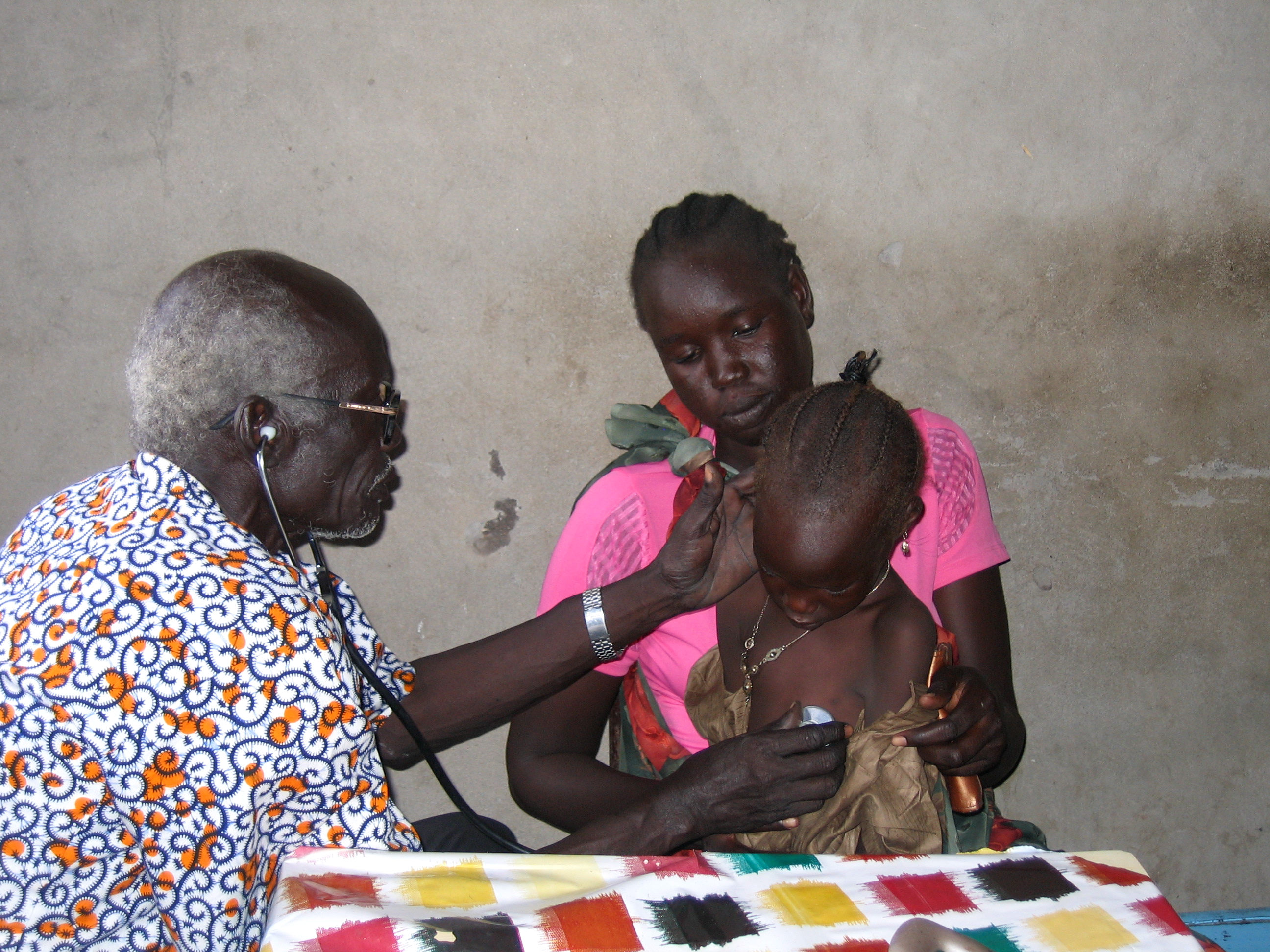
The people in Haiti need our help to fight cholera and build a nation devastated by the earthquake.

Those who are sick need our help.

There are hungry people everywhere whom we need to feed, thirsty people who need clean water from us, ailing people who need our medicine and our care. There are children who need our love. The blind desire to see, the deaf want to hear, the mute yearn to sing with joy.

None of these things will be accomplished by gently waiting for someone else to step up. We are the ones who are to make the paths straight.

Advent for me is a time for action. It’s a time for us to look at the world around us and ask, “Is this really what we want to give to Jesus as a birthday gift? A world where so many have so little and we allow that?”

I woke up this morning with Advent on my mind, all right.

The call I heard was crystal clear: “Get cracking! Do the work you’ve been given to do – now! There’s no time to wait for someone else to do the work. Hurry! It’s Advent! Do something!”

Share this:
Share this page via Email Share this page via Stumble Upon Share this page via Digg this Share this page via Facebook Share this page via Twitter

An Open Letter to the Members of Congress

Dear Ladies and Gentleman:

I write to you today on behalf of the people of the United States of America. I do not actually claim to speak for all of my fellow Americans, but I do know that many of us feel the same.

As you prepare for the new Congress, with a Republican-led House, a Democratic-led Senate and a Democrat in the White House, please remember these things:

First, you work for us.

You work for all of us.

We do not work for you.

Obviously we are not your immediate constituents. But in reality, we are. Because we are the citizens of this country, and you are the legislative power of this country. So please, when you are doing your work in Washington, remember that anything you do for your own constituents affects the rest of us, your national constituents.

Second, stop playing games.

We the people do not really want your strutting, your posturing, your gamesmenship. Just as productivity is important in our workplaces, just as we are rewarded when we meet goals at work, we expect you to be productive, too. Running the country is not a game; it is your job. It is your duty. It is your privilege.

So stop the games. We do not care one whit about you scoring points. Scoring points is not what we elected you to do. We elected you – each of you and all of you – to work. So get to it!

Third, remember us! I know you may think you are remembering us, but trust me, when you talk about rescinding health-care reform without a plan to replace it that is based in reality, not on partisanship, we the people are not pleased. You know why? Because we know that you have the best health-care in the world, and that more than 50 million of us don’t. Don’t talk to us about your ideas on health-care if you plan to leave 50 million of us hanging in the wind – yet again.

Remember, too, that we are the ones who are feeling the pain right now. Those of you who oppose extending unemployment benefits? Get real. Your gamesmenship means many of us will not have enough to eat, cannot pay our bills, and may lose our homes. For you this is a “matter of principle,” although we cannot figure out which principle it might be. For us, this is bottom-line reality: No more unemployment benefits, we’re in deep trouble. Stop balancing your principles on our backs.

Fourth, get real. Do not talk to us about balancing the budget and getting rid of wasteful spending and then demand that we extend the Bush tax breaks to the richest people – at an estimated cost of $700 billion over the next 10 years! Please. We are not stupid. We can do the math ourselves. And in doing that math, we can see that adding to the deficit will not end the deficit.  When 40 of the richest individuals in the United States publicly say you should to tax them more, when Warren Buffett says it is time to end the free ride for the richest, listen to them! Should you extend the tax breaks for the middle class? Yes. But for the richest, who only have gotten richer in the last decade? No. They’ve had their free ride, they’ve received their riches, they do not need more. You know why? Because there’s no such thing as trickle-down economics. When the rich get richer, they simply get richer. And we know that.

Finally, please, please, please: Respect us in the morning. We the people are not stupid. Obviously, many of you think we are. You think you can pull the wool over our eyes. But you cannot. We are paying attention, we do understand what’s going on, and we will hold you accountable.

It is time for you to step up and do the jobs we the people gave to you. We the people do not want to hear any more excuses. We do not want to hear you blame “big government” when you are that big government. We do not want any more posturing, any more points-scoring.

What we want is for you to work on our behalf.

We the people put you there, and we want you to remember that.

So get to work, please. Play your games some other time.

X X X

The Rev. Lauren R. Stanley is an Episcopal priest in the Diocese of Virginia who served for five years as an overseas missionary.

McClatchy-Tribune New Service

Share this:
Share this page via Email Share this page via Stumble Upon Share this page via Digg this Share this page via Facebook Share this page via Twitter

Seeing and being seen: A lesson in community

Luke 19:1-10

Almost half my lifetime ago, I left my newspaper editor’s job in cold, wintery Bismarck, N.D., to serve overseas as a Peace Corps volunteer. I ended up in Kenya, in Eastern Africa, where Peace Corps, at my request, trained me to become a water technician.

For the first 10 weeks in Kenya, I lived in the central part of the country, attending classes every day, with the greatest focus on cultural and language training. At the end of that time, I was fairly proficient in KiSwahili, the national language. And then Peace Corps, in its wisdom, sent me out to the western part of the country to live and serve among the Luo peoples.

I wasn’t in my village but a few days before I realized that the Swahili I had labored so hard to master wasn’t quite the same Swahili the Luos spoke. I had learned classical KiSwahili; the Luos spoke something I later learned was called “dirty Swahili.” The former is highly technical and intricate; the latter is very simple and ignores all rules of grammar.

Which meant that my training, which had led me to believe that I could live and move and have my being among the Luo, was insufficient at best, a barrier at worst.

Kenya

All this became crystal clear to me within my first week in my village. Wherever I went, whenever I spoke Swahili, people looked at me in confusion. I couldn’t communicate that well, despite my high score on my language exam.

Worst of all, I could not properly greet people.

And greeting people, in Africa as in much of the world, is a very important part of life. Whether you greet them … how you greet them … even if you are just walking down the street (or the dirt path, if you live in much of the developing world) … all of those things place you in society. So if you can’t properly greet people, you really don’t have a place … you don’t know where you belong … or even whether you belong.

One morning, as I was walking down a dirt road, an old woman – and I mean, an old woman, with frizzy little tufts of grey hair on her head and a face filled with wrinkles and dark, dark eyes that peeked out from between those wrinkles – one morning, this woman greeted me on the road.

“I see you,” she said.

I was so startled that she spoke to me in English that I didn’t respond at first. I simply while I thought, I see you? What kind of greeting is that?

So I responded in kind.

“Um, I see you?” I replied, questioningly.

The woman smiled at me and stood there and waited for me to go on.

“Um, how are you?” I asked, not knowing what else to say.

“I am here,” she said.

OK, I thought.

“I am here, too,” I replied, thinking, Isn’t that obvious? We’re standing in the middle of a dirt road, face to face. Of course you’re here. Of course I’m here!

“It is good to be seen,” she said.

And then we began to talk, mixing Swahili, the version I didn’t really know well, and DhuLuo, the tribal language that I really didn’t know yet, and English, which she didn’t know well, and somehow she managed to teach me that in her tribe, as in much of Africa, a proper greeting begins with, “I see you.”

The proper response is, “I am here. I see you.”

The one who began the conversation concludes the greeting with, “I am here. It is good to be seen!”

In much of Africa, this greeting is what gives people life and builds community. You don’t walk down the street and ignore people – you see them. And by seeing them, you do more than acknowledge their presence in the same piece of earth that you occupy. You acknowledge their whole being. You grant them meaning. You name them as part of your community.

As we parted, she in her direction and I in mine, I realized: I had just been introduced to a whole new way of being.

I was seen.

Therefore I belonged.

And I saw.

Therefore the other person belonged as well.

Yes indeed, it is good to be seen!
• • •
Seeing and being seen is what today’s Gospel lesson is all about.

We have Luke’s story of Zacchaeus, the wee little tax collector who was so anxious to see Jesus that he climbed a sycamore tree in order to see over the people in the crowd.

Now most of the time, the focus for this story is on Zaccheus giving away half his fortune and paying back four times what he might owe to people because he had defrauded them. That focus centers on Zaccheus’ conversion and subsequent repentance for the wrongs he had done.

But this story is not so much about repentance as it is about inclusion. Or, more accurately, about God’s wild, radical, inexplicable inclusion of all of God’s beloved children, no matter what the world might think of them or how the world might treat them.

Zaccheus and Jesus

Zaccheus, remember, was the chief tax collector in Jericho; therefore he was:
(a) Rich. Luke says so;
(b) Despised. Tax collectors, as all who witnessed this event knew, were employees of the oppressive Roman government. Any Jew who worked for the Romans was considered a traitor. Any Jew who collected taxes for the Romans, thus keeping the Romans in power, was a double traitor; and
(c) Pretty much an outcast in his own society. See (a) and (b) above.

So when Jesus calls Zaccheus down from the tree – where he really had no business being, since he was both a grownup and a powerful man – Jesus was setting, yet again, another example of God’s incredible love, even for those whom society does not love.

Jesus teaches us, yet again, that God’s love trumps society’s hate. You see, society would have preferred that Jesus ignore that little traitor up in the tree, and society expected the Jesus would never have gone to that little traitor’s house, much less eaten with him.

But Jesus never paid much attention to what society wanted, did he? Instead of letting society dictate to him, Jesus dictates to society. He declares who is good, who is worthy. He determines who belongs, who is part of the community.

So what if society despises this wee little man? Jesus doesn’t.

So what if society has judged this tax collector and found him wanting? Jesus doesn’t.

Instead, Jesus declares that Zaccheus is a son of Abraham – a beloved child of God!

Jesus saw Zaccheus and declared him good.

Take that, society!

Jesus demonstrates to and for us an in-your-face, I-really-don’t-care-what-society-thinks radical hospitality that declares, once and for all, that all of us – that each of us – is a beloved child of God. That all of us and each of us belongs to God. That our community is in and with and through God – because God said so!

How many times have we declared that someone is not welcome in our community, is not one of “us”? We’ve all done it – we decide that because someone is different, looks different, sounds different, smells different, that he or she cannot come in to our community.

And how many times have we been told that we do not belong, that we can’t come in, that we are not welcome in a community? That has happened to all of us as well.

But both stances – saying no and being told no – violate the very image of God in which we are created.

We are created in God’s image of love, because we are not necessary to God (God was before we were and will be after we are, so we can’t possibly be necessary), and God’s image of community (God the Father, God the Son, God the Holy Spirit, always together). Since God created us in God’s image, God gets to decide who’s in and who’s out. And since God never votes anyone off the island, and God never says, “You I love; you … eh …” we are called to do the same. To include people.

To see others – really see them …

… and to be seen.

I see you, Jesus said to Zaccheus

I am here. I see you, Zaccheus replied.

I am here. It is good to be seen! Jesus said.

Zaccheus’ story is a lesson in community – in God’s community, and how God wants us to be in community. It’s a reminder that we don’t get to make the rules; God does.

God sees each and every one of us, welcomes us into the household of God, makes room for us, sits down and eats a meal with us.

And then God asks us to do the same. God asks us to see each other not for what we think they are, but for what God knows they are: God’s beloved children.

It indeed is good to be seen!

Amen.

A sermon preached at Epiphany Episcopal Church, Richmond, Va., on the 23rd Sunday after Pentecost, 31 October 2010, Proper 26, Year C.

Share this:
Share this page via Email Share this page via Stumble Upon Share this page via Digg this Share this page via Facebook Share this page via Twitter

Do not lose hope – we shall have new life

Joel 2:23-32

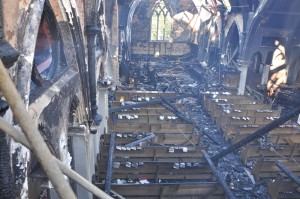
On Friday afternoon, about 4 p.m., Immanuel Chapel at Virginia Theological Seminary burned down. Within minutes, the entire chapel was on fire. Within an hour, it was gone. By nightfall, the walls were all that remained standing – although the fire department warned that they could yet collapse.

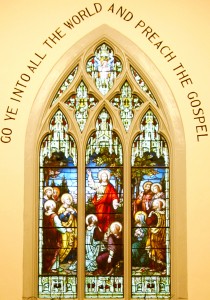
The historic Great Commission window in the VTS chapel, before the fire.

Most of the windows, many given by graduating classes, are gone, from the great stained glass depiction behind the altar with the inscription Go Ye Into All the World and Preach the Gospel, which inspired thousands of worshippers and had its Robert E. Lee-look alike St. Peter, to the great Tiffany window of St. Paul testifying in chains. Some windows melted, some exploded. All that is left are jagged openings from which many of us watched water pour as the firefighters fought the two-alarm blaze. On Saturday, we learned that apparently, the six-toed Jesus at the back did survive after all.

The altar rail that was sent from Liberia in the late 1800s is gone, as is the altar table and the organ, which seemed to burn for hours.

Everything in the sacristy was destroyed, from the patens and chalices and old, time-worn prayerbooks to “Anna Baptist,” the baby doll that thousands of us used to learn how to baptize children.

Gone, too, is the pulpit, from which were spoken great soaring sermons meant to inspire us and not-so-great sermons given by preachers who were literally quaking in their boots, and which many of us thought would collapse a few years ago on Martin Luther King Jr. Day when Bishop Michael Curry of North Carolina pounded and swayed and called us yet again to realize the dream not of Dr. King but of our Lord Jesus Christ.

Immanuel Chapel, the home in three-year cycles for thousands of seminarians for the past 129 years, the place that nurtured us and then sent us into the world to preach the Gospel, is no more.

This is a time for great mourning among the Seminary community. It is a time of great sadness.

But already, the community is giving thanks.

Thanks that no one was in the chapel at the time and thus no lives were lost. Thanks that none of the dozens of firefighters were injured. Thanks that none of the surrounding buildings were damaged. And yes, thanks that the great cross still towers above the ruins.

And already, it is a time for the community to dream.

To dream of the new chapel that will rise from those ashes. To dream of better access and better bathrooms. To dream of the unknown possibilities that make up those dreams, and that inspire us to new heights, not just of how to glorify God through our worship, but how to glorify God with our lives.

It is as though the prophet Joel were writing this morning just for those of us who loved that Chapel.

“Then afterward,” Joel wrote – meaning after the great calamity which in his day was famine brought on by an invasion, either of real locusts or of the locusts known as Babylonias –  “afterward,” the Lord says, “I will pour out my spirit on all flesh; your sons and your daughters shall prophesy, your old men shall dream dreams, and your young men shall see visions.”

VTS Chapel after the fire.

In other words, God says to us through the prophet Joel, despite the calamity of your life, do not lose hope.

In other words, God says, do not let the tragedy overcome you. Overcome the tragedy instead, because I the Lord am pouring out my Spirit upon you, because your young are prophesying and seeing visions, and your old are dreaming dreams.

Even in the midst of despair – over an economy that will not get its feet back under itself, over wars that are claiming thousands of lives, over injustice and oppression in Sudan and Congo and Zimbabwe, over enduring desperation and a sudden, deadly outbreak of cholera in Haïti, over hatred in the Middle East and oil spills in the Gulf of Mexico, over stubborn unemployment and devastating housing foreclosures – even in the midst of all that can send us plummeting into the pit of despair, we are not to give up. We do not lose hope.

Because God’s spirit is pouring over us, and because we are prophesying and dreaming and seeing visions, and therefore, we shall overcome. We shall have new life. That is where God’s Spirit, which is being poured out abundantly over us, leads us: to new life.

But only if we live into those prophecies, those dreams, those visions.

My friends, let’s be plain here: This is our calling in life. To take the gifts God gives us in the Spirit – the prophecies, the dreams, the visions – and to make them happen.

We – who are the beloved children of God – we – who are created in God’s image of love and community – we – who are created to live in love and in community – we are the ones who are especially called to make God’s dreams for us come true.

This is not someone else’s call … it is not up to someone else to work on God’s behalf.

It is our call.

It is our mission.

It is, in fact, why we were created.

• • •

I need you to know that I am a missionary. For the last five years, I have served as your missionary in both Sudan and Haïti. I have been an Appointed Missionary of the Episcopal Church, which means I represented you and the entire Episcopal Church wherever I went, whomever I served.

And because I am a missionary, mission is important to me. But I tend to define “mission” a bit differently than most people, because for me, mission is not simply about going into the world, it is not merely about doing things.

For me, “mission” is a way of being.

It is how we live our lives as beloved children of God.

“Mission” encompasses every aspect of our lives, every action we take, every word we speak, even the thoughts we think.

Our mission in life is the result of God creating us in God’s image, and declaring us the beloved.

You see, when God created the heavens and the earth and the birds of the air and the fishes of the sea and the animals of the land, God brought forth man and woman in God’s very own image. God did so not because God needed us, but because God wanted us. Remember, we are not necessary to God – and we know that, because God was before we were, and God will be after we are, so we can’t possibly be necessary to God. Which means that God loved us into being. So the image of God is that of love. And because we are Trinitarians, believing in the Father, Son and Holy Spirit, always together, never apart, God’s image is that of community.

So we are created in love and community to live in love and community.

The dance of the Trinity

All of which means that each of us is and all of us are God’s beloved children. I’m a beloved child of God. You are a beloved child of God. And you. And you. And you. And you. You are the beloved. We are the beloved.

Our mission, therefore, is to love. Not just the people and the things we like. Not just the people and the things we know. But all of God’s creation. As fully, as wildly, as radically, as inexplicably, as eternally as God loves us.

We want to make those prophecies and dreams and visions, the ones that come from God and are God’s gift to us … we want all those things to come true?

We have to start with love. And we have to always act as God’s beloved. And we have to always remember that everyone else also is God’s beloved.

If this is how we live our lives, if we always begin and end in love (no matter how hard that is), when tragedy and calamity hit, we will be fine. Not because we are immune – for we are not. But because we know how to move forward. We know that God loves us, and because God loves us, God gives us the prophecies, the dreams, the visions we need to continue bringing God’s love to the world.

God who loved us into being is pouring out God’s Spirit upon us. As the beloved, we have the prophecies, we are dreaming the dreams, we are seeing the visions.

Our job, our mission, is to bring those prophecies and dreams and visions to life. To make them happen. God doesn’t give us everything we need so that we can ignore it. God gives us everything we need so that God’s dream for us can come true.

That seminary chapel that burned down on Friday? The one where I was formed as a priest, where I learned to baptize (with dear Anna Baptist, that unregenerate baby doll), to celebrate and marry and bury people? It is gone now. But the love that built that place, the love that made it a holy place of God? That love remains. And because the love remains, the community will move forward.

We are God’s beloved.

Don’t ever forget that.

Amen.

A sermon preached on the 22nd Sunday after Pentecost, Proper 25, 24 October 2010, Year C, at Grace Episcopal Church, Goochland, Va.


Share this:
Share this page via Email Share this page via Stumble Upon Share this page via Digg this Share this page via Facebook Share this page via Twitter

God is depending on us

Luke 18:1-8

There are times when our Lord Jesus Christ is trying to teach us something and to do so, he tells us a parable – and then he pretty much leaves us to figure out what the parable means in all its aspects, and we often end up … confused.

This morning is one of those times.

The parable of the Widow and the Unjust Judge is one most of us have heard before. Jesus tells his disciples to pray always

The Widow and the Unjust Judge

and not to lose heart, and then illustrates that command with a parable that at first blush seems to back up his instructions.

But then we take a deeper look at it, and we think, “Wait a minute.”

Are we being told that God doesn’t answer our prayers unless we storm the gates of heaven, that God pays no attention to the first time, the second time, the third, the fourth, the fifth time we pray?

Are we being told that God is like this unjust judge, who only gave in to the widow because he didn’t want a black eye (that’s the literal translation from the Greek of “wear me out”)? That God only answers our prayers in order to avoid being publicly embarrassed (as if that were even possible)?

At first blush, those do seem to be the points of the parable.

Thankfully, the parable is about neither of those points.

We do not need to storm the gates of heaven repeatedly, hoping that eventually, God will pay attention. (God hears us the first time we pray.) And we do not need to worry about whether God is just or unjust. (We know God is just, because if God were not just, God would not be God.)

This parable, my friends, is about the kingdom of God on earth. It is about God’s will being done. It is about God’s justice reigning in this world.

Only by turning this parable over and focusing on the widow and what she does in the face of great injustice do we figure that out.

You see, in the days when our Lord Jesus Christ walked the earth, widows had nothing. They had no rights – no right to speak in public, no right to property, no right to testify in a court of law. Everything their husbands owned went to the husbands’ male relatives. If those relatives didn’t like the widow, or were greedy and wanted everything for themselves, they could throw the widow out on the street, and there was little the widow could do about it. Because widows had no rights. They had no one to speak for them. No one to stand up for them. No social safety net. No women’s center. No pro bono lawyers – no one.

The widow in this story? It’s obvious that she was all alone. There was no one was standing up for her. She wasn’t getting any justice from her husband’s family … that’s why she was going to the judge repeatedly. No one was taking her side – that’s why she argued before the judge alone. But even when that fool of a judge – and he was a fool, because he wasn’t even smart enough to fear God and he had no respect for anyone in the community – even when he refused repeatedly to hear her case and give her the justice that God demands, the widow refused to quit.

She knew her rights, this widow, the rights that came directly from God. She knew that from the beginning and to the end of time, God was on her side. Throughout the Torah, the Law of Moses, God places special emphasis on caring for widows, orphans and strangers.[1] Eleven times in Deuteronomy alone, God commands his people: Take care of the widows, the orphans and the strangers.  So this widow knew: God was on her side. And no foolish judge was going to stop her from getting what God said was hers.

And therein, my friends, lies the real lesson of this parable:

Do not quit.

Even when the odds are against us, this parable teaches us that we are not to stop working for God’s kingdom, for God’s justice, for God’s love, for God’s hope.

Even when the kingdom seems out of reach, when there seems to be no justice in sight, or love to embrace, or hope to cling to, Jesus tells us to keep trying, to keep pushing. Because one day – one day – when enough people focus on God’s kingdom – and not their own; on God’s justice – and not society’s; on God’s inexplicable, eternal, wild, radical love – and not humanity’s limited, short-sighted, mean-spirited imitation of the same; when people embrace God’s incredible hope – and reject humanity’s hopelessness – when all that happens, God’s justice will roll down like waters and righteousness will flow like an ever-flowing stream.

No matter how hard it seems, Jesus is telling us, no matter how hopeless it seems … do not quit.

So why does Jesus tell us this in the context of a command to pray always?

Because in Jesus’ scheme of life, prayer is more than simply asking for something. Prayer is about doing something. It’s about doing those things for which we pray!

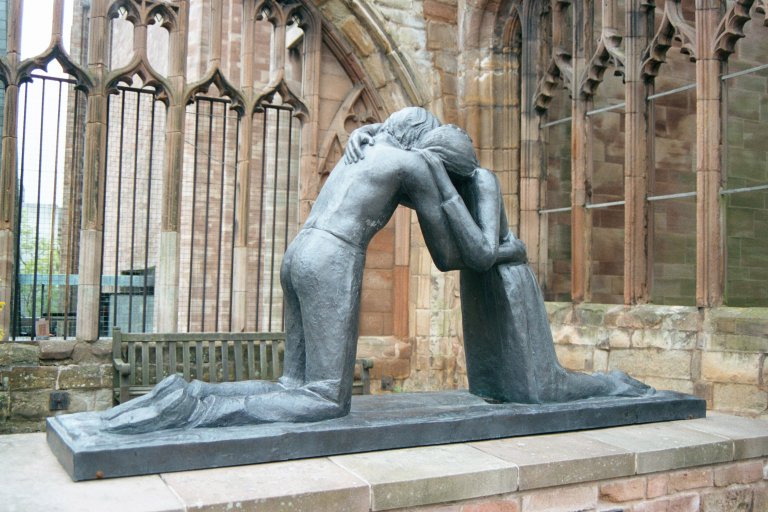
The Statue of Reconciliation, by Josefina de Vasconcellos. It sits amid the ruins of Coventry Cathedral, which was destroyed by German air forces during WWII. A replica of this statue was donated by the people of Coventry to the peace garden of Hiroshima.

It is not enough to simply ask God for peace in this world. If we want peace, Jesus says, we’re going to have to work for it. We don’t have peace in this world because there are far too many people who reject it. Those of us who want it, who pray for it, Jesus says, are going to have to work for it.

It is not enough to simply ask to God to watch over those in need this day. If we want people to have enough – not everything, but enough – we are the ones who are going to have to give them enough. This day!

Jesus tells us this parable so that we can understand: We have to actively work for that for which we pray, even when it seems hopeless. Because in God’s scheme of life, there is always hope. There is always justice. There is always love.

I know this. I have witnessed this.

For four years I served as your missionary in Sudan, a war-torn nation where more than 3 million people have died in the last 40-some-odd years of war, and another 5 million people have lost their homes. At one point in Sudan, someone was dying – either in civil war or as a result of civil war – every 6 seconds.

Every day, the people pray for peace. They’ve been praying for peace for decades. But they don’t simply ask God for peace and then sit around passively waiting for it. They work for it! Like the widow in today’s Gospel, they refuse to quit. The odds are against them, the world is pretty much ignoring them, their enemies are salivating over the chance to annihilate them. But they won’t quit working for peace.

Right now – facing yet another civil war that is threatening the lives of nearly 10 million southerners in that divided land – they are working for that peace they so desperately desire. This very day, the Archbishop of the Episcopal Church of Sudan is in this country, seeking the help of the U.S. government and the United Nations, so that they don’t face yet another genocide come January, when South Sudan will vote on whether to become an independent nation. Every day, our brothers and sisters in Christ in Sudan, who are related to us not by the blood of their birth but by the waters of their baptism, not only pray for peace. They work for it.

And this is our mission, too.

This is the mission of the Church:

To actively work for that for which we pray. Even when the world tells us it’s never going to happen. Even when the world conspires to stop us.

Our mission is to never give up.

Whenever we see an injustice, whenever we are encounter hatred, whenever we feel hope slipping away, Jesus says to us: do not quit. Do not give up.

We are supposed to be like the widow in today’s Gospel: Always striving for God’s kingdom, for God’s justice, for God’s love, for God’s hope.

God is depending on us.

Amen.

A sermon preached on the 21st Sunday after Pentecost, Proper 24, Year C, 17 October 2010,  at St. Anne’s Parish, Scottsville, Va.


[1] Exodus 22:22; Deut. 10:18, 14:29, 16:11, 16:14, 24:17, 24:19-21, 26:12-13, 27:19.


Share this:
Share this page via Email Share this page via Stumble Upon Share this page via Digg this Share this page via Facebook Share this page via Twitter

MDGs: For beginners … and finishers

From The New York Times:
By BONO
Guest columnist
(Published: September 18, 2010)

I’ve noticed that New Yorkers, and I sometimes try to pass for one these days, tend to greet the word “summit” with an irritated roll of the eyes, a grunt, an impatient glance at the wristwatch. In Manhattan, a summit has nothing to do with crampons and ice picks, but refers instead to a large gathering of important persons, head-of-state types and their rock-star retinues in the vicinity of the United Nations building and creates, therefore, a near total immobilization of the East Side. Can world peace possibly be worth this? Never, never…Eleanor Roosevelt, look what you’ve done … .

Deirdre O’Callaghan
Bono

Recent global summit meetings, from Copenhagen to Toronto, have frankly been a bust, so the world, which may not know it yet, is overdue for a good multilateral confab — one that’s not just about the gabbing but about the doing. The subject of the summit meeting at the United Nations this week is one whose monumental importance is matched only by its minuscule brand recognition: the Millennium Development Goals, henceforth known as the M.D.G.’s (God save us from such dull shorthand).
The M.D.G.’s are possibly the most visionary deal that most people have never heard of. In the run-up to the 21st century, a grand global bargain was negotiated at a series of summit meetings and then signed in 2000. The United Nations’ “Millennium Declaration” pledged to “ensure that globalization becomes a positive force for all the world’s people,” especially the most marginalized in developing countries. It wasn’t a promise of rich nations to poor ones; it was a pact, a partnership, in which each side would meet obligations to its own citizens and to one another.
Of course, this is the sort of airy-fairy stuff that people at summit meetings tend to say and get away with because no one else can bear to pay attention. The 2000 gathering was different, though, because signatories agreed to specific goals on a specific timeline: cutting hunger and poverty in half, giving all girls and boys a basic education, reducing infant and maternal mortality by two-thirds and three-quarters respectively, and reversing the spread of AIDS, tuberculosis and malaria. All by 2015. Give it an A for Ambition.
So where are we now, 10 years on, with some “first-world” economies looking as if they could go bang, and some second- and third-level economies looking as if they could be propping us up?
Well, I’d direct you to the plenary sessions and panel discussions for a detailed answer…but if you’re, eh, busy this week…my view, based on the data and what I’ve seen on the ground, is that in many places it’s going better than you’d think.
Much better, in fact. Tens of millions more kids are in school thanks to debt cancellation. Millions of lives have been saved through the battle against preventable disease, thanks especially to the Global Fund to Fight AIDS, Tuberculosis and Malaria. Apart from fallout from the market meltdown, economic growth in Africa has been gathering pace — over 5 percent per year in the decade ending in 2009. Poverty declined by 1 percent a year from 1999 to 2005.
The gains made by countries like Ghana show the progress the Millennium Goals have helped create.
At the same time, the struggles of places like Congo remind us of the distance left to travel. There are serious headwinds: 64 million people have been thrown back into poverty as a result of the financial crises, and 150 million are hungry because of the food crisis. And extending the metaphor, there are storms on the horizon: the poor will be hit first — and worst — by climate change.
So there should be no Champagne toasts at this year’s summit meeting. The 10th birthday of our millennium is, or ought to be, a purposeful affair, a redoubling of efforts. After all, there’s only five years before 2015, only five years to make all that Second Avenue gridlock worth it. With that in mind I’d like to offer three near-term tests of our commitment to the M.D.G.’s.
1. Find what works and then expand on it. Will mechanisms like the Global Fund get the resources to do the job?
Energetic, efficient and effective, the fund saves a staggering 4,000 lives a day. Even a Wall Streeter would have to admit, that’s some return on investment. But few are aware of it, a fact that allows key countries — from the United States to Britain, France and Germany — to go unnoticed if they ease off the throttle. The unsung successes of the fund should be, well, sung, and after this summit meeting, its work needs to be fully financed. This would help end the absurdity of death by mosquito, and the preventable calamity of 1,000 babies being born every day with H.I.V., passed to them by their mothers who had no access to the effective, inexpensive medicines that exist.
2. Governance as an effect multiplier. In this column last spring, I described some Africans I’ve met who see corruption as more deadly than the deadliest of diseases, a cancer that eats at the foundation of good governance even as the foundation is being built. I don’t just mean “their” corruption; I mean ours, too. For example, multinational oil companies. They want oil, and governments of poor countries rich in just one thing, black gold, want to sell it to them. All well and good. Except the way it too often happens, as democracy campaigners in these countries point out, is not at all good. Some of these companies knowingly participate in a system of backhanders and bribery that ends up cheating the host nation and turning what should be a resource blessing into a kind of curse of black market cabals.

Well, I’m pleased to give you an update on an intervention that some of us thought of and fought for as critical: hidden somewhere in the Dodd-Frank financial reform bill (admit it…you haven’t read it all either) there is a hugely significant “transparency” amendment, added by Senators Richard Lugar and Benjamin Cardin. Now energy companies traded on American exchanges will have to reveal every payment they make to government officials. If money changes hands, it will happen in the open. This is the kind of daylight that makes the cockroaches scurry.
The British government should institute the same requirement for companies trading in Britain, as should the rest of the European Union and ultimately all the G-20 nations. According to the African entrepreneur Mo Ibrahim, who has emerged as one of the most important voices on that continent, transparency could do more to transform Africa than even debt cancellation has. Measures like this one should be central to any renewed Millennium Development Goal strategy.
And the cost to us is zero, nada. It’s a clear thought in a traffic jam.
3. Demand clarity; measure inputs and outputs.
Speaking of transparency, let’s have a little more, please, when it comes to the question of who is doing what toward which goal and to what effect. We have to know where we are to know how far we’ve left to go.
Right now it’s near impossible to keep track. Walk (if you dare) into M.D.G. World and you will encounter a dizzying array of vague financing and policy commitments on critical issues, from maternal mortality to agricultural development. You come across a load of bureau-babble that too often is used to hide double counting, or mask double standards. This is the stuff that feeds the cynics.
What we need is an independent unit — made up of people from governments, the private sector and civil society — to track pledges and progress, not just on aid but also on trade, governance, investment. It’s essential for the credibility of the United Nations, the M.D.G.’s, and all who work toward them.
And that was the deal, wasn’t it? The promise we made at the start of this century was not to perpetuate the old relationships between donors and recipients, but to create new ones, with true partners accountable to each other and above all to the citizens these systems are supposed to work for. Strikes me as the right sort of arrangement for an age of austerity as well as interdependence. (The age of interrupted affluence should sharpen our focus on future markets for our sake as well as theirs.)
No leader scheduled to speak at the summit meeting is more painfully aware of this context than President Obama, who one year ago pledged to put forth a global plan to reach the development goals. If promoting transparency and investing in what works is at the core of that strategy, he can assure Americans that their dollars are reinforcing their values, and their leadership in the world is undiminished. Action is required to make these words, these dull statistics, sing. The tune may not be pop but it won’t leave your head — this practical, achievable idea that the world, now out of kilter, can re-balance itself and offer all, not just some, a chance to exit the unfathomable deprivation that brings about the need for such global bargains.
I understand the critics who groan or snooze through the pious pronouncements we will hear from the podium in the General Assembly. But still in my heart and mind, undiminished and undaunted, is this thought planted by Nelson Mandela in his quest to tackle extreme poverty: “Sometimes it falls upon a generation to be great.”
We have a lot to prove, but if the M.D.G. agreement had not been made in 2000, much less would have happened than has happened. Already, we’ve seen transformative results for millions of people whose lives are shaped by the priorities of people they will never know or meet — the very people causing gridlock this week. For this at least, the world should thank New Yorkers for the loan of their city.
Bono, the lead singer of the band U2 and a co-founder of the advocacy group ONE and (Product)RED, is a contributing columnist for The Times.

Share this:
Share this page via Email Share this page via Stumble Upon Share this page via Digg this Share this page via Facebook Share this page via Twitter

Leaps of faith

Luke 16:19-31

I am a rich person.

I know this because I looked it up on globalrichlist.com, where I entered my income from last year and discovered that I rank in the top 13.74 percent of the wealthiest people in the world.[1]

U.N. wealth-per-capita chart

According to this web site, I am the 824,785,999th richest person in the world, this out of the approximately 6.8 billion people now living.

That is an amazing ranking, isn’t it? I was astonished when I found out how rich I am, when compared to the rest of the world.

At the same time, I also am a poor person.

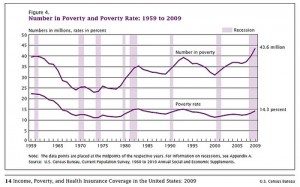
I know this because I looked in the Census Bureau’s Poverty Report that was released a few weeks ago.

According to that report, I am incredibly poor.  I am so poor that I inhabit, according to the Census Bureau, something called the “poverty universe,” along with more than 40 million other Americans.

One report says I am rich. The other says I am poor.

Let me clear this up for you a bit: For the last five years, I have been an Appointed Missionary of The Episcopal Church. I served for four years in the Diocese of Renk of the Episcopal Church of Sudan, and for about one year in the Diocese of Haiti. During that time, I was paid, by The Episcopal Church, $6,000 per year.  $500 per month. I raised money during that time to help support me, so for both of those reports I consulted, I raised my income to $8,000 last year.

On a worldwide scale, I am rich.

In the “poverty universe,” I am poor.

Census Bureau Poverty Index

Somehow, I have managed to span the great chasm between rich and poor, the chasm of which Jesus speaks as he tells the story of the Rich Man and Lazarus in Luke’s Gospel.

The story he tells is not a new one. It is, in fact, much older than Jesus himself, coming out of the Egyptian tradition. But regardless of its age and provenance, the story Jesus tells is an important one, not just for the disciples and Pharisees who are listening then, but to us now.

Let’s get something straight right off the bat: Jesus – God – has no problem with wealth. We know that because the Bible tells us so. In this very story, Lazarus, the poor man who had been abandoned outside the gates of the unnamed rich man, is sitting next to Abraham, the patriarch of the people of Israel and indeed of the three great faiths of the world. Abraham was a very wealthy man, far beyond simply being rich. He had land, animals, money … By reading that Lazarus, a poor man in such bad shape that he was covered in nasty sores, so weak that he was licked by dogs (that most despised of animals), simply by reading that Lazarus is sitting in paradise next to Abraham, we know that wealth in and of itself is not a bad thing in God’s eyes. By hearing Abraham tell the rich man, “Sorry, you’re out of luck, Lazarus can’t help you,” we know that in God’s eyes, Abraham the wealthy man is also Abraham the exalted man.

So wealth is not the problem that Jesus is highlighting in this story.

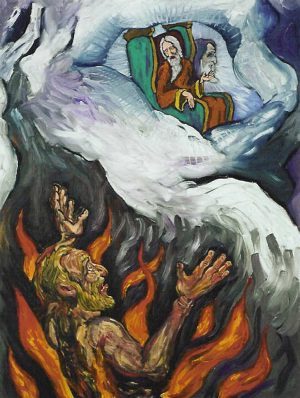
The Rich Man and Lazarus

What Jesus is focusing on is the great chasm between wealth and poverty, between those who have, and those who do not have.

For it is that chasm that gets in the way of God’s will being done in God’s very good creation.

I know a lot about this chasm. I knew a lot about this chasm before I went online and found out that I am simultaneously rich and poor. In my time as a missionary, I have lived among some of the poorest people on earth. I have seen the poverty, and I know what it is like to be on the wrong side of the chasm.

In South Sudan, I lived in a mud hut, with no running water, very little electricity, lots of disease, limited food to eat. And I lived a life of privilege in Sudan, compared to the average person, who lived in a hut made of grass, who had no electricity ever, no clean water and no way to clean the water she had, frequently far too little to eat and no way to make enough money to ensure her children could grow up healthy and strong. I once had to explain to some U.S. government officials who wanted to learn what life was like in South Sudan that, no, there really was no functioning economy there, that most people were poor beyond belief, that there was never enough of anything, and no hope of getting any more. The Americans simply shook their heads in disbelief.

In Haiti, I lived in the poorest nation in the Western Hemisphere. The area in which I lived was surrounded by terrible slums, where people had very little, and even less hope of getting any more, while at the same time they were surrounded by people of wealth. Compared to my life in Sudan, my life in Haiti was full of riches. But when my colleagues saw where I lived, and how I lived, they could only shake their heads and ask me why. Why didn’t I have electricity all the time? Why did I haul water up three flights of stairs? Where was my air conditioner? My TV? (Hint: No electricity, no AC, no TV.)

So I know something, quite a bit, actually, about the poverty that Jesus is attacking in this story we call “The Rich Man and Lazarus” but which one commentator says more accurately should be called “The-Indifferent-Man-Who-Could-Have-Listened-to-Moses-and-the-Prophets-and-Followed-God’s-Way-of-Life-and-Been-Welcomed-Into-Paradise-by-Father-Abraham-But-Chose-Not-To and Lazarus.”[2]

The rich man, who is given no name in this story, knew what he was supposed to do. The Torah, the Five Books of Moses, told him: Care for the poor, the sick, the widows and the children. Leviticus says to love God with all your heart, mind, soul and strength. Deuteronomy says to love your neighbor as yourself. You cannot do the former if you do not do the latter. The Prophets who came after Moses said the same thing. Micah asks, “What does the Lord require of you, o mortal, but to do justice, love kindness and walk humbly with your God?” (Micah 6:8) Proverbs say that “If you close your ear to the cry of the poor, you will cry out and not be heard.” (Proverbs 21:13) Isaiah quotes God thundering, “What do you mean by crushing my people, by grinding the face of the poor?” (Isaiah 3:15) followed by a promise from God to never forsake them. (Isaiah 41:17) Jeremiah laments: “For the hurt of my poor people I am hurt, I mourn, and dismay has taken hold of me.” (Jer. 8:21), then asks, “Is there no balm in Gilead? Is there no physician there? Why has the health of my poor people not been restored?” (Jer. 8:22) Ezekiel proclaims: “This was the guilt of your sister Sodom: she and her daughters had pride, excess of food and prosperous ease, but did not aid the poor and needy.” (Ezek. 16:49)

Moses and the Prophets continuously spread God’s word: We are to care for the very least among us.

In telling the story of the rich man and Lazarus, Jesus continues in that same prophetic vein:

You see someone in need, you help him.

You feed the hungry. Give water to the thirsty. Make the lame leap for joy, the blind see, the deaf hear, the mute speak. Visit the sick and those in prison. Clothe the naked.

Lord knows – and it is true, God truly does know – that there is a great chasm in this world between the rich and the poor, between the have’s and the have-nots. You and I know it, you and I have seen it, some of you and I have lived in it.

But just because it exists does not mean we can’t do something about it.

Rich or poor – or both, if you are like me – we can cross that chasm – in this life – and we can do something about it, if we so desire. In this country alone, more than 44 million of us inhabit what the Census Bureau now calls the poverty universe. More than 85 percent of the world inhabits that same universe.

Is that what we want?

Is that what God wants?

The real question we have to ask ourselves this morning is this:

Are we willing to cross that chasm ourselves?

The only way to answer that question is to figure out what exists in our lives that keeps that chasm there, and keeps us from crossing it. We may not want to cross it because the poor are too much like Lazarus, covered in ugly sores, so weak that the dogs – the dogs – are able to lick his wounds without hindrance.

We may not want to cross the chasm because to do so would mean leaving our comfort zones, and we are afraid.

We may not want to cross the chasm because we may feel, in our deepest secret places, that sometimes, the poor deserve what they have, or rather, what they don’t have. We may feel that far too many of the poor are poor simply because they refuse to work.

(But know this: In this story that Jesus tells, Lazarus is so far gone that he didn’t go to the rich man on his own to beg. He was placed there because he was so far gone that the people who put him there knew the rich man was his last hope. So in this telling, Jesus is quite clear that he is not talking about people who refuse to work; he is talking about people who cannot help themselves.)

Whatever reasons we may have for not wanting to cross the chasm, we have so many more for doing so.

It doesn’t take much to become poor; we all know that. The economy in this country and around the world went from riding high to sinking like a lead balloon almost in the blink of an eye. We all know someone – and generally more than one someone – who lost their jobs, and then their savings, then their homes. Going from being a rich person to poor, which is so often outside our control, is frighteningly easy. In other words, one very personal reason for crossing the chasm is that because we could have been, and still might be, the ones on the far side, the ones who need help.

We know, too, that while there is nothing wrong with being rich – however you define that term – there is something wrong, in God’s eyes, with not using our wealth to help others in need. We may not be in a position to join Warren Buffet and Bill Gates and all those other billionaires who are giving away half their fortunes, but surely we are able to give something to those who have less.

And we may not be the ones who are called to work directly with the poor. Our call may be to use our wealth – however big or small – to help others help the poor. There is nothing wrong with that – each of us has different gifts, and some people’s gift is to fund the work of others.

Whatever our gifts are, the important question we always have to consider is this: Do we want to cross the chasm?

Because that surely is what Jesus is calling us to do today.

To make the leap of faith and cross the chasm.

Are we willing?

Amen.

A sermon preached on the  18th Sunday after Pentecost, 26 September 2010, Proper 21 Year C, at Christ Church, Millwood. 


[1] cf www.globalrichlist.com

[2] The Rev. Dr. George Hermanson, “Paying Attention,” on David Ewart’s www.holytextures.com,

Share this:
Share this page via Email Share this page via Stumble Upon Share this page via Digg this Share this page via Facebook Share this page via Twitter

Mission: Now is the time for prophetic action on the MDGs

From Episcopal News Service:
By Devon Anderson and Ian Douglas, September 22, 2010

(The Rt. Rev. Ian T. Douglas, Bishop of Connecticut, upper left, and The Rev. Devon Anderson, Executive Director of Episcopalians for Global Reconciliation, bottom left.)

[Episcopal News Service] This week the eyes of the world turned to the U.N. Summit on Millennium Development Goals, where world leaders have spent the last few days considering a "global, results-oriented action plan" to accelerate progress toward achieving the goals — which include cutting extreme poverty in half, reducing child mortality rates, and increasing access to education — over the next five years.

World leaders agreed in 2000 to achieve the eight goals by 2015.The summit met to examine successes and continuing challenges to progress as a foundation for renewing commitments, galvanizing coordinated action among all stakeholders, and eliciting the funding needed to achieve the eight MDGs.

In a nutshell, the summit will ask the world to move from talk to action.

The occasion of the summit is an opportunity for the Episcopal Church, which committed to the MDGs in 2003, similarly to celebrate its MDG successes up to this point, renew our collective commitment to 0.7 percent giving at all levels of the church, and redouble our efforts toward results-oriented action in the next five years. More crucial still, this summit, at this particular time in the life of the planet, is a clarion call for Episcopalians to perk up, garner our resolve, and commit to the kind of prophetic ministry that will be needed if we are to make good on our promises to be an effective, dynamic contributor to the MDG movement.

The Episcopal Church has come so far. As of early 2009, to our best calculations, some 82 dioceses across the Episcopal Church had included a 0.7 percent line-item in their annual diocesan budgets for global mission. Following suit later that year, General Convention inserted a 0.7 percent line-item into its triennial budget for MDGs, courageously locating our commitment to global mission squarely at the heart of the church, while bearing the full weight of that worthy commitment in painful budget cuts elsewhere. And all across the church, congregations and dioceses have begun important work forming relationships and partnering with people across the globe to curb hunger, provide needed health care and stem disease.

And yet, there is still so much to do. The Rev. Sabina Alkire, an economist and Anglican priest who directs a major international development agenda in Oxford, England, and who is a founding member of Episcopalians for Global Reconciliation describes the work at hand this way: "The number of people living in abject poverty has reached one billion for the first time ever (just a few years ago it was 841 million hungry souls on earth). International aid budgets are being cut; and in many countries government-funded social programs are also being reduced due to shrinking economies. Even the countries that gave 0.7 percent for international development are giving less money in real terms because their economies are smaller. Where I sit, the secular development agencies are in turmoil. I wish the churches were equally concerned. It is a time for the church to be prophetic, to speak out, to sustain its own commitment and call on others to sustain theirs. Quitting is easy. But our actions have consequences for the poorest of the world."

Now is the time for prophetic action. The world leaders have come to New York briefed by their own economists and political advisors. They are negotiating commitments and generating their collective resolve as governments to achieving the MDGs by 2015. Clearly none disputes the worthiness of the MDGs. But even as they debate the best roadmap to 2015, world leaders are also weighing the probability that any specific commitment they make will pass muster with their citizenries.

But prophets don’t trade in probabilities. Maimonides, the Jewish scholar of the 12th century, argued that prophetic hope is belief in the "plausibility of the possible" as opposed to the "necessity of the probable." Likewise, biblical faith calls Christians to something more in this Kairos moment than settling for realistic probabilities. Biblical prophets and Jesus’ ministry calls us to sustain a vision where the needs of all are met in the economy of God.

At this difficult time in our human global economy, the prophetic witness asked of us cannot merely be one of words but of vociferous, concrete action. Now is the time to move from MDG education and promotion to a model that will enfranchise Episcopalians for goal-oriented action and commitment. The hard work of motivation, equipping and action remains before us. Prophets have action plans. After all, Micah implores us not merely to speak justice but to do justice, love mercy, and walk humbly with our God.

— Devon Anderson is the executive director of Episcopalians for Global Reconciliation. Bishop Ian Douglas is the bishop of Connecticut and vice chair of the EGR board.

Share this:
Share this page via Email Share this page via Stumble Upon Share this page via Digg this Share this page via Facebook Share this page via Twitter

Forgiving extravagantly

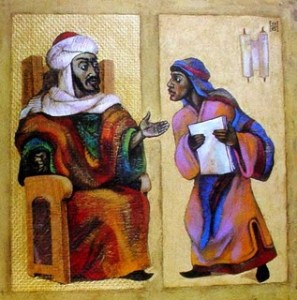
The Dishonest Steward

Luke 16:1-13

Jesus is in the middle of telling a series of parables about finding that which once was lost – parables of the lost sheep, lost coins, a lost son, all of which were easy to understand and cause for rejoicing – when he launches into yet another story, this time about a rich man’s steward caught with his hand in the till, and once again, we are set back on our heels and left to wonder:

Did he really just say what we think he said?

Did Jesus really just lavish praise on a thief, on a crooked manager, on a cheat?

And did he really just instruct his disciples – did he instruct us – to live by sly cunning in order to get ahead?

When you listen to Luke, it sure sounds that way.

The Parable of the Dishonest Steward – that’s what this story is called. It’s also called one of the most problematic parables in the Gospels, because the message is mixed and makes us feel … uncomfortable.

It’s the story of a steward, a manager of a rich man’s estates. The rich man hears that the steward was cheating him … we don’t know exactly how, other than the fact that the steward was squandering his master’s property. The rich man is royally upset by these reports – for who wants to hear that someone you trusted, somebody you put in power, is wastefully throwing away your money?

Squandering, remember, means to be wasteful … reckless … decadent. But its first definition is to be extravagant … which can be both positive and negative. As we hear this story, we need to remember: The main charge against the steward is that he is extravagant …

At any rate, when the rich man learns of this, he hauls the steward in and says, a la Donald Trump, “You’re fired! Give me an account of all you’ve done, and get out.”

The steward reacts as any of us would, with great dismay and extreme worry. “What am I going to do?” he asks himself. “I can’t dig (like all those poor people over whom I’ve had authority for all these years). And I refuse to beg – that’s too just too shameful.”

So the steward thinks for a while, and then he goes right back to what he’s been doing all along: He becomes extravagant again.

He calls in all those who owe money to the rich man and asks, “How much do you owe my master?”

[Now here’s something to think about … why would the steward, the man charged with keeping the accounts, not know how much each person owed? Could this be the reason he’s being fired? Not because he’s stealing, but because he’s stupid? A good steward should know these things off the top of his head … he should at least have some books, an accounting … he should be ready for an audit, at the drop of a hat. That’s what good stewards do … they do more than keep an eye on the business. They run the business. But not this steward. He’s been so extravagant with the master’s business that he doesn’t even know what’s going on!]

So he asks the first person he calls in: “How much do you owe?” The peasant says, “One hundred jugs of olive oil.” Now, my friends, you know that olive oil is expensive, right? Good olive oil runs up to six times what regular vegetable oil costs. So if this man owes 100 jugs of olive oil – gallons and gallons of it – he’s probably in hock to the master for the rest of his life! He’s an indentured servant and owes everything – every teeny, tiny thing of his life – to the rich man. There’s no way he can get out of this debt – because that’s how the system was designed.

And what does the steward do? Does he demand payment? No. Does he threaten the man (which is probably what the peasant was expecting; after all, this steward is the rich man’s representative, which gives him life and death power over the peasant …)? So does he do that? No.

Instead, he says, “Write down 50 jugs …” Half of what you say you owe. Which suddenly makes the debt reasonable. Which gives the peasant hope that one day, perhaps, he can get out from under this brutal debt, meaning his children and grandchildren won’t have to suffer from it as well …

Every person the steward calls in finds their debt cut … some by half, some by one-fifth …

In order to make his own life better, in order to make the peasants who probably have feared him forever now think better of him, perhaps even like him, the steward acts extravagantly, forgiving their debts by slicing them down to size.

Oh, he doesn’t erase the debts. That would be going too far – if he did that, the rich man would come back and say, “No way. I won’t stand for this.”

But by cutting each person’s debt to a reasonable size, by forgiving the outlandish portions of those debts, the steward makes the rich man look good. He makes himself look good. His own future suddenly looks good again, too – remember, the rich man ends up praising the steward.

All because, in sheer desperation, out of unbridled terror and unremitting pride, the steward forgave debts.

It’s important here to step back a bit and examine what this means to Jesus. Before Jesus told his disciples this parable, he taught them how to pray. In what we now call the Lord’s Prayer, Jesus teaches us to say, “Forgive us our sins as we forgive those who owe us.” Translated another way: As we forgive everyone who is indebted to us. This is not how we translate the prayer. In the King James Version, we say, “Forgive us our trespasses, as we forgive those who trespass against us.” And in the so-called “modern” translation, we say, “Forgive us our sins, as we forgive those who sin against us.” But neither translation is accurate, for in both Matthew and Luke’s gospels, Jesus says, “Forgive us our sins as we forgive those who are in debt to us.” Jesus balances our sins against others’ debts … So Jesus is telling us, right in the prayer he taught us, that we are to forgive debt. Which is exactly what the steward did: He forgave debts.

• • •

I have a friend, a theologian, who spent more than a year working with this text. She thinks that the key to today’s Gospel is forgiving those who owe us.*

It doesn’t matter, Dylan says, how the steward got to that forgiveness, or even why he forgave. It doesn’t matter that he was only forgiving a portion of the debt, or that the debt wasn’t even owed to him.

What matters is that he forgave.

Forgiveness

That is what Jesus wants us to do: Forgive.

Jesus tells this parable, and praises this steward because, even though the steward did it for all the wrong reasons, he still showed mercy. He still forgave people.

And forgiveness is key to how we are called to live as disciples of Jesus. Not to hold on to debts, but to let them go.

How many times have we been in situations where a little forgiveness would go a long way … and we didn’t do it? And the situation got worse?

How many times have we been in situations where we didn’t feel in the least inclined to forgive, but we did so anyway, even just a little, with only half our hearts, and life was better, for us and for the people we forgave?

Jesus is very clear about this: We are called to be extravagant in our forgiveness. To squander our forgiveness. To scatter it hither and yon, when we want to, and when we don’t want to.

It simply does not matter how we get to forgiveness.

It does not even matter why we forgive.

It only matters that we forgive …

… the big things that get in the way of us living our lives fully devoted to God and God’s beloved creation: those times when our loved ones hurt us … when our friends fail us … when we are forgotten … when we are not appreciated …

… and the little things as well which, taken on their own may not mean much, but put together with all those other little things – squeezing the toothpaste from the middle … tossing our clothes on the floor … leaving dirty dishes in the sink … when those things combine to suddenly make our lives seem like nothing but an uphill struggle …

… all of these things and more …

… we are called to forgive.

Extravagantly.

With as open a heart as we can muster, at that given moment, with that particular person.

There’s a reason Jesus tells this particular story; there’s a reason Jesus showers praise on the steward.

Not because he was the best example out there.

But because even though he was a lousy example … he was dishonest, he wasn’t paying attention, he squandered his boss’ money … even though he wasn’t someone we want to emulate ourselves, he still managed to forgive.

Extravagantly.

And if someone as incompetent and dishonest as this steward can manage to do this, Jesus says, how much more can we – we who are his disciples, we who are children of the light – how much more can we forgive?

If the steward can be extravagant in his forgiveness, for all the wrong reasons, how much more can we be extravagant in our own forgiveness, for the right reasons?

“It boils down to the same thing,” my friend Dylan the theologian says. “Deluded or sane, selfish and/or unselfish, there is no bad reason to forgive. Extending the kind of grace God shows us in every possible arena … can only put us more deeply in touch with God’s grace.”

Even in the darkest of times, we who are children of the light are always called to forgive, and to do so extravagantly.

That’s really what Jesus wants to teach us today.

Amen.

* I am deeply indebted to Sarah Dylan Breuer’s exegesis, found sarahlaughed.net, http://www.sarahlaughed.net/lectionary/2007/09/proper-20-year-.html, and http://www.sarahlaughed.net/lectionary/2004/09/proper_20_year_.html.

A sermon preached on 19 September 2010, Christ Church, Millwood, Va.

Share this:
Share this page via Email Share this page via Stumble Upon Share this page via Digg this Share this page via Facebook Share this page via Twitter