Go ahead: Buy. Hope. Prepare. It’s Advent!

OK, here’s the thing:

Come Sunday, we will be in the season of Advent. The season of waiting. The season of preparing. The season of hope.

One of the biggest complaints you hear in the Church is that society in general tends to skip over Advent and move right to Christmas, that Black Friday is more important than anything the Church has to offer, that somehow, we’re taking the “Christ” out of Christmas.

And yeah, in some ways, we probably are.

But I am wondering, right now, if in condemning those who focus on Christmas in Advent, we are missing the point.

If you and your significant other were to be expecting a baby on Christmas Day, wouldn’t you be preparing?

Wouldn’t you be out there, rushing around to get the last-minute supplies?

And go to the baby showers?

And paint the room?

And lay in the food?

And buy, buy, buy, buy?

Wouldn’t you?

So … if it’s OK to do that for your baby, why isn’t it OK to do for God’s baby?

I mean, yeah, some people do miss the meaning of Christmas, and it does become a thing about buying for the sake of buying, and partying for the sake of partying.

But even then, are they really missing the point? Aren’t they focused, at least in some little way, on relationships?

Because isn’t that what all this frenzy is about, in this season of Advent? Aren’t we going nuts because of relationships?

I mean, what if the presents we are buying are the ones that people actually need?

Or what if the presents are the kind that help others – you know, the gift cards that help bring clean water to the thirsty, and food to the hungry, and clothing to the naked?

And what if, in attending those parties, we are celebrating relationships? Community?

And what if, in going to see family for the holidays, we are doing the same thing?

So, here’s the thing:

Be careful what you wish for.

Telling people they can’t celebrate Christmas in Advent means that in reality, we are telling people they can’t prepare.

And last time I checked, that’s what Advent is all about: preparing.

After all, isn’t that what John the Baptist kept crying: Prepare ye the way of the Lord!?

So forgive me if I’ve reached the age when I feel it’s OK to get a bit worked up about Christmas. When I say I’m going to a “Christmas” party, and not an “Advent” party. When I let slip with a “Merry Christmas” on occasion.

And forgive me for getting excited about the fact that there’s a BABY coming!

And forgive me for spending a lot of time thinking about what gift I’m going to get for each of my loved ones. I put a lot of thought into this, and a lot of work as well. Will the gifts I give be the biggest and the bestest? Hardly. But they will be thoughtful, and they will be loving, and I will enjoy giving them, and pray that my loved ones will enjoy receiving them.

So go ahead. Go a little nuts if you must in this season of Advent. Because remember: You are preparing.

If you really want to know what Advent is all about, look at this video, Advent in 2 Minutes.

And then remember: Advent? It’s about preparing. And hope.

So go on … go prepare. And hope some, too.

That’s the spirit.

Share this:
Share this page via Email Share this page via Stumble Upon Share this page via Digg this Share this page via Facebook Share this page via Twitter

Dear Congress: For God’s sake and ours, please, just do it!

Dear Members of Congress:

It is time to get back to work.

The election is over.

Many of you won, some of you lost.

It doesn’t matter. You are still the 112th Congress, and you still have a spit-load of work to do.

So go do it.

Now.

For God’s sake, and for our sake, please, just go do it!

I know you’re tired. I know you’ve been working your butts off getting re-elected, that you’ve been traveling a lot, that your throats are sore and your heads are probably pounding, and that your body is, quite simply, ready to quit

So take a few days off — but ONLY a few.

Then come back to DC and do the work we actually elected you to do.

Yes, Thanksgiving is coming, and you traditionally take a long time off for that, and yes, this is a lame-duck Congress, and yes, you really want to rest right now.

But the rest of the country is working – hard – either at jobs or at trying to get a job. The rest of us don’t get to take a break. We don’t get to pass the buck, and neither should you.

Because of your recalcitrance, mixed in with some of the same from the President (who got re-elected, so deal with it), you have managed to pass the buck on darned near everything. Through your intransigence, we are now facing a man-made (and yes, I chose that word deliberately) fiscal “cliff” that is completely your own fault. You don’t want to make hard decisions, you don’t want to compromise your so-called values, you don’t want to look weak.

Blah, blah, blah.

We the people have spoken, and we have not spoken for more gridlock caused by people who cannot, for the life of them, learn to play well together in the sandbox, much less share their toys.

Well, guess what, gentlemen and gentlewomen?

They aren’t your toys. They’re ours.

And we the people demand that you use them well, for the greater good of the American people and the world.

We demand that you pass a jobs bill that indeed will indeed put us back to work. It’s not a hard thing to do, so please: Just do it.

We demand that you pass a budget bill that is not filled with special perks, also known as “pork.” We’re on a diet, folks – we don’t need the extra fat. Face reality: You are going to have to mix tax increases with cuts. You cannot come remotely close to a decent budget – never mind a balanced one – on the backs of the poorest and the neediest.

The automatic cuts? The automatic rise in tax rates for all? The looming limit on the debt? FIX them! Stop messing around and just do it!

Remember: You did not win a mandate for business as usual. You are in Congress now – and many of you will continue in your jobs – because we, the people, need you to work on our behalf. So pass a danged budget that is sane and fair, that raises money from those who can afford to give more, and cares for those of us, the forty-SIX percent (that’s the accurate number) who need help.

No more posturing, no more whining, no more fantasies about trickle-down economics. Face reality, and do the right thing. For God’s sake and for our sake, just do it.

And lest you think that is all you need to do: Wait. There’s more!

We demand that you, Congress, step up and pass a bill that will stop this obscene spending on election campaigns. Billions were spent on this election, in great part because of the Citizens United ruling by the Supreme Court, and that, ladies and gentlemen, is, as I said, obscene. Just think of what we could have done with that money. Think of the people we could have fed; the teachers, firefighters and cops we could have hired; the medical care we could have provided; the infrastructure we could have repaired; the homeless who could have had shelter.

Think about what could have been – and then hang your heads in shame.

So the next time you see a person begging for food, the next time you see a person sleeping on the street, the next time you actually meet a person in need – ask that person for forgiveness, for you, my dear members of Congress, could have done something about this.

And you didn’t.

While you’re back at work, remember: We women in this country? We do not want you messing around with our bodies. No way. No how. So stop your assaults on us. Stop trying to pass moral laws that are, at best, immoral. Get your hands off our bodies. Now.

We demand that you finally, finally, take a realistic look at climate change, and do something about it! I know, I know: Some of you live in a fantasy world in which you believe you can deny reality. If you are in any way confused about what climate change looks like, call Chris Christie. Or Cory Booker. Or Michael Bloomberg. Ask them to take you on your very own personal tour of devastation.

Then, get real about what is happening to our world, and do something about it. Just do it.

In the House, we the people demand that you stop passing stupid – I really can’t think of another word to use here that would be more accurate – bills to rescind the Affordable Health Care Act, that try to impose inane economic policies, that target women and their bodies, yadda, yadda, yadda. Yeah, we know you want to show off your conservative credentials. But the fact is, every time you pass one of these stupid bills, you look like a child taunting the loser of a game: Nah-nah-nah-nah-nah-nah! We won and you lost! For God’s sake, could you possibly act like grown-ups? The fact that the country has spoken should tell you: Stop screwing around. Just do it.

And to the members of the Senate, one of the most exclusive clubs in the world: You, gentlemen and gentlewomen, need to read the Constitution again. Nowhere does it say that a majority is not a majority, that to merely have a bill considered takes 60 votes. This is balderdash and a childish game. So stop it. You have a chance, right now, to finally demonstrate to the people who elected you that you are grown-ups. So end this stupid practice right now and get to work. Just do it!

We have a lot of work to do in this country. We need to get out of a war, care for our veterans, find housing for millions, jobs for millions more, and make sure all those people have health care. Our infrastructure needs urgent help. The people of New York and New Jersey are in dire straits. Our children need better education.

We the people are damned tired of the war between the have’s and the have-not’s. We are fed up with posturing. We are not stupid – we understand economics a whole lot better than many of you do, apparently. We are willing to sacrifice together for the common good. We want to feed the hungry, give water to the thirsty, proclaim jubilee for the poorest. We want to be a community!

And we can’t – not while you’re lolly-gagging around and posturing like puffed-up little Napoleons.

So listen to us, dear members of Congress:

For God’s sake and for our sake, please: Just do it!


Share this:
Share this page via Email Share this page via Stumble Upon Share this page via Digg this Share this page via Facebook Share this page via Twitter

Completed any miracles lately?

On All Saints Sunday, Jesus is clearly asking us to finish the miracle he began in bringing Lazarus back from death.

So the question I have for each of us is this:

Completed any miracles lately?

The video of my sermon at St. Matthew’s, Sterling, Va., is below.


Share this:
Share this page via Email Share this page via Stumble Upon Share this page via Digg this Share this page via Facebook Share this page via Twitter

ENS: Fleeing from genocide to South Sudan

By Robin Denney | October 8, 2012 |

EPISCOPAL NEWS SERVICE

 Yida, the largest refugee camp in South Sudan, stretches for miles. It is home to more than 64,000 of the 206,000 refugees from the Republic of Sudan who have fled the bombing and violent attacks against civilians by the Khartoum government since June 2011.Yida camp itself was bombed Nov. 10, 2011, killing 12 refugees.

Only 20 kilometers from the volatile border between Sudan and South Sudan, Yida camp sees a constant stream of nearly 200 new refugees a day, coming from the Nuba Mountains region (South Kordofan State) in Sudan. Rebel groups in Darfur, South Kordofan, and Blue Nile states have united against the Khartoum government’s army, Sudanese Armed Forces (SAF), whichindiscriminately attacks rebels and civilians in those areas.

“They kill everybody, Christians and Muslims. They burn houses, churches, and schools. They kill people. They drop bombs. Just two days ago soldiers came to my area [in the Nuba Mountains] and killed one person and burned houses,” said the Rev. Ameka Yousif, a pastor who has lived in Yida camp since February. “[In the Nuba Mountains] when people see the planes, they run and hide. Bombing is happening almost every day.”

Yida Refugee Camp from the air. Photo/Robin Denney

Children gather at an Episcopal Church of Sudan church in Yida Refugee Camp. Photo/Robin Denney

Yida camp continues to grow, as attacks on the Nuba Mountains by the SAF haveincreased in intensity during the past month. The U.N. expects as many as 90,000 people to occupy the camp by the end of the year.

In January 2011, a referendum was held in which citizens of what was then southern Sudan decided overwhelmingly to secede from the north and become an independent nation. Six months later on July 9, 2011, the Republic of South Sudan was born. The referendum was specified in a Comprehensive Peace Agreement (CPA) — signed in 2005 between the north’s Khartoum-based Government of Sudan and the south’s Sudan People’s Liberation Movement — that ended a decades-long civil war that killed more than 2 million people and displaced an estimated 7 million more.

Although conditions on the ground have improved in much of South Sudan since the referendum, fighting along the border, especially in disputed areas, has intensified.

From some villages in the Nuba Mountains, entire communities have moved to Yida, Yousif explained. “But some people refuse to leave, they say ‘this is my place, I will die here.’”

Four thousand members of the Episcopal Church of the Sudan’s Diocese of Kadugli now reside in Yida camp. They have four churches organized in different parts of the camp, and seven priests. The ECS churches are made up of many tribes worshiping together. They support one another in prayer, and help the most vulnerable among them, especially the widows and orphans.

“The church is growing, I baptized 40 new believers last month,” said the Rev. Ali Haroun, head pastor for ECS in Yida. When asked why people were flocking to the church in this desperate place, Haroun said, “They see how we care for one another.”

Conditions in the camp are desperate. In July, the daily mortality rate was three deaths per 10,000 children under five, and one death per 10,000 adults. In August, the rate reduced to one death per 10,000 children per day, still at the emergency threshold, according to U.N. data.

“The food ration, four tins of sorghum per person per month, it is not enough,” said Yousif. “People trade some of their sorghum for salt and soap, and then their ration finishes before the month. Grinding is also expensive, so many people are just chewing the grains.”

There are several medical stations in Yida where people can receive care, but the lines are long.

“Sometimes people can stand all day and be told to come back the next day. The next day can be too late for them,” said Kukuri Mathias, a nurse and ECS member.

The free health clinic run by the Episcopal Church of the Sudan at the Yida Refugee Camp. Photo/Robin Denney

There are seven certified nurses and six nurse assistants who are ECS members in Yida. In response to the desperate need for medical care, they run a free clinic. They set up a simple grass structure with two beds where they can admit people. With donations from the refugees, they sent someone traveling for three days by foot through flooded territory to reach Pariang, the nearest town to Yida, to buy medicine. These medicines have now finished.

The Sudanese Development and Relief Agency (SUDRA), with assistance from Episcopal Relief & Development and Hope International, is seeking to get more support to the refugees in Yida. Some medicines from SUDRA are currently in transit to Yida. Episcopal Relief & Development will soon send additional support for SUDRA’s work there. But more is needed.

Because Yida is classified as a transitory camp, the United Nations refugee agency UNHCR does not provide assistance for agriculture or education. Desperate for more food, the refugees in Yida have planted around their homes seeds they brought with them from the Nuba Mountains, but the tools available to them are few and far between. Desperate for education, refugees have organized community schools, with volunteer teachers. Most of the teachers have not been trained, and supplies are so few that more than a hundred people cram around a small blackboard. These make-shift schools service only a small fraction of those who desire education.

A community-organized school provides education at Yida Refugee Camp. Photo/Robin Denney

“My first priority is education, and second is agriculture,” Bishop Andudu Adam Elnail, bishop of Kadugli diocese, which includes Nuba Mountains, reported after his recent visit to Yida camp. Most people from the Diocese of Kadugli have been displaced either into the camp or into the mountains.

The cathedral and diocesan buildings in the Kadugli diocese were burned by government forces more than a year ago. They also sought to kill the bishop, but he was traveling at the time for medical treatment in the U.S. While there, he testifiedbefore the U.S. House of Representatives Subcommittee on Africa, saying, “If I were not here today to testify before you, I do not know whether I would be in a mass grave in Kadugli now.”

The civil war in Sudan reaches beyond the Nuba Mountains, including Darfur, and Blue Nile state as well. Approximately 655,000 Sudanese have been displaced from Blue Nile and South Kordofan States.

Former U.N. Coordinator for Sudan, Mukesh Kapila, said that the current conflict in South Kordofan is even worse than the famous Darfur genocide which began in 2003. Video evidencefound by the rebels and released by Al Jazeera shows government soldiers being instructed to leave no one alive. Evidence of mass graves has also been gathered by the Enough Project. Because U.N. and humanitarian organizations have been banned from the area by the Khartoum government, there are not solid numbers regarding casualties, many thousands have died. But it is clear that urgent action is needed from the international community to curtail the violence and ensure humanitarian assistance.

– Robin Denney from the Diocese of El Camino Real was an Episcopal Church missionary in Sudan from 2009-2011 and served as an agriculture consultant to the Episcopal Church of Sudan. She recently returned to South Sudan to visit some of the church’s agriculture projects and the Yida Refugee Camp.

Share this:
Share this page via Email Share this page via Stumble Upon Share this page via Digg this Share this page via Facebook Share this page via Twitter

Church’s work in Haiti continues

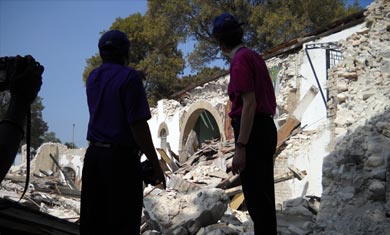
Our brothers and sisters in Christ in Haiti still need our help. Rebuilding a devastated country – one devastated by political shenanigans and hurricanes long before the 2010 earthquake struck – takes time, prayer and the will to continue despite the long odds. 

Please, continue to pray for Haiti: Almighty God and heavenly Father, in whom we live and move and have our being, send your Holy Spirit upon the people of Haiti, that they may know your love, feel your support, revel in your joy. Send your Spirit upon all those who continue to work in Haiti, rebuilding the lives of its people, so that they may be faithful servants who listen without dictating, who work in community and not as solo artists, who care first and foremost for your beloved children, and not for their own glory. Bring health to the people of Haiti, who put all their trust in you. In Jesus’ name we pray. Amen.

The latest news from The Episcopal Church Center:

Holy Trinity Cathedral, three weeks after the earthquake.

[October 2, 2012] With the third anniversary of the devastating earthquake which destroyed Haiti mere months away, the Episcopal Church continues its emphasis on assisting the church’s largest and fastest-growing diocese.

“It is a great gift and privilege for us to be able to work with the people of Haiti,” commented Bishop Stacy Sauls, Episcopal Church Chief Operating Officer.  “I never fail to be inspired by them and their indomitable sense of hope.  The problems and issues Haiti faces would absolutely devastate many.  The people of Haiti continue to face their challenges with faith and spiritual strength that calls forth a like response in all of us.”

The January 12, 2010 earthquake destroyed much of the Caribbean island country and cost many lives. Leveled were churches and diocesan facilities, including Holy Trinity Cathedral with its priceless murals in the capital city of Port-au-Prince.

General Convention 2012 named the focused effort for the Diocese of Haiti as one of the priorities for the Church.

The newly reorganized Development Office of the Episcopal Church is coordinating all the fundraising efforts for the rebuilding of the Diocese of Haiti.  This follows the conclusion of the first phase of the project by Episcopal Church Foundation.

“We are thankful to the Episcopal Church Foundation for its grassroots campaign,” Bishop Sauls said.  “The baton has passed to the Development Office, which has been maintaining regular consultation with the diocese on how and where to help, looking at a wide variety of infrastructure needs.”

Bishop Duracin with President Bishop Katharine Jefferts Schori, three weeks after the earthquake.

To that end, an Episcopal Church team soon will visit Haiti to engage with diocesan leaders and officials. “This mission trip will include a thorough assessment and fact-finding to determine what steps will be taken in the short- and long-term for this all-encompassing project,” Bishop Sauls said.

Currently, Bishop Sauls and his staff are working diligently on a final agreement with an architect for the cathedral complex. He is also planning to lead a pilgrimage to Haiti in early 2013.

And, as another facet of the Church’s work with Haiti, the Church Center is now the home in a rental agreement with Le Consulat General de la Republique d’Haiti and the Haitian Permanent Mission to the United Nations.

For information on how individuals, congregations, dioceses and groups can help the rebuilding of Haiti, contact Kim Moore at kmoore@episcopalchurch.org

To learn more:  http://www.episcopalchurch.org/page/rebuild-our-church-haiti
The Episcopal Churchwww.episcopalchurch.org
Facebook: www.facebook.com/episcopalian
Twitter: twitter.com/iamepiscopalian
YouTube: www.youtube.com/TECtube
On the web:
The Episcopal Church’s work in Haiti continues
http://www.episcopalchurch.org/notice/episcopal-church%E2%80%99s-work-haiti-continues


Share this:
Share this page via Email Share this page via Stumble Upon Share this page via Digg this Share this page via Facebook Share this page via Twitter

God’s ‘enough’ is always enough

Numbers 11:4-6, 10-16, 24-29

To paraphrase a former president in a presidential debate, “There they go again.”

Those Israelites.

Carping and complaining, moaning and groaning.

“If only we had meat to eat!”

“We remember … Egypt.”

“Our strength is dried up …”

“There is nothing … but this manna to look at.”

Here the Israelites are, multiple years into their journey in the wilderness, and they are fed up to their gills with manna – you know, bread from heaven manna? – and what do they want? What do they really want after all these years of eating the bread of heaven?

They want meat.

Oh, they can talk about the veggies and the fruit they used to eat in Egypt – I’m telling you, their doctors were probably really pleased, because they wanted a balanced diet, good for their hearts, but, no, what they really wanted was Capital M-Capital E.-Capital A.-Capital T-MEAT. Because they were tired of eating manna.

It’s not like the Israelites didn’t have enough to eat – they did.

They had the manna from heaven – the bread that God sent, in just the right amount. Every single morning, God sent them just the right amount of manna. And they didn’t want it anymore. Now I want you to know, in case no one has told you, manna actually is real. Manna is a real substance that you can find, to this day in the Sinai, if you are out in the remote areas, where the Israelites once sojourned. Manna is not what most people think it is. A lot of people think of manna and they think it is those little communion wafers that you get in church on Sunday mornings. Uh-uh-uh, that’s not manna. Manna is … um … plant lice excretion,[1] also known as bug poop.

That’s what the Israelites are complaining about this morning. They are tired of bug poop. It’s not that they are tired of having bug poop every day. What they are tired of is only having bug poop every day.

And frankly, let’s be honest, if had to eat bug poop every day, wouldn’t you be tired of it? After all, there are only so many ways you can fix bug poop. You can boil it. You can bake it. You can toast it. That’s it. There’s nothing else you can do with it. And if you don’t do that pretty quick, it goes rotten anyway.

So, we’re not exactly talking about gourmet meals that the Israelites had had all those years wandering in the wilderness.

It was nutritious.

But it was not gourmet.

The Israelites were not complaining about not having enough. Because they had enough.

And it wasn’t simply that they wanted more – more food, more variety.

They were complaining because they thought that they deserved more. They thought that they had been faithful long enough, wandering around in the wilderness, scooping up bug poop every single morning, and eating it morning, noon and night. They thought that they were special. And because they were special, they should have something more.

Sinai from space, via NASA

The problem is, these people had forgotten, in all those years of roaming the wilderness, of being fed day and night by God on high, of being led day and night by God on high, they forgot that they were special not because they had been so faithful for so long, but because they were created in God’s very image. God chose to create them in God’s very image, the image of love – because, my friends, we are not necessary to God, so God must have wanted us, God must have desired us, God must have loved us into being – and the image of community, the community that comes from when God said, “Let us create humankind in our image.”

The Israelites had forgotten that they were created in that image, the image of love and community, and in God’s version of love and community, it’s never about what you deserve. In God’s version of love and community, it’s not about what you have earned by your faithfulness.

In God’s version of love and community, it is always about what God gives you.

And what God gives you is always enough.

Always.

• • •

I have to tell you, when I read this passage about the Israelites carping and complaining about how hard their lives were because they were tired of eating bug poop every day, I think back and remember my friends, my “families,” in Kenya and in Honduras, in Sudan and in Haiti, and I think to myself, “Man, I know a whole slew of people who would give anything to have what you people  had. I know a slew of people who would love to have … enough.

I mean, come on.

The Israelites are getting a guaranteed meal delivered to their doorstep every single morning, and they are kvetching about this?

They have enough, and they want more?

When I read this passage, I remember the days when I lived in Kenya, and the rains didn’t come and they didn’t come, and our crops dried up and died almost as soon as we put them into the ground, and we had so little to eat … so little … and our children went hungry and their bellies distended, and their hair turned red because they were malnourished, because we were literally eating the leaves off the trees …

I remember walking through the market looking for anything – anything – that I could possibly eat, and over here, there would be this little pile of scraggly little onions (and they were scraggly), and over here there would be this little pile of scraggly little tomatoes – barely an excuse for a tomato – and then I would see these piles of weird greens that I had never seen before and that I had no idea how to cook …

I remember asking the mamas, “What are those greens?” and having them laugh at me, because there I was, the white woman who was the Peace Corps fundi wa maji, the water engineer, who brought them water when possible, and I had no idea what I was looking at …

And I remember them telling me, “Those are leaves from the trees, mama.” And how, when I asked, “Which trees?” the women laughed even more and said, “If we told you that, you wouldn’t have to buy them from us!”

And I remember asking them to teach me to cook those scraggly leaves with those scraggly onions and those scraggly excuses for tomatoes, and how much we all rejoiced when finally, some rain arrived, and we could once again grow some of our crops.

When I think of the way the Israelites moaned and groaned because they didn’t think they could stand one more bite of God’s bread from heaven, I remember what it was like in Honduras, where we ate rice and beans, beans and rice, rice and beans, beans and rice, rice and beans, beans and rice, morning, noon and night … because we didn’t have anything else …

I remember what it was like in Sudan, a country that has been at war for most of the last sixty years, where food shortages were common, and death stalks the land on a constant basis, and nearly weeping to discover that war had once again brought death to our doorsteps, depriving us of fish and tomatoes and vegetables, because war means death, and death means bodies in the Nile River, and bodies in the Nile River upstream from us meant cholera downstream where we lived … so we couldn’t eat anything that had come into contact with river water … and all we had left were onions and lentils, and lentils and onions, and onions … and onions …


I remember more rice and beans, beans and rice in Haiti, where the poor subsist on less than a dollar a day – if they are lucky – and where oftentimes, there were more beans than rice, because the rice industry has been destroyed in that country by politics and hurricanes and earthquakes … and where to stave off hunger, we would buy pieces of sugar cane, so that we could gnaw on it, so that t

I remember what it is like to be hungry every single day … to not have enough …he sugar would abate our hunger, but it did nothing for our nutrition, and our children there were just as malnourished, with their bellies just as distended, and their hair turning just as red as they did in Kenya.

So you know what I think, when I read about the Israelites demanding more, demanding M-E-A-T-all-capital-letters-MEAT?

I think: You have enough! Quit complaining!

• • •

The sad thing is – and we do not like to admit this – we all are like the Israelites at some point in our lives.

We have enough – enough food, enough medicine, enough opportunity – and at first we think, “Thank you, Lord.”

But then …

Then …

We start complaining.

Because after a while, enough is not enough.

After a while, we want more …

After a while, we stop trying to keep up with the Joneses and we start trying to surpass the Joneses, and the next thing you know, we have more than enough, and the Joneses?

Well, the Joneses are out of luck.

This is what our society teaches us right now – you know this. Look at the advertising you see. Advertising that says, “Buy more, more, more, more!” And, “If you buy this, your life will be fulfilled!” Until the next version comes out. Adversiting tells us we simply cannot live if we do not have the latest version of whatever the newest thing is, if we do not wear the newest styles, if we do not drive the newest cars.

And right now, for some strange reason, society is telling us, in every way possible, that it is perfectly okay to say, “I’ve got mine, and I don’t care if you ever get yours!”

But that attitude of us against them? That attitude that demands more, more, more? That attitude that leaves others in the dust?

That is not God’s plan for us, my friends.

That is not how God looks at us. That is not why God created us.

Because in God’s very good creation, there is no such thing as “us’s” and “thems.” All of us – each of us and all of us – are beloved children of God.

God’s plan is that each of us – every single one of us beloved children of God – has, quite simply, enough.

Not too little.

Not too much.

Simply …

Enough.

Because in God’s very good creation, the one in which we who were created in God’s very image live, God’s plan, God’s dream, is that each one of us has enough.

Our call, as faithful people of God, is to make God’s plan, God’s dream for God’s beloved creation, come to fruition.

It is on us to do what God wants done.

Now, the moral of the story for those carping, complaining, moaning, groaning Israelites is that God basically replied, “More?!? You want more?!?! I’ll give you more! I’ll give so much more that you will literally choke on the meat that I will send you, and you will die from it!!!”

Which is what happened. If you keep reading in Numbers, remember, this is what happened.

These carping, complaining, moaning, groaning, there-they-go-again, stiff-necked people, they got what they asked for, and you should always be careful about asking, because you might just get what you asked for.

It’s not a pleasant ending to this story. But it does get across God’s basic message to us, who, I pray, are not carping, complaining, moaning, groaning, there-they-go-again, stiff-necked people.

Hopefully, we actually hear God’s message, and hopefully, we actually live God’s message, which is this:

In God’s eyes, enough truly is enough.

Amen.

Sermon preached on the 18th Sunday after Pentecost, Proper 21, at Immanuel Episcopal Church, Glencoe, Md., on 30 September 2012.


[1] From Barbara Brown Taylor’s Bread of Angels, Cowley Publications, 1997.


Share this:
Share this page via Email Share this page via Stumble Upon Share this page via Digg this Share this page via Facebook Share this page via Twitter

It’s not a competition

Mark 9:30-37

Who is the greatest Christian you have ever known?

Who is the best Christian you can think of?

I want you to take a moment, and think about that.

Get that name or a picture of that person in your brain … everybody have somebody?

Are you as good a Christian as that person?

Do you measure up to the person that you have locked in your brain?

           Ken Follett wrote a book two decades ago called The Pillars of the Earth. In this book, which is a novel of the building of cathedrals in England, there is a stonemason who has an idea on how to build a cathedral. He’s pretty confident that he knows how to build what we now call flying buttresses, but he’s not certain that he can do it as well as they are doing it in France.

So he goes to the abbot, and he says to the abbot, who is a wise man, “Do I have to be the best there ever was? What if my gift isn’t as good as someone else’s?”

The abbot looks at him and says, “You don’t have to be the best there ever was. You have to be the best that you can be.”

My friends, you don’t have to be as good a Christian as that saint I’m confident you each thought of.

You have to be as good a saint as you can be.

Because if you are doing the best that you can do, at any given moment … if in any given moment, you give your best, and it’s pretty darned good, God will look at you and say, “Well done, good and faithful servant.”

And if the best you have to give is really pretty bad, but it’s still the best you have to give, at that given moment? God will look at you and say, “Well done, good and faithful servant.”

Because you tried.

You don’t have to be the best Christian there ever was to walk the earth.

You have to be as good as you can be, in that given moment.

• • •

Jesus is walking along, teaching his disciples, explaining to them a little more of what he has already told them – that he is going to have to go up to Jerusalem, he’s going to be arrested, he’s going to be tried, he’s going to be beaten, he’s going to be executed, and on the third day, he will be raised from the dead.

Now, he’s just gotten done telling them this. And Peter – gosh, good beloved Peter, who gets it and never gets it, in the exact same moment, Peter, who is so good at this, says, “No, no, Lord! You can’t go and do this.”

Jesus has just finished saying to him, “Get behind me, Satan, you’re thinking of earthly things instead of heavenly things.” Now he’s walking along, teaching his disciples, they get to Capernaum, they go into a house, and Jesus says to them, “So, what were you all talking about behind my back?”

They don’t want to tell Jesus, because you know what they were talking about behind his back?

“I’m better than you!”

“Oh, no, I’m a better Christian than you are,” – OK, they weren’t using the word Christian in those days, they were saying, “Oh, no, no, I’m a better disciple than you are. I want to sit at the right hand of God.” “No, no, me!”

They were like a bunch of squabbling little kids!

They’re fighting behind Jesus’ back. They’re not concentrating on being the best they could be in any given moment, they’re concentrating on who is going to get the glory!

And Jesus says to them, “No, no, no. You don’t get it. It’s not a competition!”

Being a follower of Jesus is not a competition!

Trust me, my friends, if you are keeping score, God’s going to have something to say to you. When you get to the pearly gates, the first thing God is going to do is rip up your scorecard!

Because being a Christian is not about being better than anybody else at it. It’s about you reaching deep inside yourself, and being the best that you can be at any given moment.

As I said, some days, those efforts are going to be glorious, and God is going to smile upon you … and some days, those efforts are going to stink, and God is going to smile upon you.

Because you tried.

You don’t have to be the best there ever was.

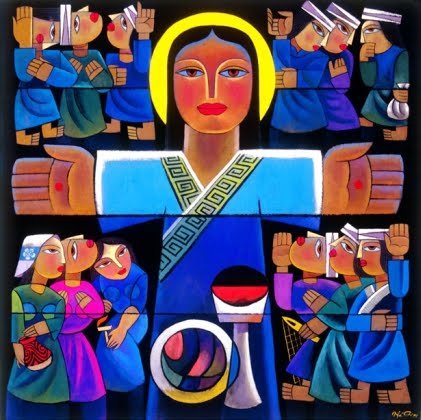
Following Jesus in not a competition. (He Qi's "The Risen Christ")

You have to be the best that you can be.

Mahatma Gandhi once, when talking about Christianity, said that he thought Christianity was a marvelous religion; it was a really great religion. And that the tenets of Christianity were incredible! The problem was, he said, he’d never really met anybody who lived them. He’d never really met a good Christian.

And that’s what our problem is.

We get so wrapped up, sometimes, in competing with each other that we forget that it’s not a competition.

Being a good Christian is not about topping the guy next door or the guy down the street. We are not better than the Methodists down Braddock Road. We’re not. The good news is, they’re not any better than we are! It’s kind of a draw.

It is about how we can live our lives faithfully every moment of our lives.

• • •

How many of you have stood in a checkout line at the grocery store, where there’s a little old lady … who’s taking forever to get her checkbook out … I’m not talking about writing the check, I’m talking about when everything has been rung up and she hasn’t gotten the bloody checkbook out yet … and you’re standing in line, and the Redskins are coming on in, oh, 22 minutes, and it’s going to take you 18 minutes to get home … if this lady will get out of your way! Right? And you can feel the tension rising … and while she’s looking for her checkbook, she’s having a little chat with the lady who’s checking her out, and saying, “Oh, I can’t find this.” We’ve all been through this situation, and the tension is rising, and your blood pressure is going up, and you really are getting mad …

Has it dawned on anybody, that for this woman, this is the most human contact she is going to have in any given day? And she is stretching it out … because this is her human contact? Because when she goes home, there’s nobody who is going to call her, and nobody who is going to visit her?

Would it kill us as Christians to reach out and have a conversation with the woman, to greet her?

That’s what it means to be a Christian.

I’m not talking about the big, bad stuff that could happen to you.

I’m not talking about going out and being the best there ever was.

I’m not talking about you going and changing the world all at once.

And I for darned certain am not talking about you saving the world. That’s been done. About 3 o’clock in the afternoon, outside the gates of Jerusalem. It was a Friday, 2,000 years ago. The world’s already been saved, folks. It’s not on our shoulders.

All Jesus asks us to do … is to be faithful … every moment of our lives.

When we’re driving on 495 … and it’s rush hour … we sin more in our cars than we sin anywhere else in our lives! I am convinced of it! (Except at 11 o’clock on Saturday mornings, when we’re all listening to Wait, wait! Don’t tell me! and we’re driving along the road, laughing like hyenas, because it is so funny.) The rest of the time, on 495, during rush hour, we are all getting … tense … and we’re saying bad words, and we’re calling people bad names … right? Everybody has done this? I cannot be the only person …

Take that time, right then and there, to stop and think, Is this what God really wants me to do? Is this what it means to follow Jesus? To call people names?

            I got really upset one day, when I was zipping home from this neck of the woods. I now live over in Falls Church, so the best thing to do is to go down 236, get on 495 North, zip around 495 North to 66 East, get off at 66 East, go one exit, to 7, and then I’m a mile and a half from home. Right? Piece of cake. Easy-peasy, 18 minutes, 20 minutes in normal traffic.

All of the sudden, the exit comes up – and you know, they’ve redone the exits for 66, east and west, off of 495 – and I have to slam on my brakes, because no traffic is moving. We start inching our way and inching our way, and I’m thinking to myself, “All right, hold it together. As soon as you get to 66 East, these are all people who want to get on 66 West.”

Well, I go to get on 66 East, and what happens but there’s a cop car, and he has blocked the entrance. The reason we are all slowed down is not that 66 West is slow, it’s that all of us, all three lanes of us who have been trying to get on 66 East and 66 West together, were now going west.

I ended up having to get on 66 West, and go farther out than where I had started, to get off the highway, to zip around, to get on the highway to go back.

I … was … livid!

I was such a bad person that day! I was so upset. I really was.

There was nothing on the news about this. There was nothing to tell us what was going on, no signs, no nothing.

I kept fuming, “Couldn’t you tell us about this?”

Well, when I finally get on 66 East, and I go blitzing past the exit I should have taken earlier, almost an hour before, I saw a really bad traffic accident.

They had to do an airlift to take someone to the hospital …

… and I felt awful.

I had been so concerned for myself that I had not once thought that maybe, just maybe, there had been an accident, and that someone’s life was in the balance.

In all that time driving, I never once thought about being the best that I could be – because all I cared about was me.

My friends, trust me, this was not a moment when God smiled upon me and said, “Well done, good and faithful servant.”

But if … if … each of us were to think about offering our best, especially in those times when we don’t want to offer our best, the world would be a far better place.

It would be such a good place that we could change the world.

As long as we remember: This is not a competition.

We don’t have to be the best there ever was.

We simply have to be the best that we can be …

Every single moment of our lives.

Amen.


Sermon preached on the 17th Sunday after Pentecost, Proper 20, at the Church of the Good Shepherd, Burke, Va., on 23 September 2012.


Share this:
Share this page via Email Share this page via Stumble Upon Share this page via Digg this Share this page via Facebook Share this page via Twitter

Dear Mr. Romney: You have gone too far

Dear Mr. Romney:

I cannot tell you, right now, how much you have enraged me in the last few days. I am beyond being annoyed with you, beyond being merely mad at you.

I am now enraged!

Every time I hear your voice – every time I hear your voice – I find myself yelling at you via the radio or television.

Thank God for the print media – because of them, I do not yet believe I am in danger of having a coronary. I simply turn the page.

Do you know why you have enraged me? I think not, for if you did, you would stop saying some of the incredibly insensitive, stupid things you have been saying. So let me educate you.

First, simply because I don’t pay income taxes doesn’t mean I am a “victim.” I am not a victim. I simply don’t make very much money. Thus, when it is time to do my taxes, I am granted the Earned Income Tax Credit.

In case you are not aware of this, sir, this tax credit is very similar to the ones you take to keep your tax rate down to the insultingly low level of 13 percent.

You yourself have stated, repeatedly, that you take advantage of every single tax break thrown your way. Congratulations, sir, for being smart enough either to (a) hire someone to do your taxes who knows his or her business; or (b) are really good at filling out the forms yourself.

So answer me this: Why is it perfectly acceptably for you to take your tax breaks and not for me to take mine?

I pay every single cent I legally am required to pay in taxes.

If that statement sounds familiar, it is because I am echoing you.

Second, I pay a bucket-load of taxes, sir. I pay state income tax. I pay payroll tax. Because I am self-employed, I pay the entire share of FICA. I pay local property taxes, state property taxes, and state sales taxes. I pay federal taxes for every gallon of gas that I purchase. I support, through my taxes, government, schools, the military, the infrastructure of this country, and a whole slew of other things.

In other words, sir, I am a taxpayer.

What I am not is a victim!

How dare you say that just because I use the tax code as well as you do (on a much, much, can I say again, MUCH smaller basis than you), that I am a victim?!

How dare you proclaim that I expect the government to take care of me?

Did I mention that I pay for my own health insurance as well?

I realize that in the context in which you were speaking last May, you were declaring as already lost the so-called “47 percent” (and may I point out, sir, that you really need to get more of your facts correct, since the correct number is forty-six percent? And yes, one percentage point does indeed a difference make).

I get it. You don’t think you can convince a huge swath of this country to vote for you.

That’s fine. I understand. Because I, sir, am one of those people who will not be voting for you.

But you, sir, went too far. You decided to tell your more ardent supporters that the only reason I won’t vote for you is because I am a victim, a worthless slug of a couch potato who wants to be bottle-fed by the U.S. government.

You insulted me, sir.

And you insulted every person in this country just like me.

And that is a step too far.

I was willing to give you grace about your boasts of being a job creator – which you are not. Your time at Bain Capital was never about creating jobs. What you are, sir, is an incredibly gifted wealth creator. That’s what you did at Bain – you created wealth for your investors, and from all records, you were outstanding at your job. Pretty ruthless when it came to the people who actually worked for the companies you were attempting to build up or turn around, granted. But your investors made more than one pretty penny off your work.

So bravo for creating wealth upon wealth.

I would be happier, I should note, if you would be honest about what you did there, and stop trying to tell me that you created jobs. You did not.

And I was willing to give you grace on your budget proposals, even though I disagree with just about every thing you have said, every idea you have had. Your proposals, combined with Paul Ryan’s proposals, will do lasting harm to this country. You will continue to attempt to use an economic theory that has never, in the history of the world, worked. Trickle-down economics, sir, are dangerous for the overall wealth of this land and its people.

But it’s your proposal, and I give you credit for standing by it.

I even was willing to give you a modicum of grace for comments you made on your first overseas trip as the presumptive nominee. Trust me, I winced and cringed much of the time you were overseas, but I understand what you thought you were trying to say.

I was less willing to give you grace every time you told yet another lie about this country, or about the man against whom you are running, President Obama. You repeat canards that are offensive on a constant basis, and for that, I was not willing to give you very much grace.

But in an attempt to try to give you grace, I decided you had poor advisers who gave you bad information, and that in your rushed life, you did not take the time to say, “Hey, is this really true?”

Because if it wasn’t your advisers’ fault for you proclaiming, repeatedly, that President Obama has apologized for the United States (not true); that President Obama is wiping out work-requirements in welfare (not true); that … oh, dear, the list is far too long to repeat here, but you know whereof I speak … if it wasn’t your advisers’ fault, then you, sir, must be either (a) an idiot (which I do not believe is true) or (b) vicious (which I did not want to believe about you).

That’s not much grace, I grant you. But I’m trying here … so work with me, OK?

But then your comments at your fund-raiser were leaked.

Which is when my blood pressure went up, and I went from being mad at you to being enraged (sadly, I cannot even convey that properly, but imagine, if you would, please, see that word in blood-red, in HUGE letters, with lightning bolts and sparks flying off it – that’s how enraged I am)!

Because in trying to speak a truth, you made a point of absolutely denigrating nearly half of this country.

You made it plain that you hold us in contempt!

You made it sound as though we are not even worthy of your consideration as human beings, much less as a major portion of the people you seek to represent and lead.

And that, sir, is a step too far.

You have made a major mistake, sir.

For I am not alone in my rage.

There are others – many others – who were willing to give you the benefit of the doubt, but who no longer can do so.

If you hold me and others like me in such contempt, do you not understand that we in turn will hold you in contempt?

You simply cannot identify us as money-grubbing, lazy, worthless, shiftless people who do not deserve your attention, or your help, or your leadership, and expect any of us to vote for you!

Even you, sir, cannot be that thick-headed!

So let me reiterate my lesson to you, because, as you well know, there will be a test – on Nov. 6. Please, sir, pay attention.

  1. I do not make a lot of money.
  2. I do pay taxes – lots of them.
  3. I do not expect the country to give me everything I need.
  4. I survive based on hard work, and the incredible generosity of friends and family, many of whom are in the same boat.
  5. I do expect you to treat me, and others like me, with respect. You do not have to like me, and others like me. I get that. But if you want to lead, sir, if you want to be a leader, stop denigrating me and mine. Stop it. Right now.

Because if you want to be president, sir, you are going to have to realize: People like me? We vote.

And we do not vote for people like you.


Share this:
Share this page via Email Share this page via Stumble Upon Share this page via Digg this Share this page via Facebook Share this page via Twitter

Discipleship is in the details

Mark 8:27-38

                   Welcome, my friends, to “Take Up Your Cross Sunday.”

                  Aren’t you excited? Isn’t this exactly what you had planned on doing when you got in your cars and came to church this morning?

This is the day when you have to decide: Are you going to take up your cross and follow Jesus?

Now, normally, I can tell you that on a Sunday like today, this is not the focus of the sermons. Look at the front of your bulletin covers. Go ahead, look, look, look. It’s very pretty and should not be wasted. What does it say on the front of your bulletin cover but, “Who do you say that I am?” And so most of the time, when we hit this portion of the Gospel, Proper 19, what we decide to do is have a little chat with each of us about “who do you say that I am?” So that we can each name Jesus.

If we’re not focusing on that, then we like to focus on poor Peter. Peter, who is so quick to say, “You’re the Messiah! I know it!” – remember, this is the turning point of Mark’s Gospel. This is when it becomes open and public knowledge about who Jesus is and what he’s going to do – So we focus on Peter saying, “You’re the Messiah!” and Jesus saying, “Yes, and this is what it means to be the Messiah. I am going to be rejected. And I am going to be killed. And on the third day, I will be raised again.”

What does Peter do? He begins to rebuke Jesus – “No, Lord, you can’t go and do that!” And what does Jesus do, but he turns around and he rebukes Peter and says, “Get behind me, Satan!”

We love to revel in that, don’t we? Don’t we love to revel in the times when Jesus says – to someone else, never to us – but to somebody else, “Get behind me, Satan!” Because then we don’t have to deal with the issue ourselves.

But the fact of the matter is, today is “Take Up Your Cross Sunday.” Today is the day when you have to decide: Are you willing to do that? Are you willing to follow Jesus? Not just a little bit. But all the way?

Now, most of the time, when people think about taking up their crosses and following Jesus, they think about difficult that is, how hard it is. And that’s what gets in the way of taking up that cross – really taking it up – because, you know, spit, I don’t want to do something that hard.

Does taking up your cross and following Jesus mean that you have to become a missionary and move to Sudan and live in a mud hut with no clean water, no running water, no electricity, and death and disease staring you in the face every moment of every day?

Does it mean that you get to stay in this country but you have to give up everything you own? Your homes – for which you worked so hard? Your jobs – that gave you the money to buy those homes? Your nice cars? Your nice clothes? Does it mean that you have to give up your retirement? Does it mean that you have to give up your kids’ college fund?

Because if that’s what it means to take up your cross, Lord, I’m not certain I’m going to go there with you. I’m not certain that that’s the kind of Christian I’m called to be. That must be the guy down the street. The one at whom you’re always yelling, “Get behind me, Satan!” That’s his problem, not mine.

It’s a hard thing to take up your cross and follow Jesus, especially when you read it in the New Revised Standard Version, which is the version of the Gospel we just read.

But I want to read it to you in a different translation, so see if it has any impact, if it makes any difference in your lives.

Jesus said, “Anyone who intends to come with me has to let me lead.

You are not in the driver’s seat; I am. Do not run from suffering; embrace it. Follow me, and I’ll show you how. Self-help is no help at all. Self-sacrifice is the way, my way, to saving yourself, your true self. What good would it do to get everything you want and lose you, the real you? What could you ever trade your soul for?”[1]

This translation, my friends, is not actually a translation; it is a paraphrase of the Gospel. It was written by a theologian by the name of Eugene Peterson. He wrote this paraphrase – actually, the entire Bible; he’s now finished it – so that people who had never read the Bible, because it didn’t seem to matter to them, didn’t speak to them, and so that people who have read the Bible so much that everything in it is just old hat, been-there-done-that-got-the-T-shirt-while-I-was-at-it – so that both groups could hear the Gospel in a new way.[2] Both groups would be able to experience God in a new way. And both groups would be able to respond in a new way.

So instead of me asking you to take up your cross today, how about I simply ask you to do a little bit of self-sacrifice?

How about I ask you to let Jesus be the driver in your life?

Isn’t that just a little more palatable?

Isn’t that something that you are probably a little more willing to do?

Anybody?

Guess what?

It’s just as hard.

Because what Jesus is asking us to do is to put Jesus at the center of our lives – in everything we do.

You’ve heard the expression, “The devil is in the details”?

You know that one?

It’s wrong.

Discipleshipis in the details.

"Follow me," by Reynaldo.

Discipleship is in the details.

Everything you do in your life, every minute action, thought, decision, the details of our life – that’s where you need to be a disciple most.

Some easy examples:

When you go to your local coffee shop – I don’t think there’s a Starbucks in town, is there? – so you go into your local coffee shop, if every single time you go in there, you get a disposable cup for your coffee, you need to stop and think again. Because by doing that, that little detail, you are telling God you do not care about God’s very good creation. Would it kill you to have your own go-cup that you brought with you?

If, when you’re driving through Aldie (a small town nearby) at … twenty … five … miles … per … hour … and not one tick above that, especially if “You’re not from around here, are you?” … you know when you come out of Aldie, and you get to speed up all the way to 40, if there’s somebody who is on your tail, just waiting for the lines in the road to change so that they can jump around you, would it kill you to let that person go around you? Because maybe they do have an emergency. Maybe there is some urgency in their life, of which you know nothing.

When you are in the grocery store, and the woman who is checking you out is obviously having a terrible day; her eyes are filled with tears. Discipleship means stopping and talking with the woman. It means holding up the entire rest of the line so that you can give pastoral care to somebody who actually needs it, so that you can give grace upon grace to someone who has not experienced grace.

When you are in that same line, and you have the little old lady who is taking forever to find her checkbook – never mind writing the bloody check – and you’re getting tense because you want to say, “Hurry it up!” … stop and think for a moment … that for this woman, this may be the most human contact that she has throughout the day, and by God, she’s not going to hurry it up.

When we stop and we think, in the details of our lives, about what Jesus would have us to do, that’s when we are the truest disciples of our Lord and Savior Jesus Christ.

When we give grace to other people …

When we realize that just because you and I don’t agree on something doesn’t mean that we have to be enemies …

When we model a behavior of acceptance …

When we stop talking about them, as opposed to us – because there are no “us’s” and “them’s” in God’s very good creation …

Those little details … which I know do not sound like much, but I can guarantee you – if in the tiniest details of your life, you are stopping to be faithful, you are doing your best to be a disciple of Jesus, to do what Jesus did, which was to feed the hungry and give water to the thirsty, to give sight to the blind, and to make the mute speak, and the deaf hear, to make the lame leap for joy …

When you do what Jesus did, which was to welcome the unwelcome, to include the excluded, to love the unloved, to give hope to people whom have known no hope from generation to generation …

When you live your life that way, then you are truly a disciple of Jesus.

That’s what it means to take up your cross, so that in every moment of your life, you think about the impact you are having on God’s creation, the impact you are having on God’s people.

It’s the self-sacrifice of realizing that youme … you … and you we are not the center of the world. The world does not revolve around us.

When we take that moment to step back and to say, “What is it that Jesus would have me to do?” – whether I want to do it or not, that’s not the question – the question is, “What does Jesus want us to do?” – when we do that, then – then – we are truly being disciples of our Lord and Savior Jesus Christ.

Then we are taking up our cross.

Then we are following Jesus.

You can’t simply believe that you follow Jesus by proclaiming, God the Father, God the Son, and God the Holy Spirit! It’s not enough! Jesus has expectations that we are going to try and live Jesus’ way in this world.

So that we can indeed realize God’s dream for all of creation.

In this day and age, in this country, when we are so set on dividing each other, when we are so set on attacking each other, when we are not bothering to listen to each other, when we refuse to give grace to each, imagine the impact that we could have, if in the details of our lives, we were disciples of Jesus.

               If we stretched out our hand to someone who is different from us, who thinks differently, God forbid who votes differently, and said, “You are a beloved child of God.”

(Don’t be shaking our head! Don’t be shaking your head!)

Just because we don’t agree politically doesn’t mean that we are not beloved children of God, you and I both!

What kind of model could we set?

How would it change the world … if we focused on Jesus and what Jesus wants, and not on ourselves and what we want?

As I said, welcome to “Take Up Your Cross Sunday.”

Do I have any takers?

Amen.

Sermon preached on the 16th Sunday after Pentecost, Proper 19, Year B, at Emmanuel Episcopal Church, Middleburg, Va., 16 September 2012.


[1] The Message (Bible), article on Wikipedia, http://en.wikipedia.org/wiki/The_Message_(Bible)


[2] Ibid.

Share this:
Share this page via Email Share this page via Stumble Upon Share this page via Digg this Share this page via Facebook Share this page via Twitter

Sometimes, you need a handkerchief

Mark 7:24-37

            A few weeks after I began my life as a student at Virginia Theological Seminary, I was sitting under a tree in the Grove, reading for my Systematic Theology class.

            Now, I knew an awful lot about systematic theology – I was born and raised in the Roman Catholic, I went to Roman Catholic schools and graduated from a Jesuit university. So I was actually pretty “up” on what I needed to know for this class.

But that day, sitting under that tree, I made a stunning discovery, one that changed my life. (Yes, a textbook can change your life.) I discovered Anselm of Bec, the 36th archbishop of Canterbury, who died in the year 1109, and who wrote a stunning piece of theology known as the Proslogion.

In that textbook of mine, I read, for the first time, this tiny snippet from the Prologion, from that masterpiece:

“God,” Anselm wrote, “is that than which nothing greater can be conceived.”[1]

God is that than which nothing greater can be conceived.

I have to tell you, when I read that one sentence, my heart began to race and my body was quivering like a little puppy dog, and my mind was exploding like a supernova, going everywhere and racing around, and I thought, Oh, my God! Yes! This is it! I exulted. This explains everything I’ve ever wanted to know about God!

Think of the greatest love you have ever known – think of it –God’s love is bigger than that.

Think of the greatest suffering you have ever gone through – think about that –God’s suffering is greater.

Anything you can think of, any attribute you can describe, and God, quite simply, is greater than that.

Because God, my friends, is God.

Later on that year, I discovered the writings of Frederick Buechner, who was a theologian and a fabulous writer, and he wrote, among other things, “In his holy flirtation with the world, God occasionally drops a handkerchief. Those handkerchiefs are called saints.”

When I read that quotation, I immediately knew of whom Buechner was speaking for me. He was speaking of Anselm.

Because, for me, Anselm was one of God’s handkerchiefs. Because Anselm could answer my questions, the question that I had for God: “Who are you?”

Anselm answered that. I’m sitting under a tree in the Grove at Virginia Theological Seminary, I’ve been a seminarian for a whopping two weeks, and this little handkerchief fluttered down into my life. And suddenly, all of the possibilities were opened, and all of my theology changed, and every way in which I lived my life changed – right then and there – because I no longer had to ask God, Who are you?, but my questions changed then to, God, what would you have me to do? How can I live into your love, which is greater than any love that I could ever conceive?

            It was an amazing moment.

I believe that God sends those handkerchief saints to all of us throughout our lives, so that we all can know more than we have ever known, so that we can go farther than we have ever gone, so that we can dream bigger than we have ever dreamed, so that we can do more than we have ever done.

God’s handkerchiefs are sent to us so that we can be better than we are, so that we can become the people God wants us to be.

The Syro-Phoenician woman in Mark’s Gospel this morning?

She was one of God’s handkerchiefs.

This is a woman who was considered, by Jesus and by his disciples and by anybody else in this story in the Gospels as an unclean woman. She was Syro-Phoenician. That meant she was a Gentile, and she came from mortal enemies of the Jews. And there she is, dropped into the story. Nobody knows where she came from. Nobody knows how she heard that Jesus was, in secret, alone, in Tyre. But there she suddenly appeared.

She goes to Jesus and bows down in front of him, honoring Jesus, recognizing him for who he is, the Son of God, God’s very handkerchief, given to the entire world, and she says, “Please. Cleanse my daughter, for she has an unclean spirit.”

An unclean woman went to Jesus to say, “My daughter has an unclean spirit. Please, heal her. Please.”

Now I need you to be very clear on this:

She had absolutely no business talking to Jesus. None whatsoever.

She was a woman. And ladies, you don’t go and talk to strange men. Certainly not alone.

She was a woman from the wrong tribe. She was a Syro-Phoenician.

She was a woman from the wrong people, a Gentile.

The wrong faith – also, a Gentile.

She was considered unclean.

Jesus and the Syrophoenician woman (portion of “Forgiveness” by the painter Thierry Ona)

And yet … there she was, begging Jesus… begging him: “Heal my daughter.”

Because, first and foremost, the Syro-Phoenician woman was a mother. And her child was sick. And she needed help. And she recognized that Jesus could do this. That he was, indeed, the Son of God, and he could heal her.

And what does Jesus say? In his pastoral best, he says, “Nope. Let the children be fed first, for it is not fair to take the children’s food and throw it to the dogs.”

Really?

The Son of God, who came to be with us as one of us, who came to show us what God’s love looked like and tasted liked and felt like and sounded like and yes, even smelled like, the first thing he does is he insults this woman, with the worst insult you can give in that culture? He calls her a dog? And worse, he calls her child a dog???

Let me tell you, I have lived in cultures, I understand this … I have lived in cultures where calling a person a “dog” is enough to start a fist fight. I have lived in cultures where making this symbol (curling a finger to call someone) to come here – that’s how you summon a dog. I have watched two men pick up pickaxes and go at each other over it, because one called the other a dog and went Sssst (and made that gesture). In Africa you do this (curling four fingers under) for a human and this (curling one finger up) for a dog. Dogs are the lowest of the low, they are unclean … they are not my Great Dane puppy, Julian. OK? That’s were dogs are. Lower than even the snakes.

And Jesus calls her a dog.

What does the woman say back to him?

“Sir, even the dogs under the table eat the children’s crumbs.”

Boom!

            Take that, Son of God! Let me show you something about loving! Boom!

Just like that, Jesus has his comeuppance. Because this handkerchief from God floated down in front of him, and said, “Open your eyes. Open your heart. Open your mind, Jesus. This is my child. And I need her to be better, and you’re the only one who can do it.”

And that’s what Jesus does.

You notice that he never says, “Your faith has made her well?” No! He just acknowledges, “Wow. You said that, boom, it’s done.”

Jesus needed to have his horizons expanded, his boundaries expanded. He had blinders on. He was so set on going to the chosen people of God that somehow, he had either forgotten or not quite realized that all people are God’s chosen, that all people are God’s beloved, that all people deserve God’s love, and that all people deserve God’s healing.

He was very, very focused on God’s Chosen People, capital C, capital P, the people of the Jewish tradition. And this Syro-Phoenician woman – an unclean woman whose daughter had an unclean spirit – opens Jesus’ eyes.

From that moment forward, Jesus starts going out, and healing Gentiles, as well as healing Jews. From that moment forward, Jesus starts breaking more and more rules, because he realizes that he is there for everyone, and not just for the chosen few.

Now, before we say, “Well, jeez, Jesus, I thought you were the Son of God, you should have gotten that from the beginning” … before we get all smug knowing the end of the story – because, remember, at that point, even Jesus didn’t know the end of the story … before we feel like, “Oh! We’re better than this because we get it,” I want to ask you something:

What blinders do you wear?

What boundaries do you refuse to cross?

What stops you from embracing the world?

Is it, people who don’t agree with you?

Is it, people who are different from you?

Is it, “I don’t want to go there because it is too hard, too far away, too different”?

What blinders do we need removed and what boundaries do we need expanded so that we can live, most fully, into God’s promise to all of God’s beloved creation?

What is it that we need changed?

I’m telling you, God drops handkerchiefs on us all the time. And those handkerchiefs, they open our eyes, and our hearts, and our minds.

You never know where you’re going to find them.

It could be … the person in the grocery store.

It could be … the stranger who smiles at you as you walk down the street.

It could be … the people who come from far away to work up on a mountain so that they can learn how to improve our lives.

It could be … the successful businessmen who travel the country.

It could be … anybody you meet.

So, I want you watch out for those little handkerchiefs. Because they are in our lives every day, and they are there not to tell us how wrong we are, not  to pull a Boom! moment on us, but to say, “Look at it a different way.” Or, as one of my friends likes to say all the time, “Turn the stone over, and look at it from the other side.”

God sends us handkerchiefs so that our blinders can be removed, and so that we can live more faithfully, not as we think that we should, but as God dreams we will.

God has dreams for us, and we put limits on those dreams.

So what does God do?

He drops a little handkerchief in your lap, so that your eyes are opened, and your hearts are opened, and your minds are opened.

You could be sitting under a tree.

You could be driving through the mountains.

You could be flying across the country.

And you never know …

You could be a handkerchief, too.

Your very presence in somebody else’s life could be enough to open their eyes, and their heart, and their mind.

You could be God’s blessing.

Actually, you already are.

Amen.

Sermon preached on the 15th Sunday after Pentecost, Proper 18, Year B, at Church of the Good Shepherd, Blue Grass, Va., 9 September 2012.


[1] Anselm of Bec, Proslogion in The Prayers and Meditations of St. Anselm with the Proslogion, Benedicta Ward (Translator, Introduction), R. W. Southern (Foreword), Penguiln Classics, 1979.

Share this:
Share this page via Email Share this page via Stumble Upon Share this page via Digg this Share this page via Facebook Share this page via Twitter